Caste violence, and what the state does next. We follow each case from the attack to the verdict, measure the gap between the law Dalits won in 1989 and the convictions it delivers, and record how families and organisations force accountability.
Reservation is a constitutional claim, not a favour. We test it against the record: posts left empty for want of a 'suitable' candidate, quotas divided without data, a census that counts caste but may not change who is protected, and promised money that never arrived.
Who owns, who works and who profits. Dalit families still wait for land the state granted a century ago, sanitation workers still die in sewers officials say nobody cleans by hand, and caste still decides who gets hired, paid and funded.
Who holds power, and who is kept out of it. We count who sits in legislatures, newsrooms, courts and boardrooms, follow the parties that court Dalit votes, and ask what Dalit representatives can change once they are inside.
Caste does not disappear in code; it is written into it. We report who builds Indian and global tech and who gets filtered out, what automated systems learn about Dalit people, and who decides which Dalit voices stay online.
Dalit culture made on its own terms: work that refuses the stories dominant castes wrote for it, critics who judge it from a stated standpoint, the archives movements kept for themselves, and the Ambedkarite and Buddhist turn that treats leaving caste as a political act.
Caste and patriarchy work together, and so do the people who fight both. We report where Brahminical patriarchy bites hardest, in the field, the home and the courtroom, and hear from Dalit women and queer, trans and disabled Dalit people on their own terms.
Caste is not only India's, and neither is the fight against it. From Nepal's courts to Seattle's council, Geneva's treaty bodies and Brussels' trade talks, we track where caste discrimination is named in law, and whether naming it changes anything.
Dalit thought as the primary theory of caste, not a footnote to it. We read its thinkers closely, from Ambedkar's 1916 paper on endogamy to Dalit scholars writing now, and test their arguments against what happens this week.
Caste violence, and what the state does next. We follow each case from the attack to the verdict, measure the gap between the law Dalits won in 1989 and the convictions it delivers, and record how families and organisations force accountability.
Reservation is a constitutional claim, not a favour. We test it against the record: posts left empty for want of a 'suitable' candidate, quotas divided without data, a census that counts caste but may not change who is protected, and promised money that never arrived.
Who owns, who works and who profits. Dalit families still wait for land the state granted a century ago, sanitation workers still die in sewers officials say nobody cleans by hand, and caste still decides who gets hired, paid and funded.
Who holds power, and who is kept out of it. We count who sits in legislatures, newsrooms, courts and boardrooms, follow the parties that court Dalit votes, and ask what Dalit representatives can change once they are inside.
Caste does not disappear in code; it is written into it. We report who builds Indian and global tech and who gets filtered out, what automated systems learn about Dalit people, and who decides which Dalit voices stay online.
Dalit culture made on its own terms: work that refuses the stories dominant castes wrote for it, critics who judge it from a stated standpoint, the archives movements kept for themselves, and the Ambedkarite and Buddhist turn that treats leaving caste as a political act.
Caste and patriarchy work together, and so do the people who fight both. We report where Brahminical patriarchy bites hardest, in the field, the home and the courtroom, and hear from Dalit women and queer, trans and disabled Dalit people on their own terms.
Caste is not only India's, and neither is the fight against it. From Nepal's courts to Seattle's council, Geneva's treaty bodies and Brussels' trade talks, we track where caste discrimination is named in law, and whether naming it changes anything.
Dalit thought as the primary theory of caste, not a footnote to it. We read its thinkers closely, from Ambedkar's 1916 paper on endogamy to Dalit scholars writing now, and test their arguments against what happens this week.
Reported argument connecting an event or pattern to its structural cause.
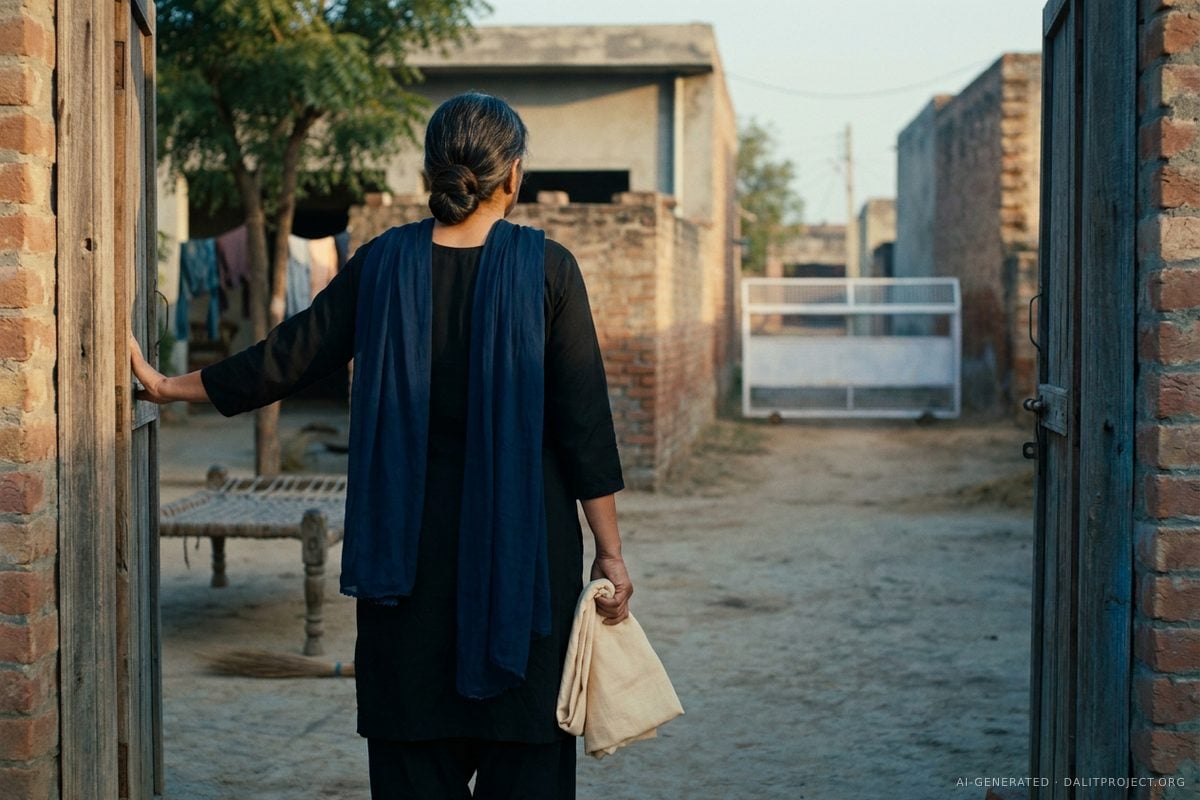
Illustration: a woman holds open the gate of a village house, a folded cloth in her hand, facing a barricade across the lane. — DalPro Frames (AI-generated) – Why AI image?
Sanamdeep Singh's family kept his body in a Sangrur mortuary for five days to press for Atrocities Act charges. Police removed them and oversaw the cremation, citing decay.
Shankersinh Vaghela dared reservation's opponents to clean excreta for Rs 50,000 a month. The BJP's reply, that the practice is gone, echoes an official definition the dead don't fit.
The Dalit M.Ed. student says faculty harassed her and held her marks down. The national commission that took up her case can demand answers, but has no power of its own to punish.
Nepal told the UN it had apologised to Dalits. No apology was passed by the Cabinet or gazetted, and a Dalit man's death in police custody was investigated only by the police.
In 2024 India's courts finished trials in fewer than 5 of every 100 caste-atrocity cases before them, and convicted in a third of those. The Una and Dangawas verdicts show what happens to the rest.
Each state built its case on its own commission's evidence after India's Supreme Court allowed the split in 2024. Federal records count Dalits in central jobs, not which Dalit communities hold them.
Twenty years after a mob killed a Dalit family of four, eight men stand convicted of murder and none of an atrocity. One court even counted the absence of caste in their favour.
Telangana says it is testing an allegation against a former chief minister. The notices have gone to Dalit families who have farmed Erravalli's assigned land for 60 years.
Three years after Darshan Solanki's death, another Dalit student has died at IIT Bombay, and the institute's first account again centred on the student. Students want many of the same reforms.
Police suspect Vimal Vaniya's wife's brother and two other men killed him over a marriage her family tried to undo. The Supreme Court asked Parliament for a law in 2018, and there isn't one.
Telangana named a bill after Rohith Vemula in April and gave it to five ministers. Five months on, it hasn't said whom the law would protect, while his movement has already published its own.
For 111 days, viewers in India could not see Tarluvada's Dalit residents describe losing land to Google's data centre. The order came from the state police, and no one has explained it.
A satirical party with a Dalit founder helped push India's education minister out, with Ambedkar's book held high and "Jai Bhim" among its slogans. Dalit writers disagree on what that means.
A former Chief Justice says the atrocities law is misused, though rarely. The 2024 data show two states' police made more than two-thirds of the "false" closures.
Nepal's 2011 law bans caste discrimination everywhere but never mentions renting. Since April, Deepa Nepali has sat in a Kathmandu square asking the government to close that gap.
Investors say an IIT degree speeds up the trust start-up money runs on, and scholars trace that degree to caste advantage. Federal programmes for Dalit founders mostly lend.
Dalit seats follow the Scheduled Caste count and a freeze that lifts after this census, not the new caste question. What else the count changes depends on what the state publishes.
When the Cockroach Janta Party's founder said he was Dalit, replies on X called him "against Merit". The same argument ran through India's year, from campus rules to an exam scandal.
A 2024 court ruling struck down OBC classifications made in 2010–2012 and called for a fresh, commission-led study. West Bengal's new BJP government restored the pre-2010 list before that study began.
Oxfam India and Newslaundry's 2022 count found general-category journalists in 191 of 218 leadership posts. Dalit journalists who built their own newsrooms explain what that does to the news.
A paper at this year's FAccT conference argues that auditing AI image models for caste bias one category at a time misses how caste works: as a ranking between groups.
A. Raju helped win equal burial rights in 2024. When he died in July 2026, he was buried only after nearly nine hours of talks, and the atrocities law no longer reaches Dalit Christians.
The Supreme Court has again refused Scheduled Caste status to Christian converts. The 1950 clause it enforces would, on its letter, have excluded Ambedkar himself when he converted.
Caste has never had its own line in international human rights law; it is argued under race or descent. A UN Human Rights Council side event tested whether that is changing.
Nepal accepted UN calls to enforce its caste law and declined the four asking for a comprehensive anti-discrimination law. UN bodies have mapped every gap; none can make an officer open a case.
A study of 16 years of survey data links more intercaste marriage to a 37 to 43 percent fall in child-stunting inequality. Yet only about one marriage in twenty crosses caste.
A new book asks what is left over when a story about a Dalit woman is neither an atrocity report nor an inspiration reel. That question is the book's argument before a single chapter is read.
On 1 April 2021, 2,389 of the 5,737 posts reserved for Dalits in India's 45 central universities, and 1,199 of the 3,097 reserved for Adivasis, were vacant, the education ministry told Parliament. Parliament's committee on Scheduled Caste and Scheduled Tribe welfare, examining faculty hiring at the All India Institute of Medical Sciences in New Delhi in 2022 and the University of Allahabad in 2025, refused the government's shortage explanation and pointed to selection panels that declare candidates unsuitable.
Courts in Odisha bailed Dalit and Adivasi accused on condition they sweep a police station. The Supreme Court struck the conditions out as caste-coloured.
Ambedkar compared caste to race in a 1946 letter to W.E.B. Du Bois, decades before Isabel Wilkerson's Caste. Court data show where the comparison holds, and where it breaks.
Dalit engineers in the US and India describe the same filter: questions that locate caste, referral networks, and reviews that read dominant-caste comfort as merit.
In a 1916 Columbia seminar paper, a 25-year-old Ambedkar named endogamy as caste's essence. A century of theory has mostly elaborated it, and matrimonial sites still run on it.