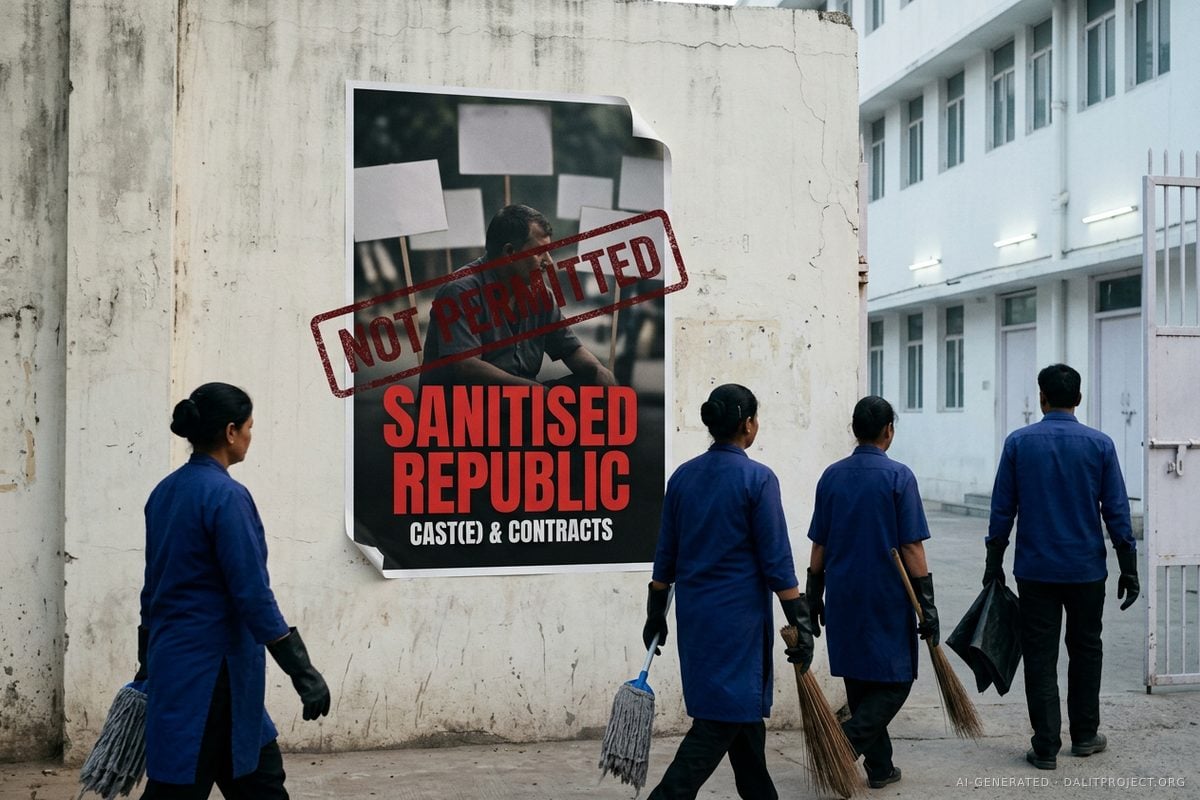
“If you are willing to take up the job of manual scavenging, I will pay you a monthly salary of Rs 50,000 to clean up the excreta of these people,” Shankersinh Vaghela, a former chief minister of the western state of Gujarat, told a rally on 2 October 2026, as reported by The New Indian Express. Manual scavenging is the cleaning of human excreta by hand, work India’s caste order assigned to Dalit communities and a 2013 law bans. Vaghela was speaking to Patels, Vaniyas and Brahmins who oppose reservation, India’s system of reserved seats and jobs for oppressed castes and tribes. Rs 50,000 is about US$560.
The remark drew accusations of casteism from Gujarat’s ruling Bharatiya Janata Party (BJP), the paper reported. Yagnesh Dave, a party leader it describes as a prominent Brahmin face, told reporters that the practice had already been eradicated in the country.
That claim can be tested, and it fails. The federal government’s own figures show people still being sent into Gujarat’s sewers and septic tanks and dying there, and thousands still validated as sewer and septic-tank workers in the state. The work Vaghela offered as a dare is real work, done today, overwhelmingly by people from the communities India’s caste order assigned it to. The claim that it is gone survives only because of how the state chooses to count it.
What happened
Vaghela, 86, spoke at a “Forest Rights Satyagraha”, a rally for land rights, at Khopi village in Sagbara taluka (sub-district) of Narmada district, which the paper calls tribal-dominated, with the Gujarat Congress president, Amit Chavda, present, the paper reported. “Reservation has not been given to anyone as a favour. Those who benefit from it have endured lifelong suffering and discrimination,” he said. The remark comes amid speculation that Vaghela may return to the Congress, India’s main opposition party.
Dave told Vaghela to begin “this noble task” himself, and offered him Rs 5 lakh (Rs 500,000, about US$5,600) a month to clean his house. Alpesh Kathiriya, a leader of the Patidar (Patel) community, called the remarks inappropriate and demanded an unconditional apology. “Making such remarks from a prominent public platform is unacceptable and hurts the sentiments of the community,” he said.
Each speaker treated the work as an insult to be offered or refused. None of them was speaking as a sanitation worker.
What the numbers show
73 Deaths in sewers and septic tanks in Gujarat since 2017, by the federal government’s count to Parliament in March 2026. Source: ThePrint
In March 2026 the Ministry of Social Justice and Empowerment told the Lok Sabha, Parliament’s lower house, that at least 622 sanitation workers had died in sewer and septic-tank incidents across India since 2017, ThePrint reported. Gujarat had 73, the fifth-highest of any state. In Gujarat two families had received no compensation and one case had been closed. The same answer said 7,634 sewer and septic-tank workers had been validated in Gujarat under NAMASTE, the federal scheme to mechanise sanitation work, by the end of 2025. Nationally the figure was 89,114.
The Safai Karmachari Andolan (SKA), the national movement of sanitation workers, keeps a higher count. It has documented 1,726 sewer and septic-tank deaths since the 2013 law that bans manual scavenging came into force, 216 of them in Gujarat, second only to Tamil Nadu among the states it lists. In the first 188 days of 2026 it counted 101 deaths nationally, against 121 in all of 2025. The two counts are far apart, as an earlier analysis set out, but both run in the same direction. Neither shows a practice that has ended.
Who does this work is not in doubt. Of 54,574 sewer and septic-tank workers verified in towns and cities, 92% were from a Scheduled Caste, Scheduled Tribe or Other Backward Class, and 67.9% from a Scheduled Caste, the ministry told the Lok Sabha in December 2024, as an earlier Dalit Project analysis reported. Scheduled Castes are the constitutional list of Dalit communities, once branded “untouchable”.
How “eradicated” is made
i
CC BY-SA 4.0Original on Wikimedia CommonsThe BJP leader’s claim is not invented from nothing. It echoes the state’s own position. In the same March answer, the government said a 2023 survey under the 2013 law found no one working as a manual scavenger in any district in the country, though surveys in 2013 and 2018 had identified 58,098. And in its replies on deaths it records those who die in sewers and septic tanks as victims of “hazardous cleaning”, saying no death has been reported “due to manual scavenging”.
So the practice is eradicated in the way the record is kept, not in the way the work is done. A person who goes into a septic tank without gear and dies is, if recorded at all, classified as a hazardous-cleaning death. A worker validated under NAMASTE is a sanitation worker, not a manual scavenger. On paper, the category empties out while the work and the deaths continue. That is how a politician can say, in good faith or not, that the practice is gone, and cite the government in support.
In their own words
“We are not scavengers because we are poor, weak, or illiterate, or because we have chosen to be scavengers. It is because somebody else has made us scavengers.” — Bezwada Wilson, national convenor of the Safai Karmachari Andolan, drawing on Ambedkar, to India Development Review
Wilson, a Dalit activist, has spent decades on the gap between the record and the work. In July 2026, after the government gave Parliament a figure of 332 sewer and septic-tank deaths since January 2021, he asked: “Why [is the] Government hiding 261 sewer and septic tank deaths? 593 persons were killed in Sewer & septic tanks, from January 2021 till date,” The Wire reported. His point answers both men in the Gujarat row. The work is not a dare, and it is not over. It is assigned, and it is still killing people.
The strongest counter-reading, and why it falls short
The best case for Dave’s answer is that it was aimed at the dare, not at the data. Vaghela offered cleaning excreta as a humiliation to be imposed on castes he was attacking. Kathiriya alleged that the remark was aimed at provoking caste-based divisions. Read that way, the BJP was rejecting the use of degrading work as a political taunt, and pointing to what governments have done: a law that bans the practice, one-time cash payments to the 58,098 people identified in earlier surveys, and a scheme to mechanise cleaning.
There is something to the first half. A dare that treats the work as punishment repeats the logic that put people there. But the second half does not hold. Dave did not say the practice was illegal or in decline. He said it had been eradicated. The government’s own figures to Parliament, as ThePrint reported them, show 73 deaths in Gujarat’s sewers and septic tanks since 2017, and 7,634 workers validated there for sewer and septic-tank cleaning. When the government told Parliament in July of 332 deaths since 2021, it also reaffirmed “its commitment to the complete eradication of manual scavenging”. A goal still being committed to has not been reached.
What to watch
When Parliament next sits, MPs can again ask the social justice ministry for its count of sewer and septic-tank deaths. Watch whether it still reports no deaths “due to manual scavenging”. In Gujarat, watch whether the row over Vaghela’s words produces anything for the 7,634 workers validated in the state: mechanised equipment, safety gear, or compensation for the families still waiting. Watch, too, whether either party in the row takes up the work rather than the insult.
Vaghela’s dare and Dave’s denial both treated manual scavenging as a figure of speech. For the workers still going into Gujarat’s tanks, it is a job, and the government’s own count of the dead says it has not been eradicated.