Christina Dhanuja joined the call from New York, from what she later described as “a well-lit beautiful room in New York City”. It was 23 May 2026, and the eShe Book Club, an online reading group run by a women-led newsroom, was discussing her first book. The interviewer was Kamna Singh, a PhD scholar at the University of Delhi who studies Dalit women’s life writing. Dalits are the communities once branded “untouchable” under South Asia’s caste order. Before Dhanuja answered the first question, she stopped to name what was happening.
“I’m really happy we finally reached a point in time and space where we are able to discuss a book like this,” she said in the discussion, “where we are able to have a discussion that is dedicated to Dalit women and it is about Dalit women and it is a conversation between Dalit women. I love that. I love that for us.” Then she gave the credit away: “I am really proud of the work that our community and our community’s women and men have done, big and small, for us to have reached here.”
Some of that work is hers. Dhanuja, a Tamil writer, researcher and strategist, is the co-founder of the #DalitHistoryMonth project and the convenor and a founder member of the Global Campaign for Dalit Women. By her own account she has spent about 16 years in roles in India, China, Singapore and the Netherlands, working with government, business and development organisations. Her book, Dalit Women and the Fullness of Life, came out in April 2026 from India Viking, an imprint of Penguin Random House India. That was Dalit History Month, the observance she helped start eleven years earlier. The Dalit Project reviewed the book in June.
The book makes an argument she has been making in other forms for more than a decade. The usual stories about Dalit women show them as victims, or as symbols of endurance, and both are too small for the lives they describe. She has made that case through a hashtag and a history project, a women’s campaign, a consultancy on caste at work, her own paintings and a museum show. Each time, the method has been the same: make a room where Dalit women speak, and let them set its terms.
A month of their own
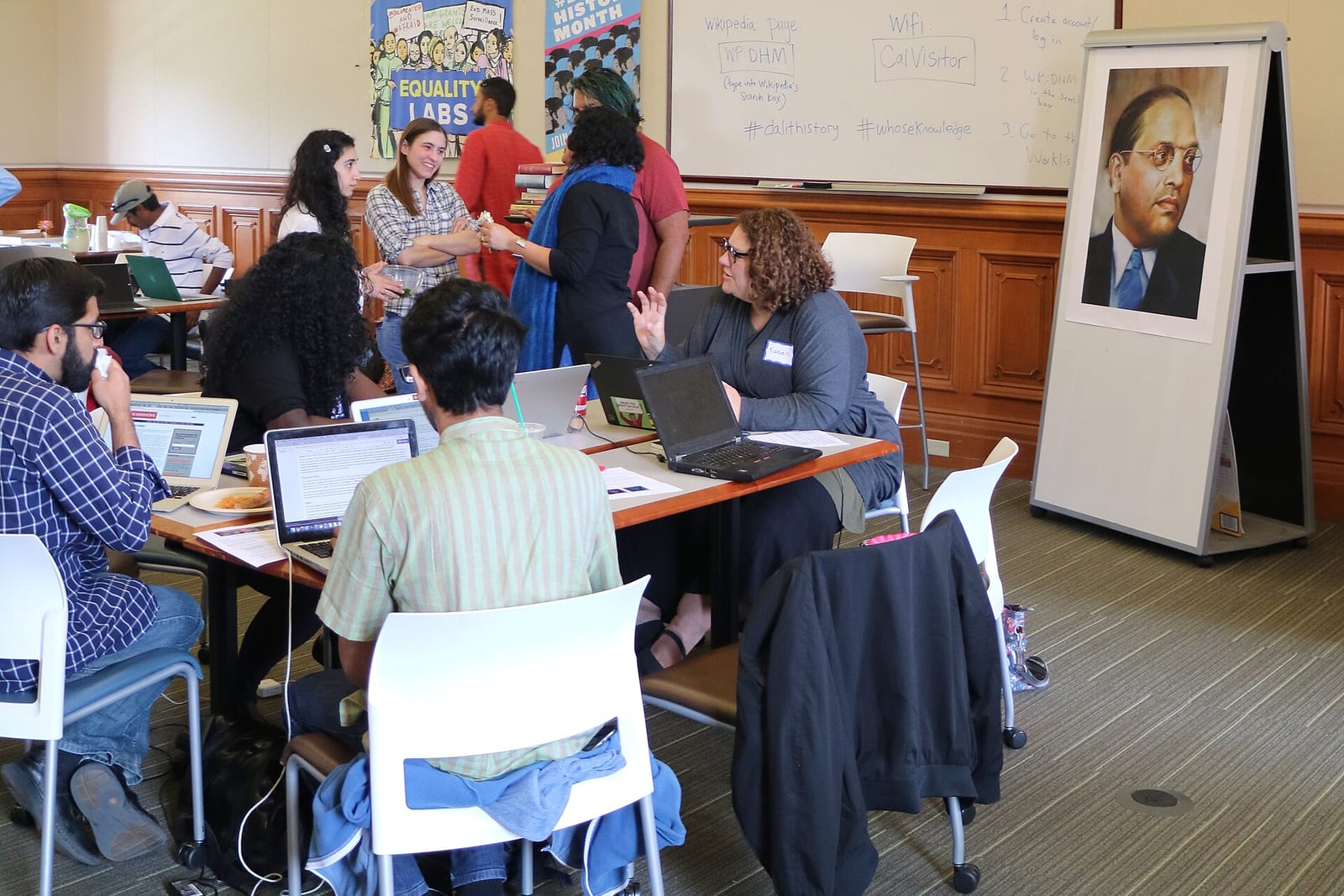
Dalit History Month began in April 2015. Hyperallergic, the arts magazine, described it in 2023 as “a participatory community history project inspired by Black History Month”, launched “by a collective of Dalit feminists, including Thenmozhi Soundararajan and Christina Dhanaraj”. It began, the magazine wrote, in US-based political and community organisations, and has grown into a global movement of storytelling, discussion and art, “largely powered by social media”. Dhanaraj is the name on many of her earlier bylines and interviews; her own site lists them under it, and the Narrative Practices India Collective, a training group, introduces her as “Christina (Dhanaraj) Dhanuja”.
Published accounts name the founding group a little differently. The Indian culture site Homegrown lists “a six-member team”: Vee Karunakaran, Christina Thomas Dhanaraj, Asha Kowtal, Sanghapali Aruna, Manisha Devi and Thenmozhi Soundararajan. Vogue India wrote in 2021 that she co-founded the project “along with Thenmozhi Soundararajan, Maari Zwick-Maitreyi and other Dalit women”. Every account agrees on the essentials: it was started by Dalit women, and it was collective.
Hyperallergic notes that the month was chosen because April is the birth month of B.R. Ambedkar, the Dalit jurist and leader who chaired the drafting of India’s Constitution, and of Jyotirao Phule, a 19th-century anti-caste reformer. Those birthdays were marked long before 2015. Dhanuja told Hyperallergic what the project added: “What this project did was mainstream the month, make it more public, and more celebratory. We’re not just talking about victimhood, we’re also taking time to celebrate the community’s resilience and resistance.”
The project’s own timeline, Homegrown reported, runs from the early origins of the word “caste” in the 1500s through forgotten Dalit leaders, community rebellions and Dalit politics. Anyone can join the conversation by posting with the hashtag. Others have built on it: Project Mukti, which Homegrown describes as “a Dalit Bahujan Adivasi women, gender non-conforming and trans led start-up”, has made mini-grants to Dalit History Month since 2018, according to the same report. Adivasis are India’s Indigenous peoples. Vogue India put the founders’ purpose plainly: to document histories that challenge “the singular narrative that Dalit women are passive recipients of oppression”.
That purpose runs straight through her later writing. In a 2022 essay for Verve, an Indian magazine, she wrote that although violence is “an inescapable reality for many Dalit women”, “the amplification of the victim stereotype not only engenders more violence but also normalises it.”
The corporate years
For most of her working life, the movement work ran alongside a corporate career. Dhanuja describes herself as “a researcher by academic qualification, a strategy consultant by experience, and an external relations professional”. She trained as a chemist. In a passage from the book that she read aloud in the eShe discussion, she recalls the campus placements at the end of her master’s degree in applied chemistry at Anna University, a public university in Chennai, the capital of the southern state of Tamil Nadu, and the Brahmin classmates and professors who believed she was “just good at English”. Brahmins are the priestly caste at the top of the caste order.
She went on to work for Shell, the oil and gas company. Her site lists her as a former external relations adviser at Shell’s headquarters in The Hague, and a government affairs and business adviser to the country chair of Shell China. Her corporate career, she writes, spans more than 12 years, run in parallel with her work for social justice. Some of her paintings are named for places she lived: Beijing Autumn, and Clingendael, after a garden in The Hague.
One earlier painting turned out to be about that career. In 2014 she painted Saree & the City, a self-portrait in a plain sari facing the New York skyline. A reproduction was shown this year in The New York Sari, an exhibition on the sari at the New York Historical, the city’s history museum. She told Hyperallergic in March: “Perhaps I anticipated the condescension that would come my way, and the plain, pink saree symbolizing my resilience, even as I’d stand facing a city’s intimidation.” The magazine said she was referring to the discrimination she faced as a Dalit woman in corporate America. On her site she writes that her sibling calls it “a prophetic painting”, made years before her essay “Being Dalit, Doing Corporate”.
That essay, as her site summarises it, argues that for Dalit women “it can be extremely frustrating to do everything that one can possibly do, and still be left behind. What one needs are not just sponsors and solidarity, but an immediate and an urgent redressal of the Indian corporate space, which still continues to be casteist and sexist.”
16 years in roles across India, China, Singapore and the Netherlands, with government, business and development organisations, by her own account.
Her consultancy, Caste at Work, now offers that redress: workshops and projects for companies, non-profits, faith-based organisations and universities: policies on caste discrimination, recruitment practices, grievance redressal, and measuring and monitoring. Its page opens with one line: “Caste is a disease of the mind.” Her site also lists her as consulting editor on an article, “What Managers Everywhere Must Know About Caste”, by Hari Bapuji, Kamini Gupta, Snehanjali Chrispal and Thomas Roulet.
In the eShe discussion she refused to treat any of this as kindness. “Every Dalit person and every caste-marginalised person has the right to a good, safe and a growth-providing workplace,” she said. “So it’s not like allyship. It’s not, you know, charity.” Workplaces and universities need “actual structural overhaul”, she said: “there has to be actual policies in place”, and grievance mechanisms that Dalit workers and scholars can use.
She also set limits on what Dalits should ask of allies at all. “We’ve become equal stakeholders in this space,” she said, “and I think we can definitely decide what types of allyships we want and who are the type of allies that we want and what’s really in it for us and what are the terms and conditions of that partnership.”
The campaign
The Global Campaign for Dalit Women began in October 2022, when Dalit women leaders who had been working in many capacities came together to form it. Its aim, in its own words, is “to empower caste-marginalized women, specifically Dalit and Adivasi women, to pursue strategies that ensure them dignity, safety, access, and justice”. It works with four groups: survivors, community leaders, marginalised youth and civil society. Its home page is blunter: “We are Dalit, we are feminist, and we are here to stay.”
The campaign’s timeline records what followed. In January 2023 it opened the Ambedkarite Social Cafe, which its home page lists as its address, in Lado Sarai, a neighbourhood of south Delhi. In March 2023 it hosted an event at the NGO forum held alongside the UN Commission on the Status of Women in New York. It has since signed three research partnerships. The cafe was initiated by Anju Singh, a founder member and the campaign’s secretary, according to a research project the two wrote together with Debarati Choudhury, a research fellow with the campaign. Singh spent a decade as a national leader at the All India Dalit Mahila Adhikar Manch, a national Dalit women’s rights forum, and at Dalit Women Fight, a Dalit women’s collective, the same page says. Vogue India described Dhanuja in 2021 as a volunteer consultant with Dalit Women Fight.
That research, “Reimagining Dalit Feminist-led Caste Equity in South Asia”, covers Bangladesh, India, Nepal, Pakistan and Sri Lanka, and is aimed at funders. Its recommendations ask them to “increase investments in long-term, sustained social change led by Dalit feminists in South Asia”, and to “work actively to de-brahminise philanthropy, which warrants a deep and rigorous understanding of caste-based structures and anti-caste movements.”
Dhanuja is precise about who the campaign is for. Asked by SheThePeople, an Indian women’s news site, in August how a rural Dalit woman “without resources” and “exempted from having opinions” might see her own desires, she rejected the premise. “I doubt if she is without opinions. This assumption is precisely what my book attempts to tackle. Rural Dalit women, even those who have very few material resources, are full of opinions—strong ones at that. The work we do at the Global Campaign for Dalit Women puts rural Dalit women front and centre of our campaigns.” As for what those women want: “We must ask them. We must ask her.”
i
CC BY-SA 4.0Original on Wikimedia CommonsShe is also candid about the system she works inside. In the eShe discussion she said she heads “a nonprofit initiative back home in India that works with survivors of caste-based sexual violence”. She called the non-profit sector “an industrial complex” and said: “we are all part of that industrial complex”. The gap between “what the state has to do” and what is done, she said, “is not being met and currently, sadly speaking, that gap is being met by nonprofit initiatives.” The aim, as she put it, is “to run movements and to transform movements with the idea that someday nonprofit initiatives must become redundant”.
She described one session she facilitated for a group of Dalit and caste-marginalised women, which began with a simple question about their life journeys. The accounts of trauma that followed overwhelmed the room, she said, facilitator included. In a session that was not Dalit-led, she said, there would have been talk of trigger warnings. Among Dalit women, “we know that there is just so much and there’s so much to be unpacked and so much to handle.”
Her other roles, as her site lists them, include adviser to Smashboard, a non-profit digital platform, and to The Blue Club Media Fellowship for Dalit women and queer people, and lead consultant to the Bhoomi Youth Leadership Initiative.
A faith, and a political name
Dhanuja is a Dalit Christian, and she does not treat that as a footnote. “A Dalit Christian is a Dalit person who has either, by individual choice or by virtue of their family’s choice, adopted the Christian faith,” she told SheThePeople. “They are not a contradiction.” She told Vogue India in 2021: “In all likelihood, my great-grandparents converted to access resources, education and a better place in society. They chose dignity, they chose life, they chose a future. I take pride in that.”
Her community was the church, and in particular the Student Christian Movement of India. “I found my people there, fellow Christians who grew up not knowing they were Dalit but were living like one,” she told Vogue. Her site lists her as a long-time senior friend and student leader of the movement, and a member of the Episcopal Diocese of New York’s task force on domestic violence and sexual assault. Its entry for the National Council of Churches in India lists her as an invited delegate on freedom of religion and belief at the UN’s 2017 review of India’s human rights record in Geneva.
The stakes are legal as well as personal. On 24 March 2026, India’s Supreme Court held that a pastor from the Madiga community, a Dalit community, had “ceased to be a member of the Scheduled Caste community upon his conversion to Christianity”, and so could not invoke the Scheduled Castes and Scheduled Tribes (Prevention of Atrocities) Act, India’s 1989 law against caste violence. Scheduled Castes is the Constitution’s term for Dalit communities. Local Samosa noted in its review of the book that the judgment reaffirmed a 1950 Presidential Order “that ties constitutional protection to religious identity”. The book’s Faith chapter takes this on. “I try to reclaim the Dalit Christian identity that is consistently being denied, in mainstream media and elsewhere,” she told SheThePeople, “through claims that Dalit Christians lack lived experience or that our faith journeys are somehow not radical enough.”
She is just as exact about caste itself. In the eShe discussion she named the caste identity she was given, Paraiyar, after the Paraiyars, a Tamil Dalit community, and said why she does not take it as her own.
“I very seriously see Dalit as a political identity and not as a caste location.” — Christina Dhanuja, in a discussion hosted by the eShe Book Club, May 2026
“I’m a Paraiyar, right, that is my caste identity,” she said, “and it is in rejecting that term of Paraiyar that I am becoming Dalit and I’m politically identifying as Dalit.” She said she holds on to that “in the hope that, it may not happen in my lifetime, but maybe 100 years from now, caste would have become so small and it would have shrunk so much that I no longer need to identify politically as a Dalit person.” Her conclusion: “the idea is not to be Dalit forever.”
Art as another room
The rooms she makes are not all for talking. From September to October 2025 she worked with the Bellefonte Art Museum for Centre County, in Pennsylvania, on Heralding Utopias, an exhibition of work by fifteen Dalit and Adivasi artists from around the world. It took its inspiration from Begumpura, the city without pain, taxes or terror imagined by Guru Ravidas, the 15th-century saint-poet, where “no one is third or second”. She sat on the exhibition committee.
She explained the stakes to Hyperallergic this year: “Caste, intertwined with class, is what shapes access to creative spaces. Which is why naming it is crucial. It allows us to sit with the discomfort of South Asian histories being complex, and often complicated, struggles for equality, status, and self-determination.”
Her book’s cover is by Shrujana Shridhar, whom Kamna Singh introduced at the start of the eShe discussion as “an artist from the community”. Dhanuja’s own paintings include Appa in the rain, an ink drawing she describes on her site as a memory of the day her father carried her home from school in the rain, the umbrella too small for both of them. Her site also includes two she painted on the bedroom wall of the family’s railway quarters, which were painted over a few months later. She introduces herself on it as “Tamizh, an anthophile at heart”, who forages mushrooms for fun.
Privilege, and the right to things
The most pointed part of the eShe discussion came from an audience member, who asked whether Dhanuja ever felt privileged as a Dalit woman. Her answer was “yes and no”. She spoke, she said, “from a very, very caste-free environment”, where “at least within my circles I don’t face caste discrimination”, and “from the global north, so that itself is another privilege”.
That is not the whole picture of the diaspora, by her own account. She told SheThePeople that South Asian communities abroad “can be deeply stifling for Dalits. There is the fear of being discovered. There is fear for your families back home, fear of retaliation and backlash, and fear of gossip.”
What she rejects is the habit of calling any Dalit who speaks English, wears make-up or holds a master’s degree “privileged”. “People don’t know the difference between privilege and right,” she said. “The fact that my parents were able to access education and that they were able to put me in school … does not mean I’m privileged. It just means that they were able to exercise their god-given human constitutional right.” Dalits, she argued, have reached a moment where they can discuss each other’s positions “really with nuance rather than, you know, make careless statements around each other’s privilege.”
She was clear, too, about whom she dresses and speaks for. Dominant-caste audiences, she said, “are not part of my mind space”. “What I do think about are my fellow Dalit women. I do think of my community.”
Her work has not always been received warmly inside the movement. When she first presented a paper with the book’s title, at an anti-caste conference at the New School in New York while she was living in the Netherlands, the response was, she said, “very lukewarm”. An older Dalit woman activist she shared it with responded “pretty nonchalantly”, with no real engagement. She took that as a sign of how deep the focus on survival runs.
The book, briefly
The book took years. eShe’s announcement says it “was developed over several years following an article she wrote in 2020”, and was written across New York, Chennai and Visakhapatnam, a port city in the state of Andhra Pradesh. In the discussion she dated the first paper to “about six years ago, six or maybe even seven years ago”. Her book proposal alone, she said, was 57 pages long.
She wrote it, she told Platform magazine, “for myself as much as I did for others”, after finding few stories about Dalit women in her twenties: “I wanted to read about Dalit women’s sisterhood and Dalit women’s joy, and if I would ever find it. I wanted language. I wanted narrative.” Its ten chapters run from Identity, Movements and Work to Body, Desire, Trauma, Faith and Joy. The Dalit Project has reviewed it twice: on how it refuses the two stories Dalit women are usually given, and on her case that a Dalit woman’s education is a right, not a privilege.
She is not finished. She told Platform that her future “will involve a lot of community work, primarily with the Global Campaign for Dalit Women and alongside South Asian anti-caste leaders”, and two more books: one on how caste shapes global workplaces, the other on lived Dalit Christian feminisms.
At the end of the eShe discussion she was asked what she hoped readers would take from the book. For readers who are not Dalit, she said, the point is to see “that every one of them is a stakeholder in the system and practice of caste”, and to look honestly at what they and their ancestors have done to perpetuate it. Then she spoke to the readers the room had been built for.
“For Dalit women who are reading this, my sincere, sincere hope is that you will be affirmed, you will be rejoiced, and you will feel not only joyful but also encouraged to write more and to write expansively and to write about everything,” she said. “And know that you can be anything that you want to be, both individually and collectively. And that as a writer, as a sister, as a friend, as a mother, I truly believe in you.”