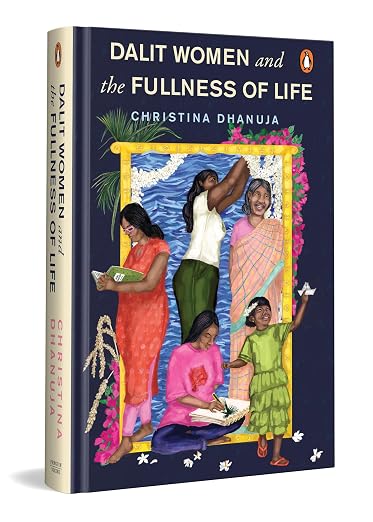
The book: Dalit Women and the Fullness of Life, by Christina Dhanuja. India Viking, Penguin Random House India, April 2026; 272 pages, hardback, Rs 699 (about US$8). Ten chapters, from Identity, Movements and Work to Body, Desire, Trauma, Faith and Joy.
The first time Christina Dhanuja put this argument in public, it fell flat. About six or seven years ago, she said, she presented a paper of the same title at an anti-caste conference at the New School, a university in New York, and the response was “very lukewarm”. She told the story in an online discussion hosted by the eShe Book Club on 23 May 2026, in conversation with Kamna Singh, a PhD scholar at the University of Delhi.
Dalits are the communities once branded “untouchable” under India’s caste order. Dhanuja, a writer, researcher and strategist based in New York, is the convenor of the Global Campaign for Dalit Women and a co-founder of the #DalitHistoryMonth project. She took the cold reception as evidence. A “hyperfocus” on violence and survival exists “for all the right reasons”, she said, but it “does more than just misrepresent us”. It “works to curb our imagination”, and makes it hard to picture what it would mean “to politically identify as Dalit and still be an astronaut, for example, or still be a botanist”.
The Dalit Project’s earlier piece on the book asked whether it escapes the two stories Dalit women are usually given, the atrocity report and the resilience narrative. The harder question is what she puts in their place. In the passages she read aloud and the excerpts published so far, it is a set of claims about power: who is credited with merit, who sets the terms of help, and what a Dalit woman’s joy is for.
Merit, and the mind that awards it
The Trauma chapter holds the book’s most useful idea, the “caste mind”, which Dhanuja said she built on existing scholarship. In a passage she read from page 167, she recalls a drug company’s recruitment drive on campus near the end of her master’s degree in applied chemistry. Some of her classmates and a couple of professors, “all Brahmins”, believed she was “just good at English. No actual talent.” Brahmins are the priestly caste at the top of the hierarchy. Of more than 70 applicants, five passed the written test. None of her Brahmin classmates did, and one said the result had been fixed.
“The caste mind not only fabricates merit, it also decides who can stake a claim on it.”
— Christina Dhanuja, Dalit Women and the Fullness of Life
The passage goes on: “My performance in class could only be because of English. My selection for a job could only be because of malpractice.”
She then catches herself ranking her own hurt as “too micro” beside what her ancestors and other Dalit women have suffered, and stops: “But isn’t this exactly what the caste mind wants us to do? Overwhelm us with trauma and have us compete with each other on who’s suffering the most while the instigators roam freely. Worse yet, make an industry out of it.”
That move, from wound to system, is the chapter’s method. It is, she said, “less about what we are going through internally and it’s more about how the system and the external world is reacting to it”. Trauma becomes something caste produces, not a shortfall in Dalit women’s strength.
Dalit as a choice, not a location
“I very seriously see Dalit as a political identity and not as a caste location,” Dhanuja said. Her caste identity is Paraiyar, a Dalit community, and she said it is in rejecting that name that she becomes Dalit, in the hope that caste will one day shrink so far that she no longer needs the identity: “the idea is not to be Dalit forever.”
It is a demanding position, and the book does not quite hold it steady. The passage she read from page 211 offers another route to the same identity: “We are Dalit because we choose joy.” Both lines make Dalitness an act of will. But caste location is not chosen, and for most Dalit women the identity is assigned long before it can be claimed. Dhanuja is candid that she speaks from “a very very caste-free environment” in New York, and that the global north is “another privilege”. The language of choice comes more easily there than in a village where caste is enforced daily. She has said that distance does not end the fear, either: in the diaspora, “there is the fear of being discovered.”
A right is not a privilege
That candour feeds one of the book’s sharpest arguments, made, she said, in the Movements chapter. A Dalit woman who speaks English, has a master’s degree or wears make-up is easily dismissed as “privileged”, including by other Dalits. “The core part of that careless statement is that people don’t know the difference between privilege and right,” Dhanuja said. Her parents’ getting her an education “does not mean I’m privileged. It just means that they were able to exercise their god-given human constitutional right.”
The distinction refuses to count a Dalit woman’s education against her. It is also less clean than it sounds: when a right is exercised by only a few, the gap between the few and the many is what people mean by privilege. Dhanuja calls it “a conversation that needs to be had”.
Allies, on Dalit women’s terms
The book’s most quotable line is about research. Dhanuja read it aloud:
“May I interview for my research that promises no structural change? No, you may not.”
— Christina Dhanuja, Dalit Women and the Fullness of Life
It follows a sentence about strategy: “Knowing when to partner with allies, why and what’s in it for the anti-caste cause is key to forging allyships that are constructive and not exploitative.” Proper mentoring for a Dalit scholar is not allyship or “charity” but a workplace right, she said, one that needs “actual structural overhaul”. Where allyship is needed, Dalits “can definitely decide what types of allyships we want”, she said, “and what are the terms and conditions of that partnership.”
She is as direct about non-governmental organisations (NGOs), which she called “an industrial complex”, and frank that “we are all part of” it: she said she heads a non-profit initiative in India that works with survivors of caste-based sexual violence. Where the state fails, she said, the gap “is being met by nonprofit initiatives”; the aim is that they “must become redundant”, with Dalit women holding the power to decide. Beside the Trauma chapter’s warning about an industry built on suffering, this stays unresolved: in what she has read and said in public, she names the trap honestly, but not how the sector would hand back its power.
Joy as a practice
The last chapter, Joy, is the book’s heart. In an excerpt ThePrint published on 9 May, Dhanuja writes that “caste minds have constructed worlds and cultivated cultures that are inherently anti-joy and actively anti-Dalit”. Savarnas, the dominant castes, “believe in the impossibility of Dalit joy—and if and when it happens, they are convinced of their right to rob it.” She takes apart the American writer Brené Brown’s idea of “foreboding joy”. Dalits are already “systemically vulnerable”, so performing vulnerability is no route to joy: “Vulnerability is not our magic potion. Recognition is. Reconstruction is.”
The passage from page 211 makes joy a principle rather than a reward: “Joy can be a value, a principle that we will not compromise on. Joy can be a non-negotiable without which we will not run our movements.” And then: “But most of all, joy can be our weapon against despair.”
This is where the book is most moving and least concrete. Its dismissal of Brown as “a tad too simplistic in the way white American worldviews generally are” is a generalisation the argument does not need. Her two avenues to joy are writing and “glimmers”, the small sensory moments of popular wellness talk, which she said she reframes “as a community-based practice for ourselves”. After so sharp a case against borrowed self-help, a reader may ask how a glimmer becomes a movement practice rather than a private one. She said the chapter shows how; the excerpts published so far do not.
The image on the cover
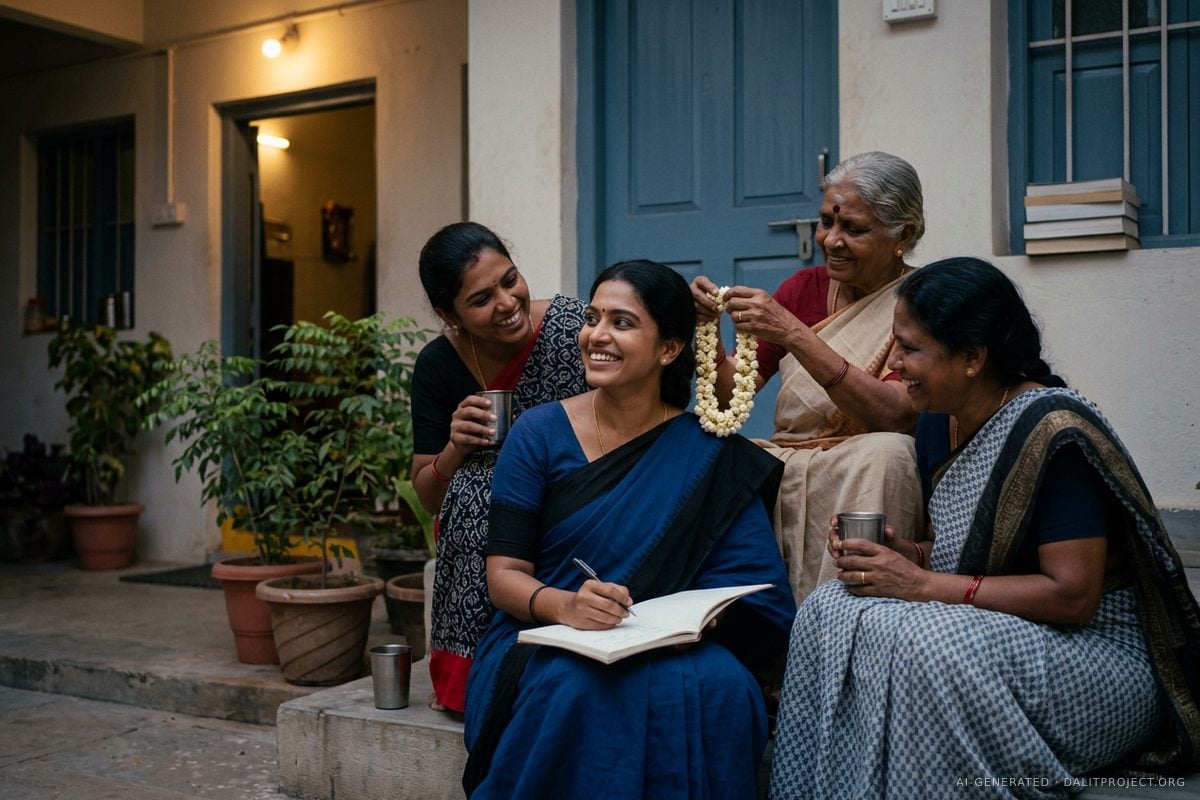
The cover makes the argument without words. Inside a yellow frame edged with flowers, women and girls of different ages get on with their lives: one reads, one writes, an older woman smiles, a girl holds up a paper boat. Nobody is suffering and nobody is posing as a heroine. Singh credited the cover to Shrujana Niranjani Shridhar, a Mumbai artist whose Dalit Panther Archive, which scans and translates the little magazines of a 1970s anti-caste movement, The Dalit Project has profiled.
The shelf matters too. Dhanuja told Platform magazine that when she went looking in her 20s, Dalit women were “afforded only certain kinds of writing”: life writing such as Karukku, history, stories such as Sangati, and poetry. Meanwhile non-fiction on “the politics of being Dalit and woman” was “often academic in nature and, importantly, upper caste or white-authored”. Her book claims the missing shelf: argued, personal non-fiction by a Dalit woman, which she wrote “for myself as much as I did for others”.
Verdict
Dalit Women and the Fullness of Life is at its best when fullness means power: to be credited, to refuse a researcher, to call an education a right. Its turn to joy is braver than it is finished, and its account of Dalit identity as a choice fits some lives better than others. Those are arguments worth having, and the book opens them on Dalit women’s terms. Asked what she hoped Dalit women would take from it, Dhanuja said she wanted them “to write more and to write expansively and to write about everything.”