A quota is only ever as strong as the discretion left to the people administering it. This is the unglamorous truth behind every guarantee of proportional inclusion, from boardroom targets to electoral reservations: the rule can mandate that a seat be set aside, but someone still has to decide who fills it, and wherever that someone retains a judgment call, the judgment call becomes the place the rule goes to be quietly undone. India’s universities offer an unusually clean demonstration, because the discretion there has a name, and the name appears in the official record.
The empty posts
The country reserves a fixed proportion of public university faculty positions for candidates from the Scheduled Castes and Scheduled Tribes: the constitutional categories covering Dalits, the communities once branded “untouchable” at the base of South Asia’s caste hierarchy, and Adivasis, India’s indigenous peoples. On paper the guarantee is firm. In practice the posts sit empty at a scale that Parliament’s own committee on Scheduled Caste and Scheduled Tribe welfare has refused to put down to a shortage of qualified people. On 1 April 2021, 2,389 of the 5,737 sanctioned posts reserved for Scheduled Castes in India’s 45 central universities were vacant, and 1,199 of the 3,097 reserved for Scheduled Tribes: about two in five, the education ministry told the Lok Sabha, Parliament’s lower house. The ministry’s answer said “the onus of filling up the vacant posts lies on Central Universities”.
How “not found suitable” works
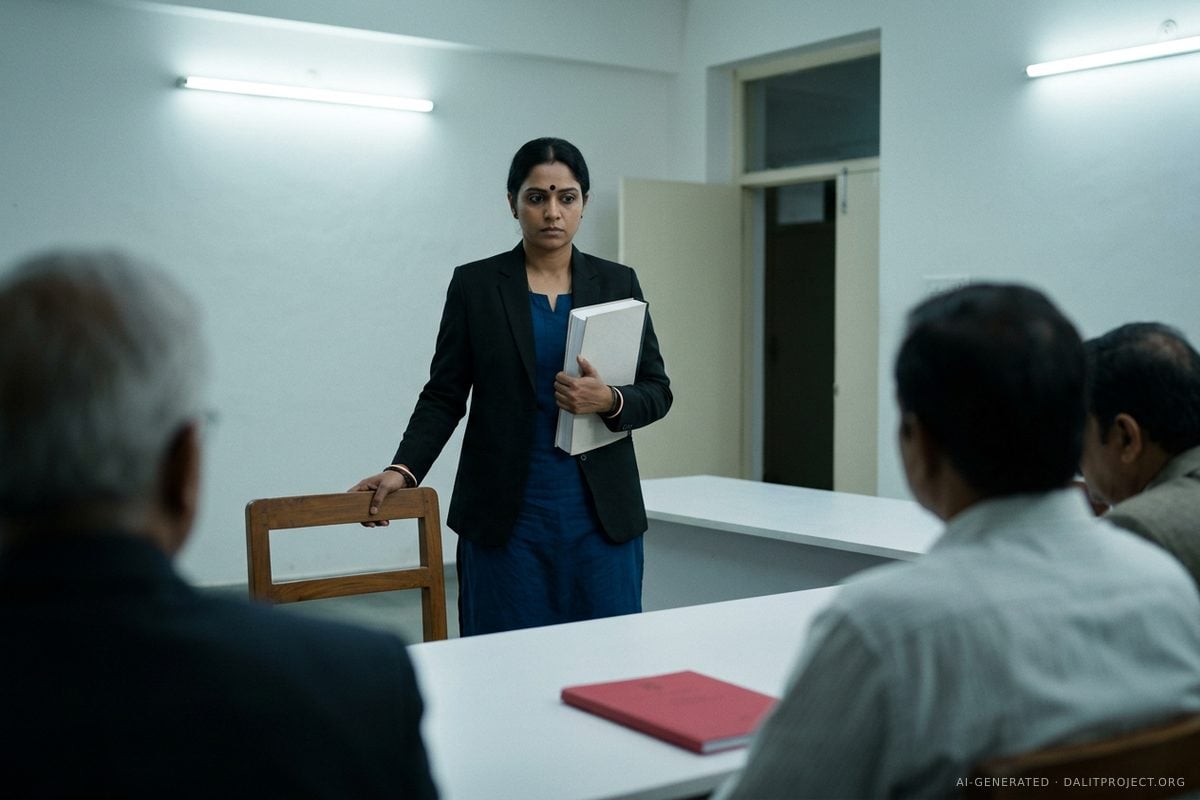
The mechanism that produces the emptiness is the selection committee, and the instrument is the phrase “not found suitable.” When a committee interviews reserved-category candidates and declares none of them adequate, the post stays empty. That committee has examined the practice inside one central university. Reporting in December 2025 on the University of Allahabad, the committee, chaired by the Bharatiya Janata Party MP Faggan Singh Kulaste, found that just 12.3% of the 428 teachers the university selected over ten years were Scheduled Caste and 5.6% Scheduled Tribe, and that it had declared 14 candidates “Not-Found-Suitable” in the last three years, Careers360 reported. “NFS allows institutions to bypass filling reserved posts,” the committee wrote. It was “not inclined to accept the frequent stereo-type reply of the government that ‘no sufficient number of suitable candidates could be found’”, and said that “in some cases candidates are declared as NFS because of a wrong assessment attitude by the selection committee just to deprive SC/ST candidates of their rights to be part of faculty members”. In 2022 the same committee, reporting on faculty hiring at the All India Institute of Medical Sciences (AIIMS) in New Delhi, had been blunter. Qualified Scheduled Caste and Scheduled Tribe candidates, it said, were
“deliberately declared as ‘not suitable’ because of wrong biased assessment by the Selection Committee.”
— Committee on the Welfare of Scheduled Castes and Scheduled Tribes, report on AIIMS New Delhi, 2022, as reported by The Wire
The pattern has a face. In 2025 a Delhi University selection panel declared the physicist Ashok Kumar “Not Found Suitable” for promotion to professor and promoted two of his junior colleagues instead, The Mooknayak reported. Kumar is a Dalit associate professor in the university’s physics department who has worked on experiments at CERN, Europe’s particle-physics laboratory, the outlet reported. The panel included a professor from a Scheduled Caste, and a subject expert on it defended the decision as a collective verdict based on Kumar’s subject knowledge and leadership skills, according to The Mooknayak. The Social Democratic Teachers’ Front, a teachers’ group, and the National Confederation of Dalit Organisations condemned the decision as caste-based discrimination, the outlet reported.
The obvious reading is that the committees are staffed by prejudiced individuals making prejudiced calls, and that the fix is to find better people. That reading is not wrong, but it stops short of the more useful diagnosis. The point is not that some professors are casteist (some are, some are not) but that the system lets their judgment operate without friction and, often, without stated reasons. “Suitability” is an unspecified standard, and the parliamentary committee’s demand that panels “justify why candidates are deemed unsuitable” implies that, as things stand, a rejection can go unexplained. Caste, in such a structure, does not need to announce itself. It lives in the remainder the rule left unspecified: in the gap between “the post is reserved” and “the person is acceptable,” a gap wide enough to drive a career through. This is why the parliamentary committee’s recommendations were about design, not exhortation: selection committees made up mainly of Scheduled Caste and Scheduled Tribe experts, with one of them in the chair, and panels that “justify why candidates are deemed unsuitable”, Careers360 reported. Both are attempts to change who holds the discretion and how it is recorded, rather than appeals to how it is used.
i
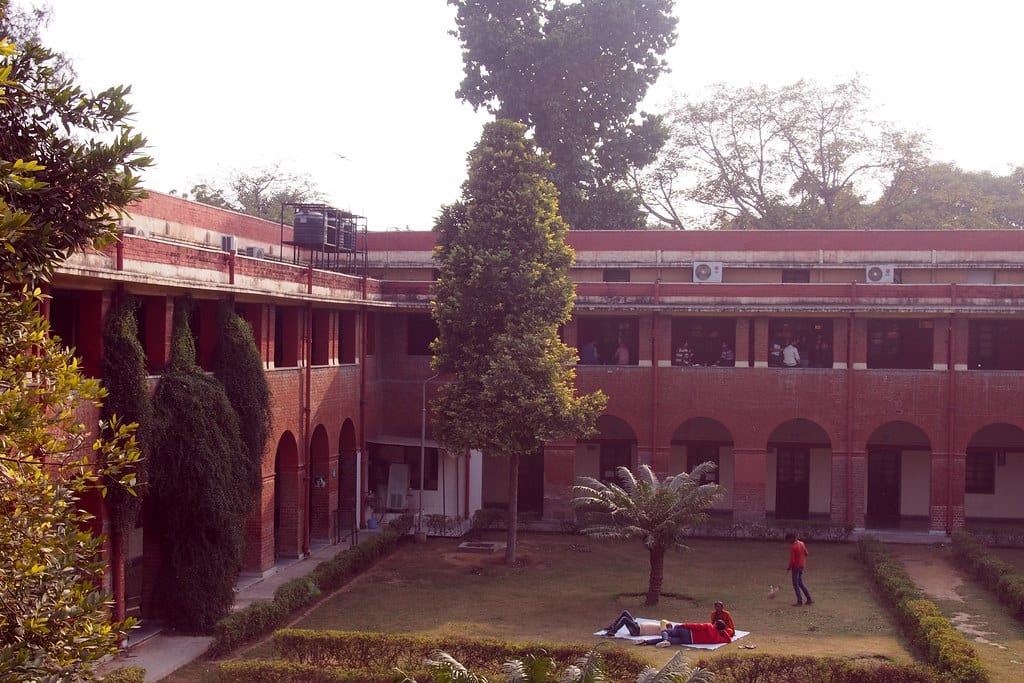
CC BY-NC-SA 2.0Original on FlickrFor a global reader, the shape of this should be recognisable under other names. It is the same logic by which “cultural fit” can quietly filter a hiring pool, by which a “merit” that is never operationalised can reproduce the demographics of the people already in the room. The mechanism is universal; what India adds is a formal quota sitting directly on top of it, which makes the exclusion legible in a way it usually is not. Most systems can claim their exclusions are invisible accidents of an open process. Here the state has already conceded, by reserving the post, that the person should exist: so when the post stays empty, the emptiness is an argument, and everyone can read it.
“Politics is at its peak in the bureaucracy and in academia. Interview boards are mostly made up of people from the forward castes, who are prejudiced against non-savarna [not from the dominant castes] candidates. Video recording of interviews should be mandatory.”
— Ashok Bharti, chair, National Confederation of Dalit Organisations (NACDOR), to The Quint Hindi, 4 July 2025, our translation
The case for the committees
There is a counter-motion owed, and it deserves its full weight rather than a dismissal. Selection committees do sometimes face thin fields, particularly in specialised or quantitative disciplines where the pipeline of doctoral candidates from these communities has been throttled for generations upstream, by the same under-representation, one rung earlier. A committee that lowered every standard to fill a post could also do a disservice, and the demand for reserved-category faculty is partly a demand to fix the pipeline, not only the interview. But this concession, taken seriously, indicts the system further rather than exonerating it. If the pipeline is thin, that is the cumulative product of the same exclusion operating at every prior stage. And Parliament’s own committee, having examined the hiring records, has twice refused the shortage explanation, calling Scheduled Caste and Scheduled Tribe candidates “equally bright and deserving” in 2022 and again in 2025. A gate that turns such candidates away is not straining to find qualified people it cannot locate. It is a gate, working.
What to watch
The test of whether any of this is changing is specific and countable. Not another circular affirming that reservation is policy: that has never been in doubt. The measurable questions:
- The Allahabad action plan. Whether the University of Allahabad’s action plan, which the committee asked for within three months of its December 2025 report, is laid before Parliament, and whether, once existing vacancies are filled, no reserved faculty seat stays vacant for more than six months, as the committee asked.
- The backlog count. Whether the number of vacant reserved posts falls below the 2021 count of 2,389 Scheduled Caste and 1,199 Scheduled Tribe posts across the central universities, rather than being “cleared” only to reaccumulate.
- The committees. Whether the “not found suitable” rate drops once selection committees are made to include the people the posts are meant for and to record reasons that can be reviewed.
If reserved posts continue to be advertised, interviewed, and returned empty at the same rate after the composition of the committees changes, the shortage was never of candidates. It was of will.
The deeper forces will outlast any single recruitment cycle. The supply of qualified Dalit and Adivasi scholars is rising, slowly, as each generation forces the door a little wider; the institutions holding the door remain composed largely of those already inside; and “suitability,” as an unexaminable standard, is far too convenient to be surrendered without pressure. A chair reserved for the excluded, left empty on the finding that no excluded person was good enough, is not a neutral outcome. It is a decision, taken quietly, many times a year. Who sits on the committee that makes it, and whether they can now be made to write their reasons down, is very nearly the whole of the question.