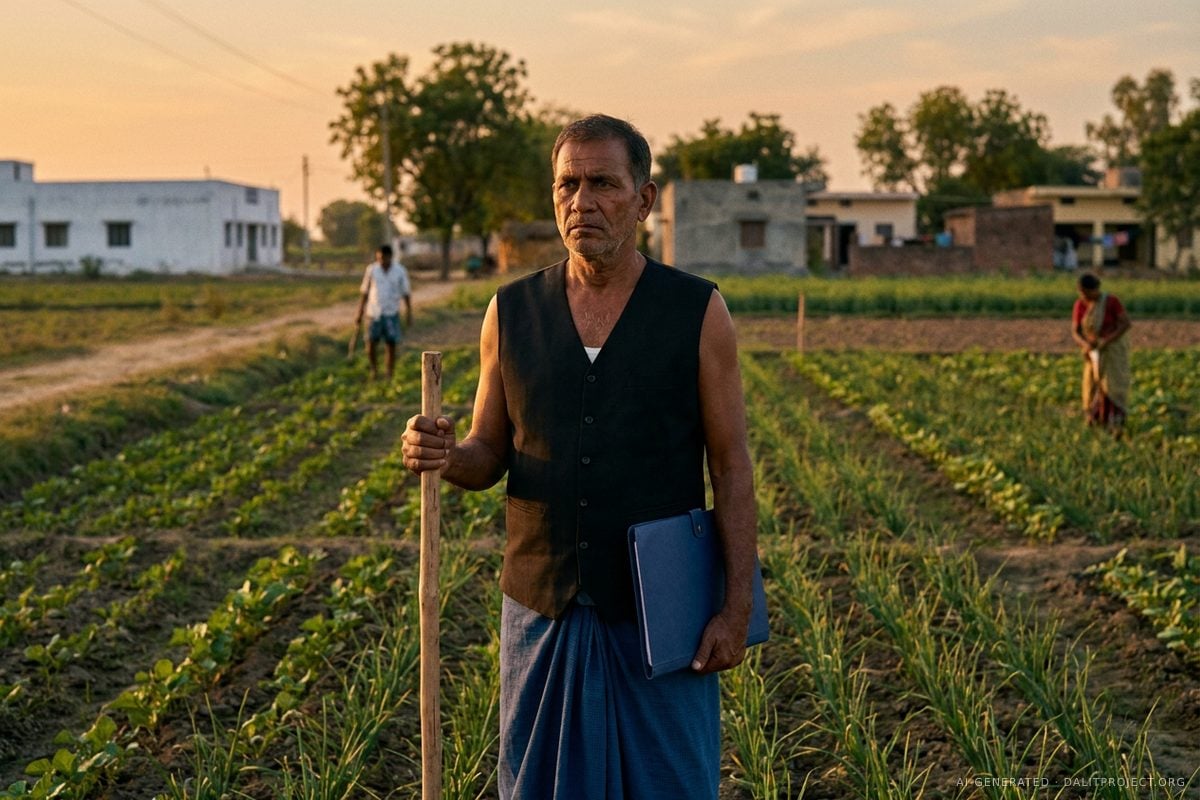
“They are not touching land owned by dominant castes,” Pyla Kondamma, a Dalit farmer and former head of the village council in Tarluvada, told the Environmental Reporting Collective (ERC), a global network of environmental journalists. “Only Dalit land.” Dalits are the communities once branded “untouchable” under India’s caste order. Tarluvada is a village near Visakhapatnam, a port city in the south-eastern state of Andhra Pradesh, where Google is building what it announced as its largest data centre outside the United States.
A two-minute Instagram reel cut from that reporting, with residents of Tarluvada speaking about the project, was published on 19 May 2026. It went viral the next day and drew more than 2.6 million views. On 22 May it was blocked in India. It came back 111 days later, on 10 September, and no authority has said why it was blocked or why it was restored.
The record does not show anyone’s motive. What it does show is enough. Dalit families lost land the state had granted them, their account of it reached millions, and a police notice took that account out of view in India without giving the journalists or the public a reason. The route used gave the journalists who posted it no reason and no hearing, and left no record the public can see. That gap falls hardest on the people with the least land and the fewest other ways to be heard.
What happened
The land. Google signed an agreement with the state for a 1-gigawatt AI data centre hub near Visakhapatnam in October 2025, with the Adani Group’s data-centre arm AdaniConneX and the telecoms firm Airtel as partners. A state government order of 11 October 2025 allotted about 600 acres across three sites, including 266.6 acres at Tarluvada, according to Land Conflict Watch, a research network that tracks land disputes. About 204 acres of the Tarluvada site were D-patta land and unrecorded land. D-pattas are conditional titles that the state gave to landless families under its land reforms. In the 1970s the state granted such plots to landless Dalit families, roughly two acres each. In Tarluvada, the ERC reported, 200 acres earmarked for the project belong to Dalit families.
On 19 February 2026 the state said acquisition at Tarluvada was complete and that 51 holders of the assigned land had given written consent. Compensation rates were raised after farmers’ representations, and the state promised developed plots, one job per family and a shop in a planned complex.
The reel. Journalists Shamsheer Yousaf and Monica Jha reported from Tarluvada in January 2026 for the ERC’s “Dirty Data” series. Instagram is owned by Meta. Its notice to the ERC said the reel was restricted pursuant to a notice from “The Government of India/Law Enforcement under Section 79(3)(b) of the Information Technology Act, 2000”. The ERC said it had received no explanation of the legal basis or the complaint.
The journalists wrote to the federal Ministry of Electronics and Information Technology (MeitY) and to Meta’s grievance officer in India. Neither replied, according to the Internet Freedom Foundation (IFF), a digital-rights group that represented them. They went to the Delhi High Court on 30 June. At the second hearing, on 23 July, Meta produced the blocking order. The petition was then withdrawn so the journalists could go to the court with jurisdiction.
According to IFF, the order was issued by the Director General of Police of the Andhra Pradesh police’s Criminal Investigation Department (CID). It named a man whom the journalists say they do not know and who, they say, has no connection to the reel. IFF then sent the state a legal notice asking for a reasoned order, a hearing and the periodic review that India’s 2021 IT Rules provide for. It received no reply. On 10 September the reel was visible again. Yousaf found out when Indian users started liking it. Meta’s notice said only that a “local legal requirement or government request” had “now expired or been reversed”.
It was not the only post blocked. On 31 May Instagram restricted, under the same section, two posts about the data centre sites by the Human Rights Forum (HRF), a civil liberties group. HRF said it knew of at least 20 short videos from 11 accounts critical of the data centre project at Adavivaram-Mudasarlova, another of the three sites, that had been blocked that week. It also said X, the social platform, had told it of a request about one of its posts from the Guntur Urban Police in Andhra Pradesh. On 19 September the whole Instagram account of the citizens’ campaign “Stop Vizag Data Centers” was restricted in India, after nine of its posts had been restricted earlier.
How the mechanism works
111 days How long the Tarluvada reel was blocked in India, from 22 May to 10 September 2026. No reason was given for the block or for the restoration. Source: Internet Freedom Foundation
Section 79 of India’s Information Technology Act, 2000, is a safe-harbour provision that shields platforms from liability for what users post. Under Section 79(3)(b), a platform loses that protection if it does not quickly remove material that a government agency has notified as being used for an unlawful act. The Sahyog portal, built by the federal Home Ministry, routes takedown communications between government agencies and platforms; police use it to send such notices. India is now one of the “limited countries” where Facebook and Instagram can “automatically restrict content, at scale and based on local law requirements”.
i
CC BY-SA 3.0Original on Wikimedia CommonsThe other route is Section 69A of the same Act. It has its own blocking rules from 2009, which require a hearing and a reasoned order. In 2015 the Supreme Court upheld Section 69A because of those safeguards, in Shreya Singhal v. Union of India. IFF argues that the Sahyog route gives the state blocking without any of them. In the Tarluvada case, the journalists were not told who had ordered the block until a court case brought the order out. Challenging the block itself would have taken a second one.
This is where caste comes in. The law does not name caste, but it works on people in a caste order. In Visakhapatnam district, the ERC reported, 68% of Dalit households own no land at all. Families who gave it up have described losing it through a land survey, revenue officials and conditional titles that, they were told, let the state take the land back. A process that blocks speech without notice, reasons or a public record makes it harder still for them to speak about that loss. A landowner with lawyers, a newspaper or a party behind them has other routes. The residents who spoke in the Tarluvada reel did not hold the accounts it was posted from. Nothing in the process required anyone to tell them their testimony was gone, or why.
In their own words
“Why won’t you give it up? You only have the right to live on it while you’re alive. It’s government land, and the government can reclaim it whenever necessary,” a revenue official said, in words Relli Ramakrishna, a Dalit farmer in Tarluvada, remembered to BehanBox.
Relli Ramakrishna’s family and 50 other landless Dalit families were granted two acres each in the 1970s, she told BehanBox, a gender-justice outlet. The land was forest when it was granted. “It took nearly a decade of this work before the land was ready for cultivation,” she said. She said officials told the families the 2025 survey was “simply about correcting the records”. Then they were told a company was coming.
Kondamma, who served as sarpanch (elected village head) in the early 2000s, said the families had offered a trade. “We told them that if they needed only around 100 acres of the nearly 300-acre stretch of land, they should leave our 200 acres alone and take the vacant 100 acres instead.” She told BehanBox: “if the government had done something good here on our land, like build hospitals, schools, or colleges, we would have gladly given our land.” She said the promised plots and jobs had not come: “The company promised us jobs, but how many jobs will really be given? And what jobs? Cleaning?”
P Venkat Rao, a Dalit farmer in Tarluvada, told The Guardian the government pressured him into giving up his only acre. He received about US$40,000 but no replacement land or job.
“I am a farmer, without my land I am nothing.”
— P Venkat Rao, a Dalit farmer in Tarluvada, to The Guardian
The other side, and why it falls short
The state has made its case in public. It told The Guardian that no land was taken by force and that eligible owners received “generous compensation”. The Adani Group, one of India’s largest conglomerates, said all legal approvals were in place. Google said the project would have “no expected impact” on the local community and that it had “engaged deeply” with local people. Nara Lokesh, Andhra Pradesh’s IT minister, said in June that it was “important to have conversations with people who believe that data centres are not good”. In the state assembly in August he urged people not to believe “fake videos or misinformation” about the data centres.
The state has not argued it, but the most charitable reading of the record is that the block was a routine police step or an error, not a decision about Dalit speech. The order did name an unrelated man, which IFF says may have been a clerical error. But that is the problem. If the block was an error, it kept public-interest reporting out of view for 111 days, and nobody has owned it. If it was not an error, the real basis has never been disclosed. The Andhra Pradesh authorities have given no explanation for either the block or the restoration, and Meta has said nothing beyond its notices to the account holder. When The Guardian put HRF’s allegation of silencing to the state government, it did not respond. A minister who warns against “fake videos” while police notices remove critical ones without explanation has not answered the question. He has made it sharper.
What to watch
The legality of the route is now before the Supreme Court. X Corp had challenged the Sahyog portal in the Karnataka High Court. A single judge dismissed that challenge in September 2025, and X and the DigiPub News India Foundation, a body of digital news publishers, appealed. Comedian Kunal Kamra and senior advocate Haresh Jagtiani brought separate challenges in the Bombay High Court in February 2026. On 22 July 2026 a bench of Chief Justice Surya Kant and Justices Joymalya Bagchi and V. Mohana issued notice on the federal government’s petitions to transfer all four cases to the Supreme Court, and stayed the High Court proceedings meanwhile. The government argued that separate High Courts could reach conflicting rulings on a central law. The petitions were returnable on 10 August.
The Tarluvada case shows the question at the centre of those cases, as the petitioners frame it: whether the person whose speech is blocked must be told who blocked it and why, before the block or at all. The reel’s legality will now never be tested, IFF notes, because it was restored before a second case could begin. On the ground, Human Rights Forum has filed three petitions against the project’s environmental clearance with the National Green Tribunal, India’s environmental court, and a separate case is before the Andhra Pradesh High Court. Families who spoke to BehanBox in August and The Guardian in September said they were still waiting for the promised land and jobs.
The reel is back. The land has gone to the project, and the 111 days the record of that loss spent out of view cannot be given back. “Only Dalit land,” Kondamma said at the start of all this. The state still has not said why Tarluvada’s own account of that loss was kept from Indian viewers for 111 days.