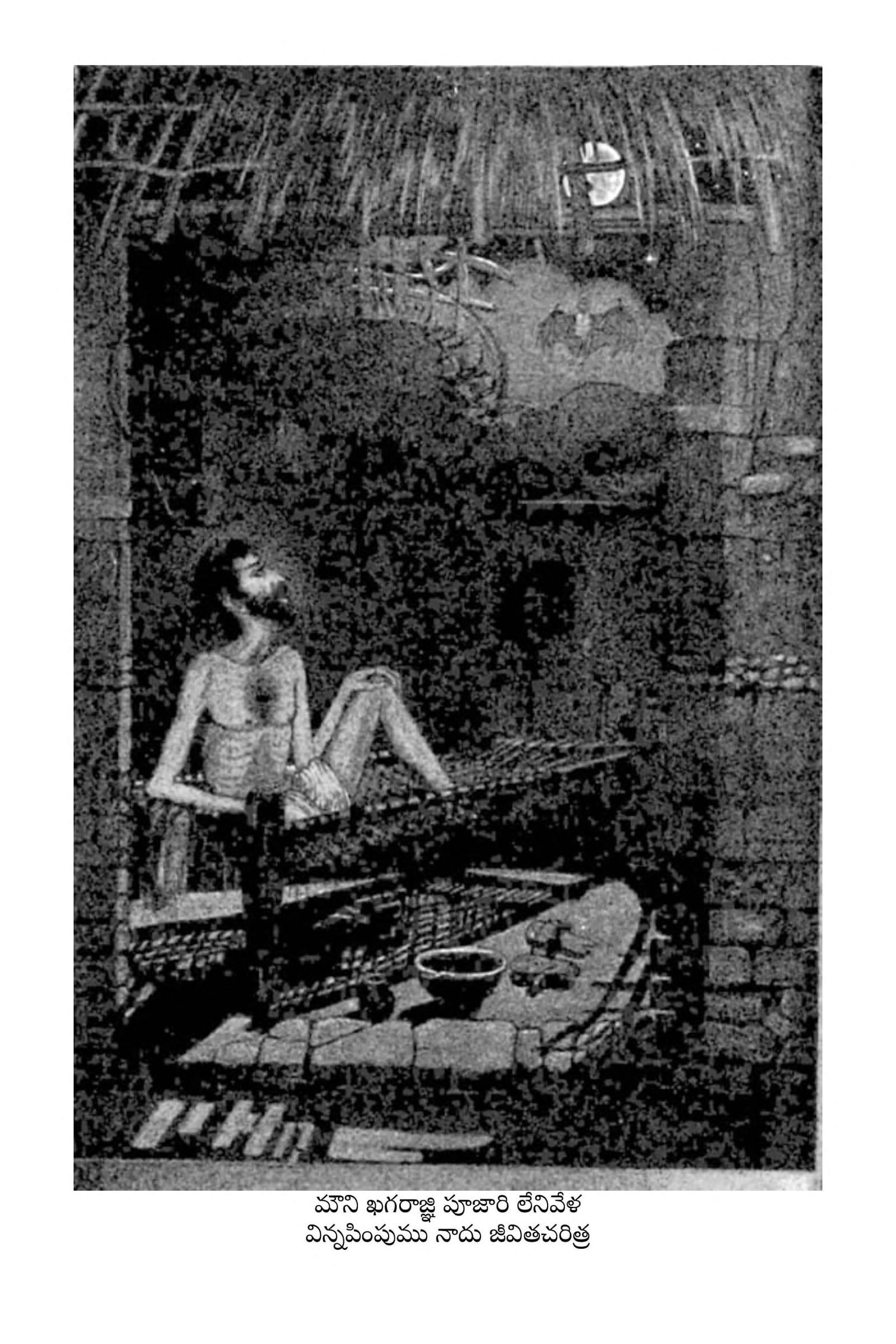
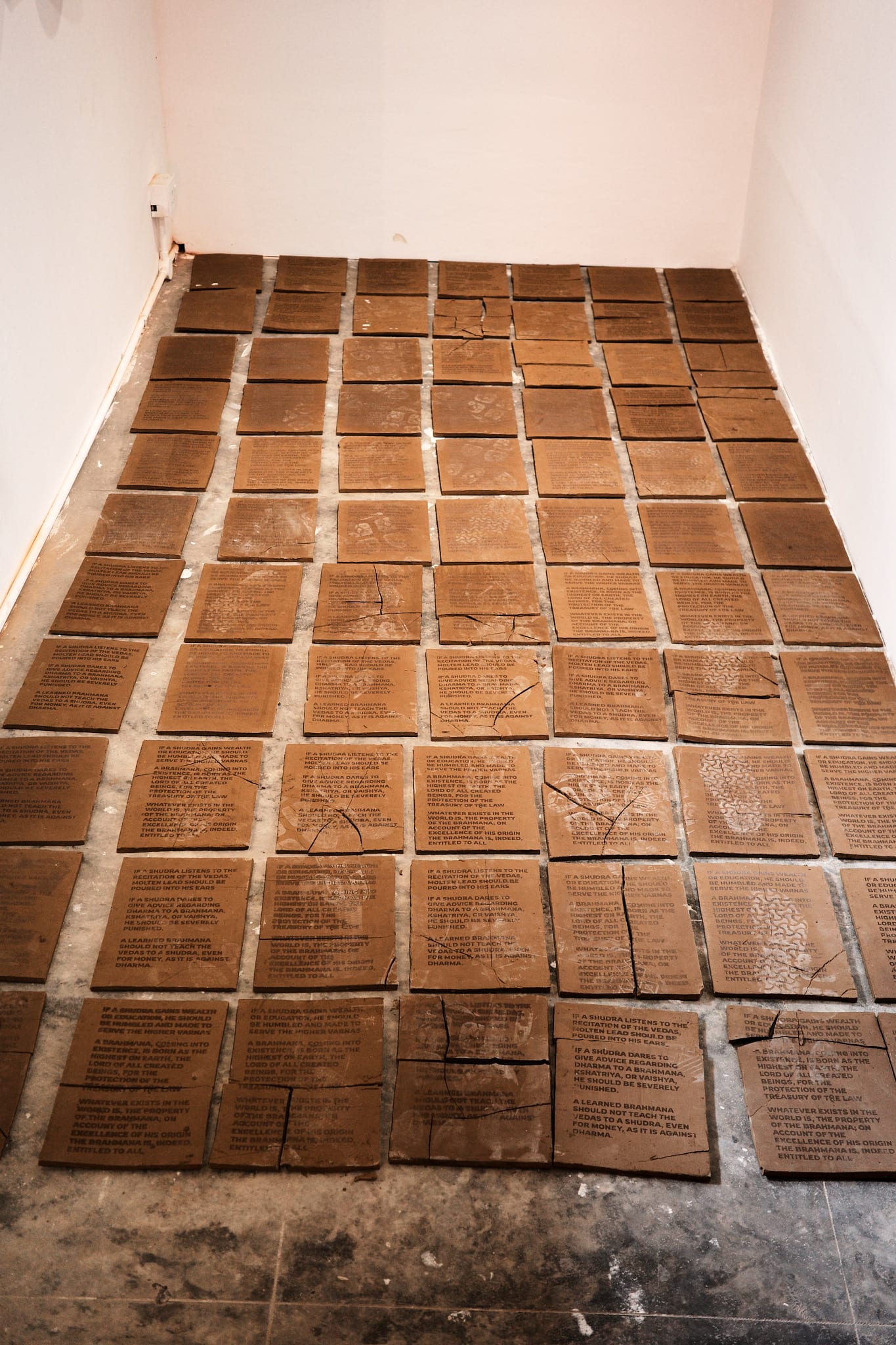
Shrujana Niranjani Shridhar wants the way into her new work to run across the Manusmriti. She made the tiles from unfired clay, each about the size of a sheet of office paper, so that they would read as documents. On each one she screen-printed, in henna, verses from the Manusmriti, the ancient Hindu law text that, as post, the Museum of Modern Art’s online journal, glosses it, “codifies social hierarchy, including caste and gender norms”. She chose the verses that prescribe punishments for people from oppressed castes who dare to study. In the full installation, water drips onto the tiles until the text dissolves and the clay turns to mud.
“I also made the tiles as a walkway,” she told the art historian Maya Varma in that conversation, published in January 2026. “You have to step on them to enter the space. It feels like stepping on dry leaves—there’s this very soothing, ASMR-like cracking sound. It’s calming. You hear the water dripping, you feel this relief in your body. And then you look down and read what you’re stepping on, and it hits you like a ton of bricks.” ASMR is the calm, tingling response some people feel to soft sounds.
She means the tiles as the way in to Educate, a series of portraits of young Dalit women at rest. “You shouldn’t be able to just walk in and enjoy the leisure of Dalit women without confronting what has been done to us,” she said.
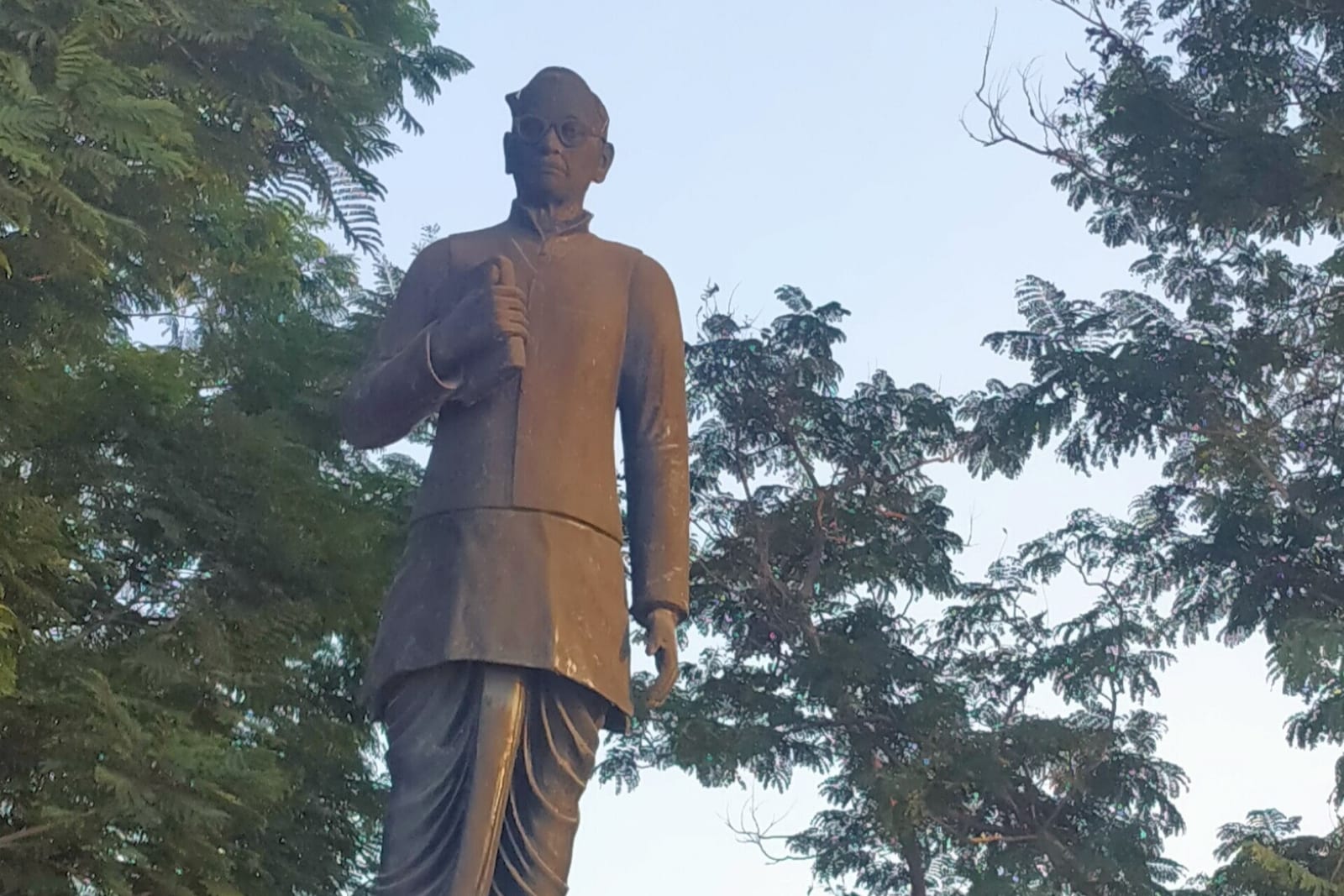
The walkway, Manusmriti Dahan/Annihilation of Caste, went to the Kochi-Muziris Biennale, an international art exhibition held across 29 venues in Kochi, in the southern state of Kerala, from December 2025 to March 2026. It was shown, she said, through Conflictorium, one of the institutions the biennale invited, as tiles alone on a floor six feet by ten. Its title joins two landmarks in the life of B.R. Ambedkar, the Dalit jurist and leader. Dalits are the communities once branded “untouchable” under South Asia’s caste order. In 1927 Ambedkar led Dalits to draw water from the Chavdar Tank in Mahad, a town in the western state of Maharashtra, a public source they had long been kept from. After caste Hindus “purified” the tank, he burned the Manusmriti at Mahad on 25 December 1927, Shridhar recounted. His burning of the text is still marked as Manusmriti Dahan Din in some communities. Annihilation of Caste is the title of the speech he wrote in 1936, which the organisers of a Lahore conference refused to hear and he published himself. “Inspired by this, I wanted to use that same material, water, to destroy the Manusmriti,” she said.
Beyond the archive
Shridhar, born in 1992 and raised in Mumbai, is best known for something else. Since 2016 she has run the Dalit Panther Archive, which finds, scans and translates the little magazines of the Dalit Panthers, a radical movement of Dalit writers in 1970s Bombay, as Mumbai was then called, from copies kept in people’s homes. The Dalit Project profiled that work in May.
The archive is one strand of a larger practice, and her own art has been the busier strand of late. In 2026 alone, MoMA’s post ran two long conversations with her, in January and March. The India Art Fair in New Delhi listed her as a speaker on a panel about artificial intelligence and originality in February. In April she showed in Chipped Teeth & Empty Bellies, the thesis exhibition of the 2026 class of the fine-arts master’s programme at Parsons School of Design in New York. And her illustration is on the cover of Christina Dhanuja’s new book, Dalit Women and the Fullness of Life.
The University of Wisconsin–Madison describes her practice in one line: it “examines the intersection of caste, gender, and capitalism.” Across about a decade of children’s books, magazine illustration, prints, paintings and installation, the work keeps returning to one question. Who makes the image of a Dalit woman, and what is she allowed to be in it?
A visual language from the trains
She grew up in what she calls a working-class city. “I was constantly out—taking buses and trains on my own by age eight or nine,” she told Varma. “That kind of mobility gives you agency that stays with you, especially for a girl in India.” Her parents, she said, are “Ambedkarite, Marxist, anti-caste people who fought hard for their education”. Galleries were not where she learned to see. “It came from the trains, the sea, the political culture of Maharashtra, the literary tradition of essays, theater, poetry, and also from the vibrance of the music we grew up with.”
She belongs to the Ambedkarite Buddhist community, Dalits who follow the Buddhism that Ambedkar embraced. Some of that lineage is in the landscape. Every monsoon, she said in the second MoMA conversation, her mother took the children up to the Kanheri Caves, Buddhist rock-cut halls in Mumbai’s Sanjay Gandhi National Park that she describes as “over-2,000-year-old caves with extraordinary carvings and sculptures”. “These were not just monuments, but also Buddhist learning centers, places where people lived, studied, and created,” she said.
She studied visual communication and art at the Srishti Institute of Art, Design and Technology in Bangalore (now Bengaluru), graduating in 2014. She remembers that period as lonely. Interviewing Dhanuja for Fourteen magazine around the tenth anniversary of Dalit History Month, an April observance that Dhanuja helped launch in 2015, she recalled first finding its timeline online: “I must have been 19-20, just out of art school and feeling quite alienated away from family and community. That was the first time I saw anything that was sort of anti-caste in nature online.”
Her early published work was for children. She wrote and illustrated Aamu’s Kawandi, published by Katha in New Delhi, about a Siddi girl from Karnataka, in south-western India, who stitches the stories of her village into a quilt made of paper. Katha lists it as shortlisted for The Hindu Young World–Goodbooks Award. By 2020 she had written and illustrated two children’s books, working mainly in digital illustration, collage and watercolour, and named bringing caste, gender and class to children through picture books as “one of her abiding interests”.
Magazine work followed. She drew for ReFrame, the Mariwala Health Initiative’s journal, in 2020, and for NO NIIN magazine in 2022. For NO NIIN she drew a girl from Jhund, Nagraj Manjule’s 2022 film about a football team from marginalised neighbourhoods in Nagpur, in eastern Maharashtra. She put her in a leopard print. “It could easily look like a Western fashion reference, but for me it comes from somewhere very local,” she said. The print was Namdeo Dhasal’s, the Dalit Panther poet known for his wild printed kurtas, or long tunics. “I’m not saying the girl is a ‘panther’ or that the Panthers are the main point of the image,” she said. “It’s more that their presence exists as a backdrop that she can stand confidently against.”
She also builds platforms for others. She is a co-founder of the Mavelinadu Collective, which the 2023 programme for Editorial Tables, an exhibition at The Showroom in London, described as “a publication house and cultural platform that publishes the work of marginalised caste creators digitally”. Social media made that kind of career possible, she told Hyperallergic in 2023: “I don’t have any of the resources, connections, and contacts that come from caste-privileged networks. It is a medium to galvanize, create culture for the Ambedkarite movement, and establish representation.”
Shows, talks and a campus
Her exhibitions began with collectives. In 2018 she and the musician Nayantara Bhatkal, her first partner in the archive, joined the artist Yogesh Barve to investigate “Dalit literature and its relationship to the Dalit Panther Party” for Working Practices, a show the Mumbai artists’ collective Clark House Initiative staged at The Showroom in London. In 2020 she was among the artists in Power & Pulp, an online project for which the artist Rajyashri Goody pulped copies of the Manusmriti into paper and sent sheets to peers to work on “however they see fit”, in the project’s words.
In Philadelphia, the gallery Twelve Gates Arts, which shows South and West Asian diaspora artists, included her in What is Destined: Stories of Resistance and Memory from November 2023 to January 2024. The gallery wrote that her illustration of the Mahad Satyagraha, the 1927 protest at the Chavdar Tank, “portrays the poignant struggle for water rights, embodying the enduring spirit of Dalit rights movements led by Dalit women and Babasaheb Ambedkar”. Her biography on the gallery’s page also lists shows at Arts House in Melbourne and with China Residencies at the University of Pennsylvania’s Center for Media at Risk.
Her talks have followed her to the United States. In April 2024 she and Dhanuja, a co-founder of Dalit History Month, presented the archive’s posters and magazines in an online session for Poster House, the New York poster museum. In March 2025 she paired a talk on the archive with a print workshop at “From Panther to Panther”, an event in Chicago where, she said, she met former Black Panthers. Columbia University’s department of Middle Eastern, South Asian, and African Studies hosted her for a visiting artist talk in October 2025.
The University of Wisconsin–Madison’s Interdisciplinary Arts Residency Program lists her among seven guest artists for its 2023–24 residency, beside the filmmaker Rahee Punyashloka and the theatre scholar Brahma Prakash. Its pages do not say what she did on campus.
Educate
The work she is making now begins with a girl of 14. In 1855 Mukta Salve wrote “About the Grief of the Mahars and Mangs” for the Marathi-language journal Dnyanodaya. The Mahars and the Mangs, also called Matangs, are Dalit castes of Maharashtra. “It’s one of the earliest published anti-caste texts by a Dalit girl,” Shridhar told Varma. “The essay is painful, but it’s also full of a sharp awareness that education is the only way out of enslavement.”
14: Mukta Salve’s age, by Shridhar’s account, when she published “About the Grief of the Mahars and Mangs” in 1855, the essay that Shridhar’s series Educate starts from. Source: Shridhar, in MoMA’s post, January 2026.
The series takes its name from the first word of the Ambedkarite slogan Shika, sanghatit vha ani sangharsh kara, usually rendered “educate, agitate, organize”. Shika, she points out, means “learn”, and she means learning in a broad sense: “the knowledge systems Dalit communities have built, the violence students have endured, and the determination with which they continue to pursue education.”
She decided not to paint Salve. The one image of her that circulates, she said, “feels like it’s coming directly from the lineage of Raja Ravi Varma”, the 19th-century painter whose women from “oppressor-caste households” went on to define “what an ‘ideal Indian woman’ or ‘goddess’ looked like”. “That visual language wasn’t built from our lives; it was built from theirs,” she said. Inventing a face of her own seemed no better. “For me to sit here and imagine her face… I don’t know what that activity does or what it gives to the work, or to us as a culture.”
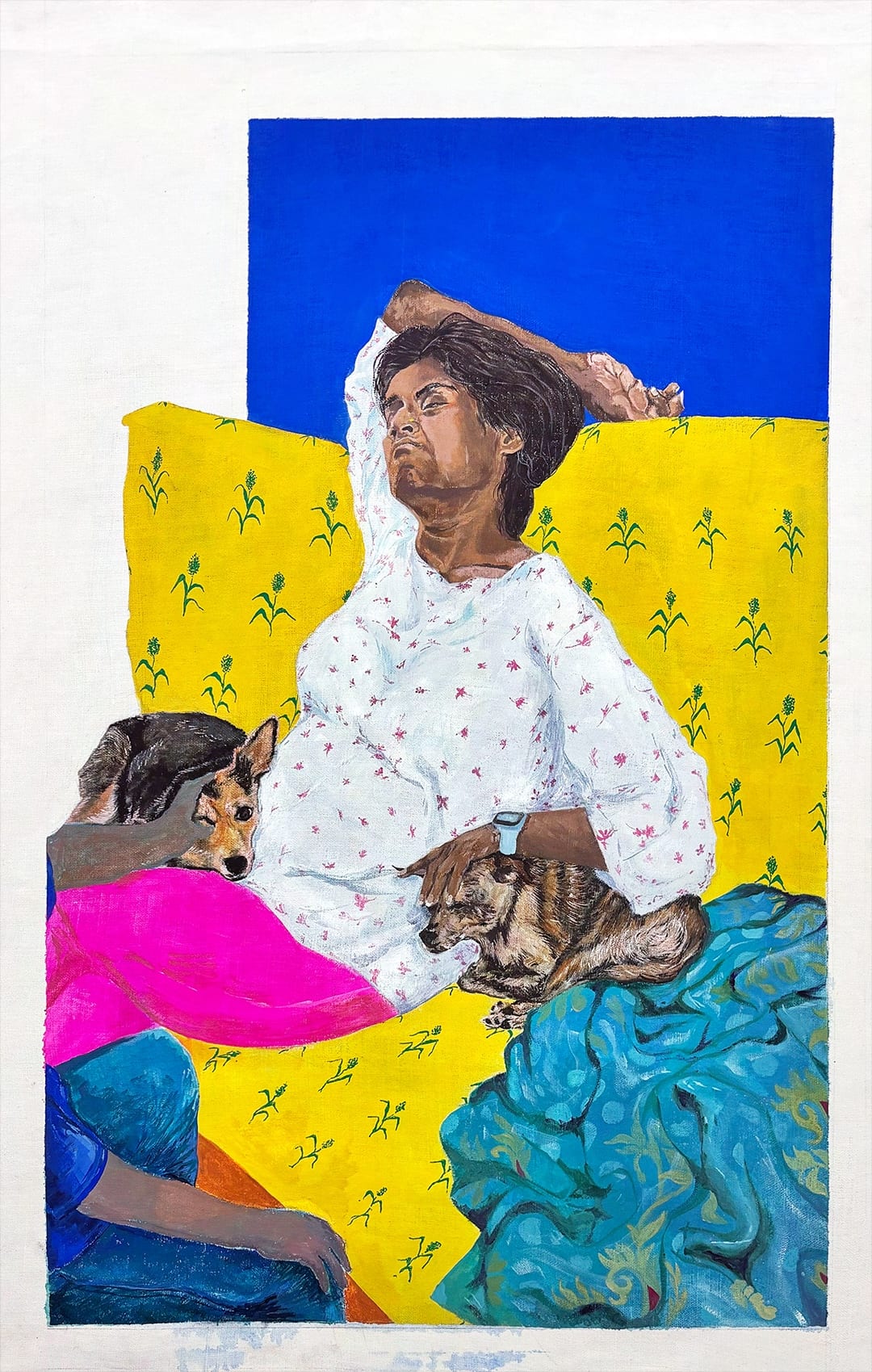
Instead she paints Salve’s heirs: Dalit women studying now. Mukta Salve’s Divya (2025), gouache on canvas, shows a friend working on a doctorate in New York. She was not posing. “I spent the day with her, waiting to see when she would finally stop moving. And, at one point, she just sat down,” Shridhar said. “If you look closely, there’s a scowl on her face. It’s not rest. It’s a five-minute break in a full day of labor.” The pattern on the couch comes from the crops grown on her friend’s family’s land, and the blanket copies the sari her friend’s mother wears in a family photograph. “Portraiture usually puts something on a pedestal: dignity, beauty, power. Here, I wanted to put that tiny, vulnerable pause on a pedestal.”
Mukta Salve’s Hrithik (2025) goes further. It shows another friend, newly arrived in the United States for a doctorate, in a bubble bath. They had talked about how a bathtub reads as a sign that “you’ve made it”, and about the guilt over the water. “And from there, we were talking about what we allow ourselves as Dalit women, and what we don’t.”
This is where her argument turns on her own movement. Drawing on the scholar Shailaja Paik’s work on Dalit women’s education, she describes how Dalit women’s bodies are made to “represent endurance, sacrifice, honor”, and how the respectability politics within the anti-caste movement leaves “no space to be fully human”.
“Art cannot just make us feel represented. It can’t only give us images of Dalit women that confirm what we already know. It also has to push us to ask, ‘What do we allow Dalit women to do?’” — Shrujana Niranjani Shridhar, in conversation with Maya Varma, MoMA’s post, January 2026
“To then say Mukta Salve’s Hrithik—that is an immense claim,” she said. “And yet while the rest of us are tense, she is there, having the bubble bath she deserves. She is in bliss.” The series, she said, is about “creating the moments we want in the future, in the present”.
The series includes her too. Self-Portrait 2 (2025) is about her early education at home. “In almost every childhood photo of me, there’s a book—or I’m scribbling on the wall,” she said in the March conversation. “My parents let me practice writing the alphabet directly on the walls.” Beside it sits Panther Chalks (2025), a glazed ceramic chalk box topped by a panther taken from a mass-market Indian chalk brand. “I’m going to take this panther and make it mine,” she said.
Her panther is the Indian leopard, not the Black Panther Party’s cat. It comes from a 1974 cover by Subash Awachat for Manohar magazine, part of what she calls the progressive print culture of Pune, a city south-east of Mumbai. She thinks of it as the leopard of Bombay, an animal of shrinking habitat that is often sighted near the Kanheri Caves. “So when I use the leopard, I’m thinking very specifically about the leopard of Bombay, the context of the Dalit Panthers, and what it means that we come from the same place as this animal.”
A cover with room in it
Dhanuja, who grew up a Dalit Christian in Chennai, in the southern state of Tamil Nadu, published Dalit Women and the Fullness of Life with Penguin Random House India this year. Shridhar illustrated its cover. Penguin Random House India’s page for the book does not name the cover artist. At an eShe Book Club discussion of the book, its host, Kamna Singh, credited the cover to her, as The Dalit Project’s review of the book noted. Shridhar described the work herself to the Chennai newspaper DT Next in May 2026, which called her “illustrator of book cover”.
The cover, as DT Next described it, shows women at different stages of life gathered around a doorway against an ocean-like backdrop. A child in leafy green plays with a paper boat, an older woman leans against the entrance, one girl reads, another draws and another decorates the door frame with flowers. Each detail points somewhere. “The flowers are a reference to the work on the ceiling of the New York Public Library’s reading room, where Dhanuja spent some time writing the book. The child’s dress is from her childhood. I’ve also referenced Urmila Pawar’s ‘We Also Made History’ as the book the girl is reading,” Shridhar told the paper. We Also Made History is the history of women in Ambedkar’s movement that the Marathi writer Urmila Pawar compiled with Meenakshi Moon, as The Dalit Project has reported.
She meant the crowd to resist a single story. “We’re all very different from each other; there may be a lot that binds us together, but we need to hold space for different aspirations and experiences,” she said. The book makes a matching argument. Dhanuja told DT Next that it “petitions for a renewed, fuller and heterogeneous understanding of Dalit women”, and The Dalit Project has profiled her work in that vein.
What art can’t do
Shridhar is wary of making art carry more than it can. “It’s irrelevant what art does, because the impact of Dalit women’s labour is experienced by every South Asian, every day,” she told DT Next. She is just as blunt about the art world. “In the larger art world, South Asian art is often represented only by those from oppressor castes,” she told Varma. “And that is deeply warped. It smells a bit of appropriation to be honest.” The weaves, looms and pottery now filed as “craft”, she argues, were made by oppressed castes.
She keeps the same discipline about solidarity in the United States. She has met former Black Panthers and felt “at home”, but she refuses to force the parallel. “It would be a disservice to both communities and both political movements to place them side by side as if they’re the same,” she said. “The contexts are entirely different, including the role of women in each movement.” She does not want to arrive, as some white visitors to India do, demanding “Tell us everything”.
And she admits the work unsettles her. “There are moments when I’m painting and I think, ‘What am I doing?’” she told Varma of the Educate portraits. “These women are simply feeling something, and it doesn’t look overtly political. It doesn’t look radical. But there is a radical edge to it.” The tiles carry their own limit. “The water only needs to be poured once,” she said. “As much as it gives me pleasure to destroy the Manusmriti, I also have to liberate myself.”
To DT Next, she put the demand plainly. “We have to force every single person to reckon with our softness and heart in light of thriving beings who are way beyond caste,” she said. “Dalit, Adivasi, and oppressed caste women have always insisted that we know how to thrive beyond the walls of caste.”