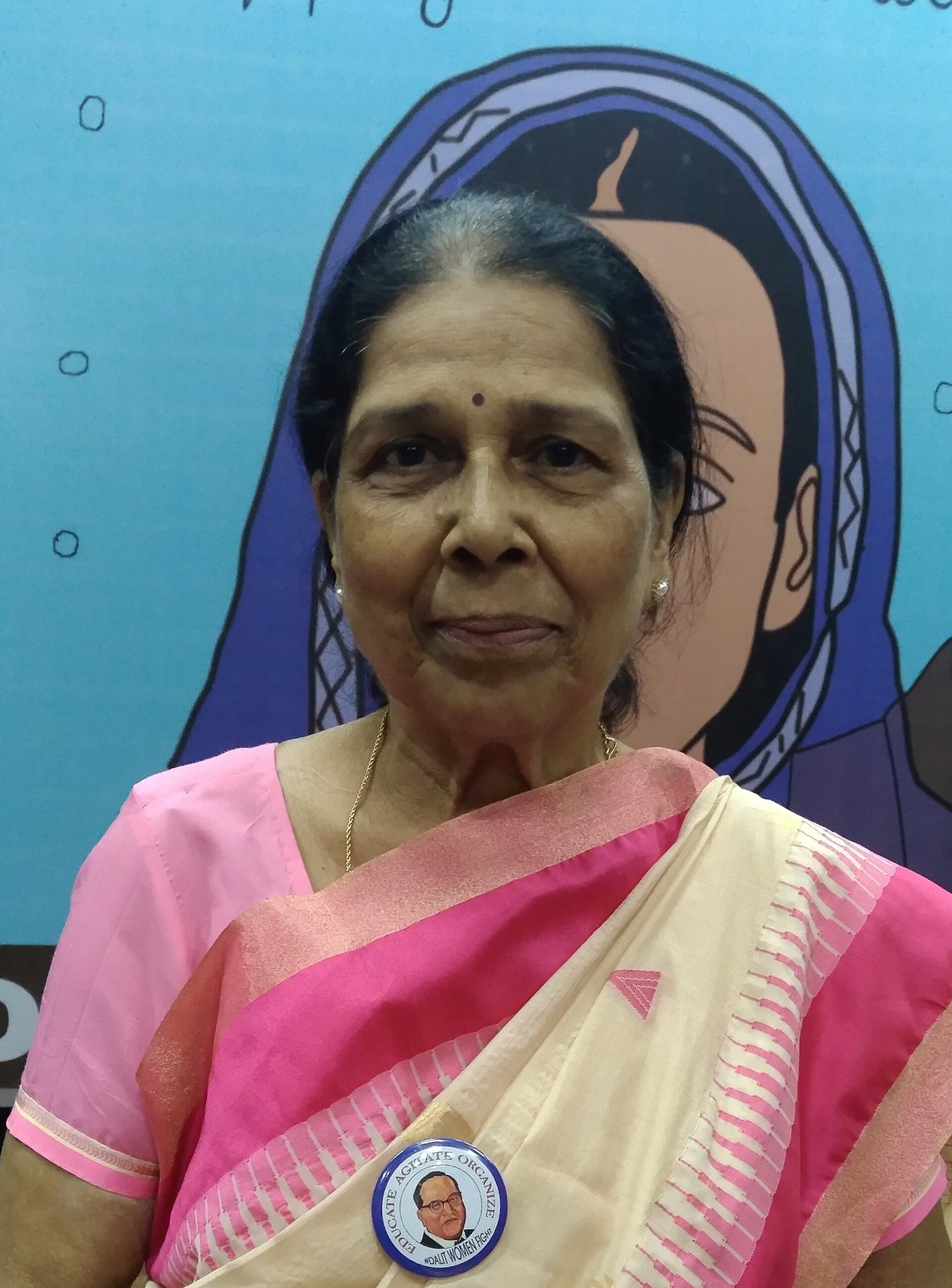
The voice is raspy, and it carries. In July 2014, as The Indian Express reported, Urmila Pawar sat at her home in Mumbai with the director Sushama Deshpande and three young actors, teaching them to swear. The scene came from her own memoir, Aaydan, which Deshpande was turning into a Marathi play, and Pawar was there to explain the dialect her community spoke in the village where she grew up. She stopped one actor mid-line to correct a word, then broke into giggles. “I am no longer used to mouthing such obscenities,” she said.
It is a fitting picture of the writer at work. For half a century Pawar’s writing has carried the speech, food, quarrels and labour of Dalit women, from the communities once branded “untouchable” under India’s caste order, into the literature of Marathi, the main language of the western state of Maharashtra, as they are, not tidied up for anyone. She has done it in short stories, in a book of oral history about the women of B.R. Ambedkar’s movement, and in a memoir that has been taught at universities, staged as a play and translated into several languages.
In March 2026 the Women AutHer Awards gave Pawar, who was born in 1945, their Lifetime Achievement Award. The jury said that “through her writing, she has given voice to stories often left unheard, shaping conversations around identity, equality, and justice with remarkable honesty and depth.” Pawar’s own account of what she was doing is plainer. Asked in a 2019 interview with the scholar Mahuya Bhaumik, published with her approval, whether she was an activist or a writer, she answered: “Basically these are two sides of the same coin. The society I hail from is marked by a sense of suffocation and humiliation. Hence the scar on the psyche is permanent. So, social activism and writing a literature of protest go hand-in-glove.”
A village that kept them at its centre
Pawar grew up in the Konkan, Maharashtra’s coastal strip, and studied in Ratnagiri, its district town, according to the Indian Express profile. Her memoir describes a village where, as its publisher’s summary puts it, the Mahar families, a Dalit community, were housed at the centre so that the dominant castes could summon them at any time. In her words, “the community grew up with a sense of perpetual insecurity, fearing that they could be attacked from all four sides in times of conflict. That is why there has always been a tendency in our people to shrink within ourselves like a tortoise and proceed at a snail’s pace.”
The work that fed the household was bamboo. In the Konkan, a review of the memoir in the Marathi daily Dainik Prabhat explains, the making of baskets, winnows and other bamboo goods, called aaydan, was the trade of the Mahars, a caste on India’s official list of Scheduled Castes (our translation). Pawar’s father was a schoolteacher. “When I was in standard III [class 3] he passed away, leaving the kids in a tender age,” she told the scholar Munira Salim in a 2015 interview. He had always pressed her mother to put the children’s education first, and after his death she kept them in school, weaving harder to pay for it: “in order to make the ends meet she used to weave more ferociously [furiously] than before.”
That weaving became the frame of everything Pawar later wrote. “My mother used to weave aaydans, the Marathi generic term for all things made from bamboo,” she writes in lines her English publisher quotes. “I find that her act of weaving and my act of writing are organically linked. The weave is similar. It is the weave of pain, suffering, and agony that links us.”
When she was 12, she became a Buddhist, she told The Indian Express, “after Babasaheb’s (Dr BR Ambedkar) call to renounce the caste-based Hindu religion”. Ambedkar, the Dalit jurist who chaired the drafting of India’s Constitution, led a mass conversion to Buddhism in October 1956. Pawar calls it the hinge of her life. “After embracing Buddhism,” she told Bhaumik, “this self-demeaning attitude of the Dalits got radically transformed and a realisation dawned that these discriminations were not made by God but by humans for their own benefits. So getting converted to Buddhism has been a turning point in my life.”
The memoir does not spare her own household. The Express piece retells how, at her first period, her mother sat her in a corner so she would not make things “impure” by touching them, and how she wrote of it: “as if I wasn’t discriminated enough by others outside, now family too, has set rules for me”.
Mumbai, a new name, and the question “Why do you write?”
In 1976, the Express reports, she moved to Mumbai with her husband. She took a master’s degree from the University of Bombay and worked for many years in the Maharashtra government’s labour welfare department, according to Columbia University Press, which also notes that she acted in radical Marathi theatre and wrote plays.
Even her name was a small act of authorship. She told Salim that her name before marriage was Vimal, and “to be honest I didn’t like my previous name”. After the wedding her mother-in-law, reasoning that her son, Harishchandra, should have a wife called Taramati, the queen in the legend of King Harishchandra, announced that name. “When my mother-in-law announced my name to be Taramati, I gave a meaningful glance to my husband!” Pawar said. “He immediately denied and said it should be Urmila!”
Writing was harder to win. “I started writing long back during 1975-76,” she told Bhaumik, starting with short stories, at a time when she was listening to educated women discuss feminism in a school hall. “Once you start writing it does not stop. It is an addiction. Moreover, people also want me to write because there are only a few Dalit women who write.” At home the question was different. Her husband was content for her to earn, she told Salim, but “the problem started when I wanted to write”. He asked, “Why do you write?” and “What’s the use?” To The Indian Express she put it more gently: “I shared a bittersweet relationship with my husband who supported me, but also expected me to fulfill the typical role of a wife, catering to kitchen duty and household chores.”
Stories with a vihara tucked inside
Her first collection of stories, Sahava Bot (The Sixth Finger), came out in 1988, followed by Chauthi Bhint (The Fourth Wall) and, in 2004, Hatcha Ek, Zee News Marathi reported, which also lists her research on the customs and folk songs of the Konkan’s Dalits (our translation). A selection, translated by Veena Deo, appeared in English as Motherwit from Zubaan, the feminist press in New Delhi.
Zubaan describes the stories through Pawar’s own self-definition: “A Dalit, a Buddhist and a feminist”. Her women are strong and clever; “her harsh, sometimes vulgar and hard- hitting language subverts another stereotype – that of the soft-spoken woman writer.” The publisher quotes the historian Eleanor Zelliot, who found “tucked in every story, a note about a Buddhist vihara or Dr Ambedkar…. All her stories come from the Dalit world, revealing the great variety of Dalit life now.” A vihara is a Buddhist temple and meeting hall. Her story “Kavach” is on the syllabus of SNDT Women’s University in Mumbai, Bhaumik notes.
A reading of the stories on the cultural archive Sahapedia follows Nalini, the heroine of “Vegli” (Odd One), a government clerk who hears colleagues say Dalits “have it good” and neighbours in her tenement mock her education: “What’s the point of all that education, after all, you too have to blow on the cooking fires to keep them lit”. When her husband gives in to his mother over moving to a government flat, Nalini picks up her baby and leaves without waiting for his answer.
“We Also Made History”
Her most lasting collaboration is a history of other women. In 1989, with Meenakshi Moon, she published Amhihi Itihas Ghadavila, a history of women in the Ambedkarite movement, through the publisher Stree Uvach. Wandana Sonalkar’s English translation, We Also Made History: Women in the Ambedkarite Movement, followed from Zubaan, reviewed in The Book Review in 2009.
Zubaan’s description sets out its two halves: a history drawn from Dalit periodicals, records of meetings and letters, covering marriage rules, religious practice and “the practice of ritual prostitution”, and then “first-hand accounts from more than forty Dalit women” who were activists from the 1930s. Moon, the Indian Cultural Forum notes, was a close associate of Ambedkar.
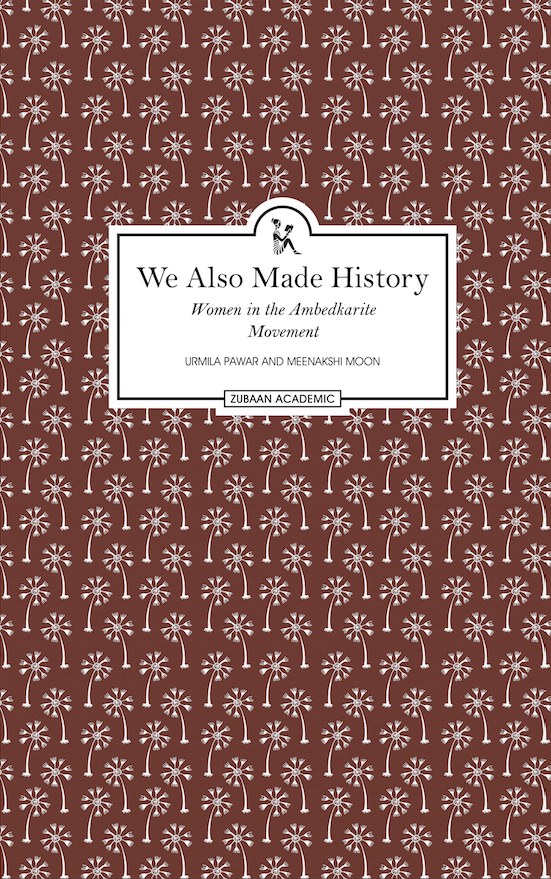
More than 40: the Dalit women activists whose first-hand accounts make up the second half of We Also Made History. Source: Zubaan.
An excerpt the forum republished shows how the authors worked. In Nagpur, in eastern Maharashtra, they went looking for Shantabai Sarode, a wrestler who said she had been to prison eighteen times for the movement. “When Sarodebai stood in front of us and took our hands in her massive hand, we were aware of her strength,” they write. Sarode’s own words carry the book’s argument: “Since we left the Hindu religion and took the Buddhist faith following Babasaheb, a revolution has come about in us.” She also had a message for women like the authors: “You are educated, you just guide us, like the rudder guides a boat, that’s enough.”
Pawar’s own organising ran alongside the history. In the 2014 Express profile she called 1975, declared International Women’s Year, a landmark in her life, and recalled the women’s collectives that followed in Maharashtra. “We spoke about the sanitation needs of village women, against dowry and the use of women as guinea pigs in the family planning experiments at the time.” she said. “A change also started to reflect in the society, where women were becoming more assertive of their rights and men more open. But then Babri Masjid fell and all our efforts were undone as cultural and religious identity once again came to the forefront.” Hindu nationalist crowds tore down the Babri Masjid, a mosque in Ayodhya in the northern state of Uttar Pradesh, in 1992.
The weave
Aaydan was published in Marathi in November 2003, 25 years after Daya Pawar’s Baluta, which the Marathi site Aksharnama calls the first Dalit autobiography in Marathi. Maya Pandit’s English translation, The Weave of My Life: A Dalit Woman’s Memoirs, with a foreword by Sonalkar, was published by Columbia University Press in 2009. The memoir has also been translated into Hindi, Kannada and Telugu, Zee News Marathi reported, and calls it a milestone (our translation).
Columbia’s summary calls it an account of three generations of Dalit women. Pawar’s own description is a dedication. “I wrote about those women who do not possess the power to write,” she told Bhaumik.
“I gave expression to my mother’s emotions. My mother was an expert at weaving; similarly I also wove with words. This book is dedicated to all those women who lead a throttled existence. My narrative is like a box woven with their sorrows and pain.” — Urmila Pawar, interviewed by Mahuya Bhaumik, Writers in Conversation, 2020
The book is also an account of grief. By the time she wrote it, Pawar had lost her son and her husband. “I was a rebellious child and had numerous fights with my mother while growing up. But by the time I wrote this book, I felt I had taken her place,” she told The Indian Express. “Like her, I was attempting to make the most of my life in a patriarchal society, I had lost my husband and my son and my two girls misunderstood me because they could not understand my need to have a life beyond home. It’s as if our lives had been juxtaposed.” She told the paper she might not have written with such honesty had her husband been alive.
When Deshpande first asked to adapt the memoir for the stage, a year after the English edition, Pawar said no, the Express reported, because she doubted a theatre audience existed for her story. She came round. A 2016 review in The Theatre Times describes the two-hour production, with three actors taking turns to play Urmila, from her school in the Konkan to the women’s movement in Mumbai.
Readings from inside and outside
One early Marathi notice came from inside the tradition the memoir joined. In the Marathi daily Loksatta, on 30 November 2003, the month Aaydan appeared, the writer Pradnya Daya Pawar, Daya Pawar’s daughter, placed Aaydan, then just coming out, at the end of a line of life stories that Baluta opened, a line whose subjects ran from the Mahar community to “the double and triple exploitation of Dalit women” (our translation). She also rejected the sneer that such autobiographers are one-book writers: for them, she wrote, writing is a “by-product” of living, not a career (our translation). Pawar, with a shelf of stories, plays, history and a travelogue of Mauritius, is one of the clearest answers to that sneer.
Other readers have pressed on the history. Reviewing We Also Made History in The Book Review, the historian Anupama Rao wrote that it “extends the frame of a masculinist dalit history which is typically narrated as ‘history before and after Ambedkar’. But the volume simultaneously reproduces a movement-centric account of dalit political subjectivity.” Rao quotes Sonalkar’s own caveat in the translation: the book “largely takes the ideology of the Ambedkar movement as given”. On that reading, the book widens the movement’s story to include women while largely taking the movement’s own terms as given.
Sheetal Kamble, who describes herself as “a Dalit woman researcher”, came to the book through Pawar herself. In a 2019 lecture at the Indian Institute of Technology in Mumbai, published by Round Table India, she recalled hearing Pawar speak before she read We Also Made History: “She was one of the first Dalit women to publicly talk about Dalit patriarchy. Before that, I had never heard about ‘Dalit patriarchy’.” The book, she said, is “the eyewitness account of two phenomena – self-expression of Dalit women, and the participation of Dalit women in the anti-caste struggle”.
Pawar’s own criticism points in two directions at once. Of the women’s movement she joined, she told Bhaumik: “Mainstream feminism does not bother to ponder over issues pertaining to caste barriers.” She gave a domestic example. “When I used to attend meetings based on feminist discussions and it used to get late I had to rush home to make ‘rotis’ for my family while the upper caste women would instruct their ‘bai’ (cook) to prepare dinner.” And of Dalit literature, which men led, she said: “Only certain bit of concern is shown by the males towards their mothers which gets reflected in autobiographies and poems of Dalit writers; but, unfortunately, no recognition is given to the other female members of the family.”
Her answer is a separate Dalit feminism. She told Bhaumik that Other Backward Classes (OBC) feminism, the feminism of the large group of castes that India classes as socially and educationally disadvantaged, “claims that it is the same as Dalit feminism but that is not a right statement”, because Dalit women live with a fear OBC women do not. “So a separate Dalit feminism is badly needed.” The Dalit writer Christina Dhanuja has made a related point about the shelf: she has described looking for argued non-fiction by Dalit women and finding mostly life writing, history, stories and poetry.
Refusals, and what has not changed
Pawar has used awards as arguments as well. In October 2015 she was among the writers who returned their Maharashtra state honours “in protest of recent sectarian killings in the country”, the newspaper DNA reported; Pradnya Daya Pawar was another. Zee News Marathi later reported that the award she returned was the state literature and culture board’s prize for Sahava Bot. The same 2021 report, announcing the A.S. Shevare lifetime award from Samyak Sahitya Sansad, a literary group in Sindhudurg, in the Konkan, notes that she has presided over literary conferences in Sangamner, Chandrapur and Dhule, towns across Maharashtra (our translation).
Her judgments on the present are not comforting. In 2014 she said that Dalit families who followed Ambedkar’s way of life were more progressive, but not much had changed for Dalit women. “In fact, it’s worsened,” she told The Indian Express. She and Deshpande agreed that the women’s movement had lost steam, as had a Dalit movement short of leaders.
She has also described caste as something only its wounded can fully read. “For me jati is just like the five fingers of our hand,” she told Salim, using the word for caste, “if one of our fingers is wounded, then we feel the pain only there, the other fingers don’t understand the pain caused there!” Then she drew the conclusion: “With this wounded identity, we use our hearts to see things.”
She named her teachers plainly: “My mother and the women of my native village are sources of inspiration,” she told Bhaumik, along with Ambedkar and Savitribai Phule, the 19th-century teacher who opened schools for girls. And when Bhaumik asked whether she felt kinship with Dalit women writers in other parts of India, she reached again for the loom.
“Casteism is a thread through which all Dalit women are tied up,” she said. “The thread has been plaited strong enough and is the symbol of our solidarity.”