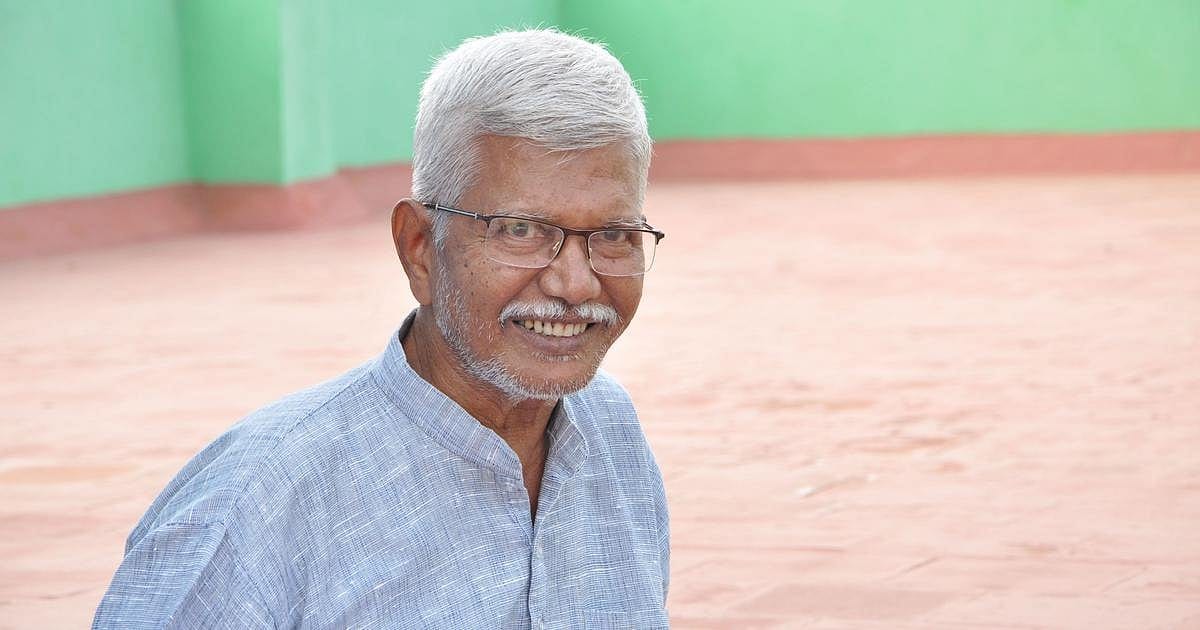
On 13 July 2026, Poomani was carried home for the last time. His body was laid out at his house in Kovilpatti, a town in Thoothukudi district in the dry south of Tamil Nadu, the southern Indian state where he lived, so that writers, poets, film people, political parties and the public could pay their respects. Then it was taken to Andipatti, the village where he was born. There, ETV Bharat’s Tamil service reported, he was buried with state honours on land his family owns, after a police guard of honour and a 30-gun salute. A state minister and the district collector, the district’s chief administrator, paid respects for the government.
The novelist, born Pulithurai Manickavasagam, died in Chennai, the state capital, on the night of 12 July, aged 79, and Tamil Nadu’s chief minister, C. Joseph Vijay, ordered the honours for his contribution to Tamil literature. In 2014 Poomani had won the Sahitya Akademi Award, the prize of India’s national academy of letters, for his novel Agnaadi. Five years later a film made from his novel Vekkai carried his name far beyond Tamil readers.
His ground never changed. For five decades he wrote the karisal, the rain-fed black-soil country of southern Tamil Nadu that the Chennai news site News Today maps as the tract from Virudhunagar to parts of Thoothukudi district. Caste, religion and politics, the plight of women and children, and the exploitation of wage labour and bonded labour run through his body of work, as the Deccan Chronicle put it in 2019. P. Shanmugam, Tamil Nadu secretary of the Communist Party of India (Marxist), said his writing portrayed the karisal’s people “especially Dalits”, the communities once branded “untouchable” under India’s caste order. Poomani himself refused one name others gave his work: “Dalit writer”. Both facts belong to his legacy.
A farmer’s son in the karisal
Poomani was born in 1947 into a family of marginal farmers in Andipatti, a village near Kovilpatti. He took his pen name early, News Today reported, while he was an employee of the state’s Co-operative Department, and his early writing appeared in Thamarai, a magazine of the Communist Party of India. He later retired from it as a deputy registrar. From 1982 he made his home in Kovilpatti, only 11 km from Andipatti.
The land he wrote was the land he had walked. “I wrote from my own personal experiences,” he told The News Minute, a south Indian news site, in 2019. “I’ve roamed the forests in my childhood, I’ve herded cattle, I’ve raised dogs, cats and birds.” He explained his pen name the same way, as something small and local that carries:
“The sound of a bell tied around with flowers, poomani, may not be loud. But it will ring nonetheless.”
— Poomani, to The News Minute, 2019
He belonged to a school: karisal literature, the fiction of this black-soil belt. Cho. Dharman, another Sahitya Akademi winner from Kovilpatti and Poomani’s relative, told reporters after his death that “after Ki. Rajanarayanan, Poomani was the most important pillar of karisal literature” (our translation from the Tamil). Just as Rajanarayanan, the elder karisal writer, had raised a whole company of writers, Dharman said, Poomani kept it going and was a model for writers like him; without the two of them, he could not have won his own award.
The short stories
Poomani’s short stories are gathered in collections such as Vayirugal, Reethi and Norungalkal. The writer Tamilselvan, himself a Sahitya Akademi winner, who paid respects alongside writers from the Tamil Nadu Progressive Writers and Artists Association, described them as works of “great subtlety, density of words and economy”, so spare that readers would ask whether a story could really be written so economically (our translation). After a time, Tamilselvan said, Poomani stopped writing short stories and turned to the novel. By 2020 he had published seven novels and more than 50 short stories, according to an author note published by the Global Literature in Libraries Initiative.
Piragu: the first novel
His first novel, Piragu (afterwards), set the course. “My first, Piragu, is on the lives of the Arunthathiyars. No one before me had written about it. It was called a pioneering work,” he told The News Minute. The Arunthathiyars are a Scheduled Caste community, India’s official category for Dalit communities, and Tamil Nadu sets aside a separate share of its Scheduled Caste quota for them. Tamilselvan called Piragu the novel that “made many turn and look”, one that told the karisal life of oppressed people after India’s independence “in great detail” (our translation).
How that novel was read at the time is part of its history. Sudhakar Ghatak, a Tamil writer, wrote in an essay on his own Dalit writing, collected in Tamil Dalit Literature (Institut Français de Pondichéry, 2011, translated by David C. Buck and M. Kannan), that when Piragu first appeared it was “not singled out as Dalit literature”. Instead, “Poomani was reviewed as an indirect leftist, and as a writer who had an excellent literary outlook.” Ghatak added: “Today’s Dalit literature continues and extends these earlier creations, and has made people pay attention to things that had previously been dismissed.”
Vekkai and Asuran
His second novel, Vekkai (heat), published in 1982, follows a 15-year-old boy who kills the landowner who murdered his brother over the family’s land, and the week he spends in hiding with his father. Poomani drew it from a real killing over land, and it never names a caste: “This novel is not about caste. Because Chidambaram’s mind is beyond all that,” he said of his boy narrator. Asked by Scroll in 2019 about criticism that the novel speaks of caste only in hidden ways, he answered from inside the boy’s head:
“Chidambaram is a boy, he doesn’t know or understand identities and the power structures behind them. He doesn’t know that Vadakkuraan is an upper-caste man. He only knows that he is an oppressor and wants to take all the land. He doesn’t know much about Vadakkuraan at all. We don’t, either, since it is completely from Chidambaram’s point of view.”
— Poomani, to Scroll, 2019
In 2019 it became the first of his novels in English, as Heat, translated by N. Kalyan Raman. Poomani read it with some unease. He told Scroll: “I thought there was a distance in the English version, I felt like I was not completely with Chidambaram. After reading four pages of the original, I could see how the reader becomes a part of the chase itself, but I didn’t feel it so strongly in English. This novel is a subjective novel, that’s where the involvement comes, you feel like you’re being chased yourself. If you look at it from an observatory point, it will feel like we are looking from the outside. There will be a distance because this is not an observatory novel and cannot be translated that way. But nonetheless, he (N Kalyan Raman) has made a very sincere translation.” Vekkai has its own review, which weighs what that silence costs.
The same year, the director Vetrimaaran released Asuran, a Tamil film drawn from Vekkai. Its star, Dhanush, won India’s National Film Award for best actor, and the chief minister’s tribute said the film had made the reach of Poomani’s writing known to the world (our translation). Poomani welcomed it: “Vetrimaaran visited me to request for permission. I was happy that they wanted to make a film out of it,” he said. But he rejected the idea that his novel portrays a victory of Dalits over their oppressors. The film’s Dalit revolt was, in his account, the director’s freedom to change a story about a family defending its honour.
Agnaadi: the long history
Poomani began his largest book soon after he retired in 2005. “There were written documents that told a story and I’ve heard of unwritten history from many,” he told The News Minute. “I wanted to write a story based on facts and so I spent several months combing through government archives for it.” The research was backed by a 28-month grant from the India Foundation for the Arts, and the book took him seven years.
i
CC BY-SA 4.0Original on Wikimedia CommonsAgnaadi, published in 2012, runs to more than 1,000 pages. It is set against the colonial-era violence at Kazhugumalai in 1895 and Sivakasi in 1899, two towns of the same southern region, which, News Today notes, involved the mercantile Nadar community and the Maravars, a subgroup of the Thevars, who are listed among the state’s Other Backward Classes. Its families, Outlook reported, come from the Pallars, Vannaars, Panaiyeri Nadars, Naickers and Thevars, and their work spans farming, washing clothes, toddy-tapping, landholding and war. The novel follows them, according to DT Next, through caste relations, agrarian life, the rise of the matchbox industry, the conversion of Dalit communities to Christianity and the influence of the Ettayapuram zamindari, a local landed estate, across more than a century to the assassination of Prime Minister Indira Gandhi in 1984.
It won the inaugural Gitanjali Literary Prize as well as the Sahitya Akademi Award. The award brought a home: Dharman said Poomani had been living in Chennai in a house given on the strength of it, under the Kanavu Illam (“dream home”) scheme of the previous state government, led by the Dravida Munnetra Kazhagam (DMK). It did not soften him toward prize-giving. In 2017, Outlook noted, he publicly appealed for greater transparency in how the Sahitya Akademi awards its prizes.
Other books, and two films
Between and after the big novels came others. Neivethiyam (1985) told the story of a widow from the Brahmin caste of hereditary priests, and Vaaikkal and Varappugal, both 1995, turned to schoolchildren and teachers. Kombai (2018) retold the Mahabharata, the Sanskrit epic, through its women. “The story that Krishna protected Draupadi is false. She was a brave woman who was capable of protecting herself,” he said. He dictated it to a typist: “After Agnaadi, my nerves got worse and I wasn’t able to write as well as I did. So Kombai, I wrote with my tongue.” At his death he was still writing a novel about Andal, the Tamil poet-saint, and Tamilselvan mourned that it was left unfinished.
He also made films about karisal labour. Karuvelam Pookkal, which he directed in 1996 for India’s National Film Development Corporation, follows children employed in the match factories of the Sivakasi and Kovilpatti region, and was screened at festivals around the world. Penakkal (pens), made for television, was about workers in the pen-nib industry. Yet when asked in 2019 whether he would work on Asuran’s screenplay, he declined: “Oh no, I don’t want to. It’s an ugly business.”
How others read him
The tributes after his death show how widely his work travelled across Tamil politics and letters. D. Ravikumar, general secretary of the Viduthalai Chiruthaigal Katchi (VCK) party, a member of Parliament and a co-editor of The Oxford India Anthology of Tamil Dalit Writing, said in a statement that Poomani “spoke of the people of the karisal whom other writers did not speak of” and “created, through his works, the grammar of a literature of resistance” (our translation). Su. Venkatesan, also an MP, said he “saw life and history standing on compassion for tormented people, and on their anger” (our translation).
Others read him for the soil and the sentence. Dharman said the book of Poomani’s he loved most was not the prizewinning Agnaadi but Vekkai. His translator, N. Kalyan Raman, said in 2020 that Vekkai describes the boy’s family “with a profound humanity that never sees them as mere victims of oppression”. He also observed that there had been “no discussion” of the caste order underlying Vekkai “by leading proponents of the anti-caste discourse across India, even after it has been made available in English”.
“I am not a Dalit”
The sharpest tension in his legacy is over the name for his work, and for his own community.
According to S. Mohan, a human-rights journalist from Thoothukudi district writing on the website Countercurrents four days after the death, Poomani was born into the Devendra Kula Vellalar community, which is listed as a Scheduled Caste. When an English newspaper called him a “Dalit writer” after his Sahitya Akademi award, Mohan writes, “He immediately rejected the description, insisting that he should be identified simply as a writer.” Mohan says the objection “was grounded in his understanding of the history of the Devendra Kula Vellalar community rather than in a rejection of any other community”. By Mohan’s account, Poomani went on to argue that the community’s place on the Scheduled Caste list was a “Historical Error” that needed review, and took up three slogans: “I am not a Dalit”, “We Yield to None” and “Quit SC”.
That position sits inside a live debate in the community. In 2021 a federal law, ThePrint reported, grouped seven Scheduled Castes of Tamil Nadu, the Pallan among them, under the single name Devendrakula Vellalar. It met a long-standing demand that ThePrint attributes to the stigma attached to the name Pallar. ThePrint reported that a section of the community also wants to leave the Scheduled Caste list, “though this is a divisive issue within the community”. K. Krishnasamy, of the Puthiya Tamilagam, a Tamil Nadu party, told ThePrint: “We have been pressing to delist these communities for the last 25 years.” Jeevan Kumar Malla, national president of the Bahujan Dravida Party and himself from the community, opposed both the renaming and the delisting, and said some people make such demands “to create divisions among Dalits”.
About his fiction he spoke in other terms. He told the Deccan Chronicle in 2019:
“I write about all these, but above all an underlying empathy, fellow-feeling, simple human relationships of love and bondage and above all humanism, shatters all caste and religious distinctions.”
“Even before the word Dalit was imported, I have been writing those people, their lives.”
— Poomani, writer, to Ananda Vikatan, January 2023, our translation
Critics have pushed back. Writing in Scroll in 2019, Yashasvi Arunkumar noted that Vekkai’s refusal to talk openly about caste “has been criticised by many literary critics”, alongside “criticism for Poomani’s personal politics in refusing to identify his works as Dalit literature”. News Today’s obituary held both sides in one sentence: he “detested being identified as a Dalit writer, though he was instrumental in developing Dalit writing into a distinctive genre through his works”.
He resisted other labels too. The Communist Party of India (Marxist)‘s Shanmugam said Poomani “embraced Marxism as his worldview”. Asked by Scroll in 2019 about his interest in Marxism, Poomani answered: “I don’t have any leanings, I have read different doctrines and I apply them as they are relevant.”
What the karisal keeps
Poomani spent his life writing a place of dry fields, match units and spinning mills, and of the question of who holds the land. He left an unfinished book, a shelf of novels that put the karisal’s oppressed people at the centre of Tamil fiction, and an argument about names that his community is still having. He was buried in his family’s land at Andipatti, 11 km from the town where he wrote. As he said of his pen name, the bell may not be loud, “But it will ring nonetheless.”