On 4 November 1948, B.R. Ambedkar introduced the Draft Constitution in India’s Constituent Assembly. He chaired the committee that drafted it, and he was born into a Dalit family, among the communities once branded “untouchable” under India’s caste order. Administrative detail was in the text, he explained, because “it is perfectly possible to pervert the Constitution, without changing its form by merely changing the form of the administration”. Then: “Constitutional morality is not a natural sentiment. It has to be cultivated. We must realize that our people have yet to learn it. Democracy in India is only a top-dressing on an Indian soil, which is essentially undemocratic.”
Seventy-seven years later to the day, on 4 November 2025, the Election Commission of India began a Special Intensive Revision (SIR), a re-check of every listed voter, in West Bengal, the eastern state that borders Bangladesh, its first since 2002. By polling day, about 9.1 million names had been removed, All India Radio’s news service reported.
West Bengal’s 2026 election showed what Ambedkar meant by top-dressing. The form held: one person, one vote, and 68 seats reserved for candidates from the Scheduled Castes (SCs), the constitutional category for Dalit communities. Beneath it, two things set the worth of a Dalit vote. The administration of the roll decided who could cast one. The party system, a Kolkata political scientist argues, decided what it could ask for.
The roll
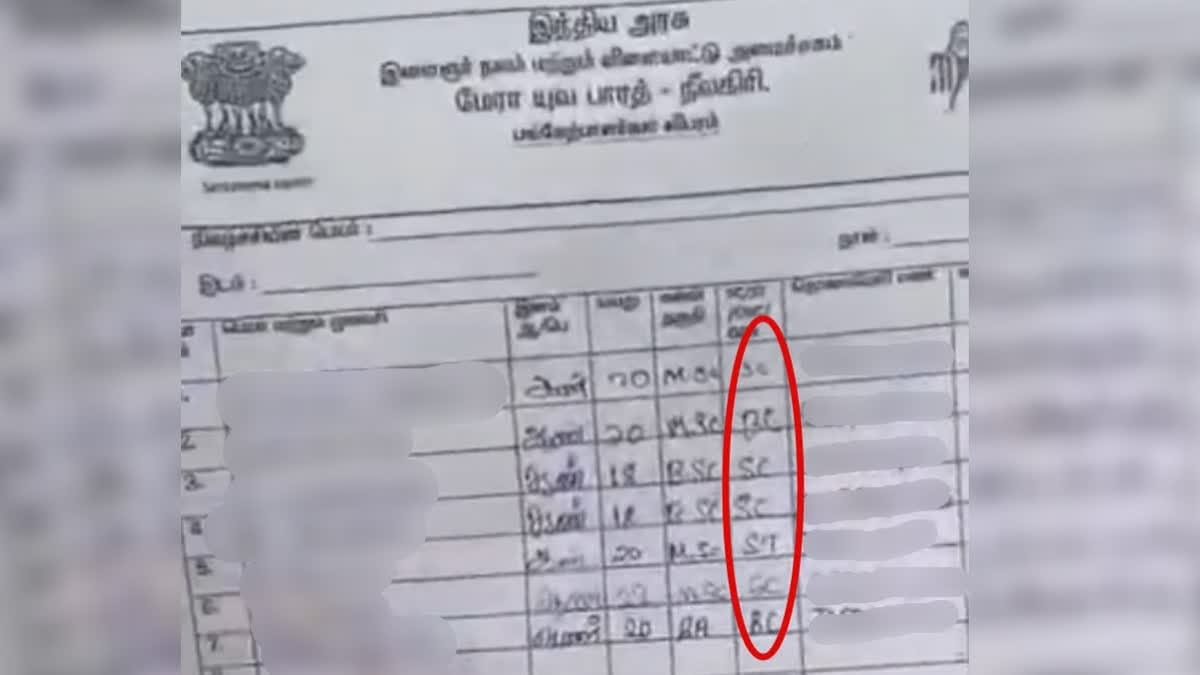
The state had 76,637,529 voters before the revision. The draft roll of 16 December dropped more than 5.8 million names as dead, moved, duplicated or untraceable. By the final roll at the end of February, deletions stood at about 6.37 million, 8.3% of the electorate, and another 6.0 million voters were kept on the roll “under adjudication”, awaiting judicial officers’ decisions over “logical discrepancies” in their forms, The Pioneer reported from the Commission’s data. By early April, judicial officers had declared about 2.7 million of them ineligible, India’s public broadcaster reported, citing official data.
The Commission said the aim was an accurate roll. The Bharatiya Janata Party (BJP), India’s governing party, called it necessary to eliminate bogus entries; the Trinamool Congress (TMC), then the state’s governing party, said it hit minorities, migrants and the poor.
The heaviest losses were not in Dalit seats. The Wire’s analysis of the Commission’s data found adjudication fell hardest on Muslim-majority border seats, and seats with more SC residents tended to show lower deletion. But, it found, “the SC crisis becomes far sharper in border geographies and refugee-origin populations where documentary continuity is weakest”. It named the Matua and Namasudra communities, which Outlook counts among the state’s Scheduled Castes.
The Matuas, Outlook reports, are a Scheduled Caste Hindu refugee community from what is now Bangladesh, following a 19th-century reform movement that challenged caste hierarchies. Voters missing from the 2002 roll had to furnish eligibility documents.
Of more than 1.4 million found ineligible in the first phase, 136 were cleared by the appellate tribunal that hears challenges to exclusion before polling on 23 April, The Wire reported. By 7 August, in 49 seats, the tribunals had decided 1.30% of the cases before them, state records obtained by The Wire show.
The form of the franchise was untouched; the administration decided who held it, as Ambedkar said it could.
In their own words
“I was born here. Despite that, today my name has been deleted from the voter list. So, whom should we trust, and where will this Matua society end up? We cannot find any direction,” Ananda Biswas told The Federal in Gutri, a Matua village in North 24 Parganas district.
In Gaighata, ThePrint met Radhakanto Haldar, 70, a temple priest whose Namasudra father came from what was then East Pakistan. “We were told in 2019 that we will get citizenship under CAA. Seven years down the line, even that has not come. Now, our names have also been struck off the electoral rolls. And there is nobody to hear us.” The CAA is the Citizenship (Amendment) Act of 2019, which offers citizenship to persecuted non-Muslim migrants from three neighbouring countries.
i
CC BY 4.0Original on Wikimedia CommonsMahitosh Baidya, general secretary of the All India Matua Mahasangha, warned in December that “many Matua families, owing to displacement, migration and lack of formal records, do not possess even a single such document”.
Subrata Thakur, Gaighata’s BJP legislator and a member of the Thakur family that founded the Matua faith, defended the revision. “It pains me to see that a number of Matuas will not be able to vote this time, but that’s what happens when a system is implemented,” he told Outlook.
In Karol, a hamlet in Thakurnagar, Ripon Mondal told Outlook all four names in his family had been deleted. He said:
“They will use us for vote bank politics and claim to protect us. We don’t need upper caste protection. Harichand Thakur, Guruchand Thakur (his son) and B. R. Ambedkar gave people like us the strength to value education over religion.”
— Ripon Mondal, a Matua voter in Thakurnagar, to Outlook, April 2026
The result
On 4 May the Commission declared the BJP the winner of 207 of the 293 seats then decided. In the 68 SC seats, the BJP won 51 and the TMC 17, according to India TV’s seat-by-seat list.
SC communities make up 23.51% of the state’s people, by the 2011 census figure cited below. Yet “the question of Dalit political aspirations and substantive caste representation doesn’t find any resonance in the Bengal assembly elections”, Subhajit Naskar, a political scientist at Jadavpur University in Kolkata, wrote in The Wire between the two polling days, citing that census figure. He argued that the BJP’s campaign against “ghuspaithiye” (infiltrators) was “very willfully advanced by the BJP to mobilise and appropriate Dalits so that independent Dalit political agency never grows in Bengal”. He noted that the state has never implemented a Scheduled Caste special component plan, which sets aside a share of the budget for SC communities, as the southern states of Andhra Pradesh, Telangana and Karnataka have. Of Bengal’s genteel elite, the bhadralok, he wrote: “There is a broad consensus among the Bengali upper caste bhadraloks of the Left, Right and Centre that Dalit aspirations and autonomous Dalit politics should not re-emerge.”
The counter-reading
The strongest objection is that Dalit voters chose. The BJP won Gaighata, Bagda and both Bangaon seats, in the Matua heartland, despite the deletions. “They will become voters again through the CAA,” Rajkumar Sarkar told The Federal in Gutri.
That should be conceded: reading 51 seats as a mistake would repeat the habit of speaking for Dalit voters that Ripon Mondal rejects.
But Ambedkar’s warning was never that voters choose wrongly. It was that the form of democracy can stand while the soil decides what it carries. In 2026, on Naskar’s reading, the campaign ran on citizenship and “infiltrators”; Dalit representation and an SC budget plan were not on offer. And in the Matua belt, community leaders’ assessments put the names struck off before polling day in the tens of thousands.
What should change
The Wire reports that India’s Supreme Court has directed a category-wise break-up of the removals; publishing it seat by seat would show who lost the vote, and why.
The 51 SC-seat legislators on the government side can be measured on Dalit demands, starting with the budget plan other states already have.
Ambedkar said it again on 25 November 1949: “In politics we will be recognizing the principle of one man one vote and one vote one value. In our social and economic life, we shall, by reason of our social and economic structure, continue to deny the principle of one man one value.”
In Karol, Outlook found, “delete” has become a word for a person: “He is delete(d),” a woman said of a neighbour. There, the top-dressing is thin enough to see the soil.