Before he was famous, Kalabhavan Mani walked into the Chalakudy river every morning until the water reached his neck, and sang as loudly as he could. Years later he told the story, laughing, on JB Junction, a talk show on Kairali TV, a channel in Malayalam, Kerala’s language, as Silverscreen India reported in 2016: “The women bathing and laundering clothes at the nearby ghat [bathing steps] would laugh at me. They would call me ‘karutha Yesudas’.”
Karutha means black. K.J. Yesudas is, in the words of the film scholar Manju Edachira, one of the most popular playback singers from Kerala. The joke on the riverbank held most of what came next. Within a few years, Silverscreen wrote, Mani’s voice was on radio and television. “It had become the rage.” He went on to act in about 200 South Indian films, sell millions of folk-song albums, and become, for a generation of Malayalis, simply “Manichettan”, elder brother Mani.
He was a Dalit, from the communities once branded “untouchable” under South Asia’s caste order, in an industry whose heroes were written as dominant-caste men. “Very seldom has a Dalit film actor-singer like him commanded such popularity and a large fan following anywhere else,” the critic C.S. Venkiteswaran wrote in the Economic and Political Weekly (EPW) weeks after Mani died in March 2016. In the same essay he asked why “a brilliant, multitalented actor like Mani” did not “get his rightful due in Malayalam cinema”.
March 2026 marked ten years since his death, and Kerala’s media marked it with tributes. The director Vinayan, who gave Mani his first lead role, used the anniversary to point at what was missing. “His memorial still lies in Chalakudy as fallow land, having come to nothing,” he wrote (our translation from Malayalam). “That we forget the artist who came from the bottom layer of society, overcame every crisis of life and astonished Malayalis, is a disgrace to cultural Kerala.”
The land his father worked
Mani was born on 1 January 1971 in Chenathunad, a village in Chalakudy, a town in Thrissur district in the south-western state of Kerala, the son of Kunnissery Raman and Ammini. ETV Bharat describes a family of ten living on what the parents earned from wage work in the fields. His father, Silverscreen reported, worked on a local landlord’s plot for Rs 13 a day. The Dalit writer and activist K.K. Baburaj describes Mani as born in a poor Dalit family in Chalakkudy.
Mani told the rest himself, on the same talk show. “We went to bed hungry on many nights,” he told the host, John Brittas, “but later, I was able to buy the land my father worked in.” He called it sweet revenge. Of his father he said: “My father wore a shirt for the first time on the day I got married. That I don’t have my parents around to witness my success is my only grief.”
Before anyone paid him to perform, he carried loads as a head-loader, drove an auto-rickshaw and did daily-wage labour. As a young man he also painted wall slogans for the Kerala State Literacy Mission to make a living, he recalled when the Mission made him an ambassador of one of its projects. At the Government Boys High School in Chalakudy he competed in mono-acting, a solo performance form, and in 1987 won first prize at the state school arts festival in Kollam, in southern Kerala. He drove the auto-rickshaw by day and performed for mimicry troupes across Kerala in the evenings.
The troupe whose name he took was Kalabhavan, an arts centre in Kochi set up in 1969 by a priest, Father Abel. It began with devotional songs and by the early 1980s had become a centre for mimicry, the comic impressions and sketches that filled Kerala’s stage shows. Baburaj, writing in Round Table India in May 2016, places that stage in Kerala’s caste geography. Mimicry artists, he wrote, came mainly from Latin Christian, Muslim, Dalit and other oppressed-caste communities, and “even now, mimicry is not considered an elite art form.” Kalabhavan was “not an elite institution like Kalamandalam”, Kerala’s academy for classical performing arts.
From comic to Ramu
Mani’s first film roles were small. He played an auto-rickshaw driver in the director Sibi Malayil’s Aksharam before his part as a toddy tapper, a palm-wine tapper, in Sallapam drew notice. Venkiteswaran describes a scene in that film in which village elders plan a festival concert and one sneers: “Should a toddy tapper sing? Can you imagine how good it will sound?”
The answer came in 1999. Vinayan had watched Mani improvise an impression of a blind man on a film set and promised him a serious role. When he cast him as Ramu, a blind singer, in Vasanthiyum Lakshmiyum Pinne Njaanum, “there was a lot of opposition,” Vinayan told Silverscreen. “He was just a 27-year-old comedian then – uneducated, and not very handsome in the conventional way. A couple of mainstream actresses refused to be a part of the film, and a well-known actor said he wouldn’t act in a movie with Mani as the hero.”
In one scene Ramu tells a washerwoman that he never had money for clothes and wore what others gave him. Mani began to cry. “It wasn’t part of the script,” Vinayan said. Afterwards Mani told him he identified with Ramu, because as a child he had never had money for clothes either.
The role won Mani special jury awards at both the National Film Awards and the Kerala State Film Awards. The media and the industry had tipped him for the state’s Best Actor award, Edachira writes, but it went to Mohanlal, one of Malayalam cinema’s leading stars, for Vanaprastham. Stories then spread that Mani had fainted at the news; the media, she notes, treated it as comedy. Vinayan told Silverscreen that Mani had been told the night before that he had won, and that he was passed over again for Karumadikuttan (2001). At a memorial meeting in March 2026 Vinayan put it more gently: had Mohanlal’s film not been in the running for the national award, “Mani would surely have got it”, he said. “But the film that came against him turned out to be the greatest classic” (our translation).
Edachira draws the line forward. The actor Vinayakan became the first Dalit actor to win the Kerala state award for best actor, for Kammatipaadam (2016). “In a way,” she writes, “Vinayakan won the award which was once denied to Mani.”
Villain, hero, and the Tamil screen
After Vasanthiyum, Mani played across the range. The evil minister with comic mannerisms he played in Vinayan’s Rakshasa Rajavu caught the eye of Tamil producers who saw the rushes, Vinayan says, and led to Gemini, the Tamil film that made his name there. He worked in Tamil and Telugu cinema, the film industries of the neighbouring southern states, alongside Rajinikanth, Kamal Haasan, Aishwarya Rai and Vikram. In Malayalam he led films such as Ben Johnson, The Guard and Valkannadi. Of all his roles, his friend Kalabhavan Prajod told Silverscreen, the evil policeman in Chotta Mumbai was one he found most satisfying.
Venkiteswaran, writing in Outlook in 2020, traces the climb. Mani started in “early comic, sidekick roles shadowing the fair hero—whose elite caste is the stated or unstated ‘neutral’ ground”, then “graduated into a variety of serious, tragic and evil roles”. In his last decade, “he donned several hero roles, vying with the superstars in terms of punch dialogues, action scenes and machismo.”
The parts were rarely neutral. Edachira notes that the few prominent Dalit actors in Malayalam cinema, Mala Aravindan, Mani and Vinayakan, “were mostly offered characters belonging to marginalised identities”, and that even Mani’s acclaimed leads were a blind man and a man with an intellectual disability from an oppressed community. Karumadikuttan, Vinayan has written, told the story of a Cheruman from Kuttanad, in Kerala’s backwater country; the Cherumans are one of the state’s Scheduled Castes. Baburaj put the pattern bluntly: “Most of the characters, given to Kalabhavan Mani by Malayalam cinema are of the same Dalit/subaltern male”. But Mani, he went on, “crossed all such boundaries and became a popular hero and a prominent singer.”
Songs for the auto stand
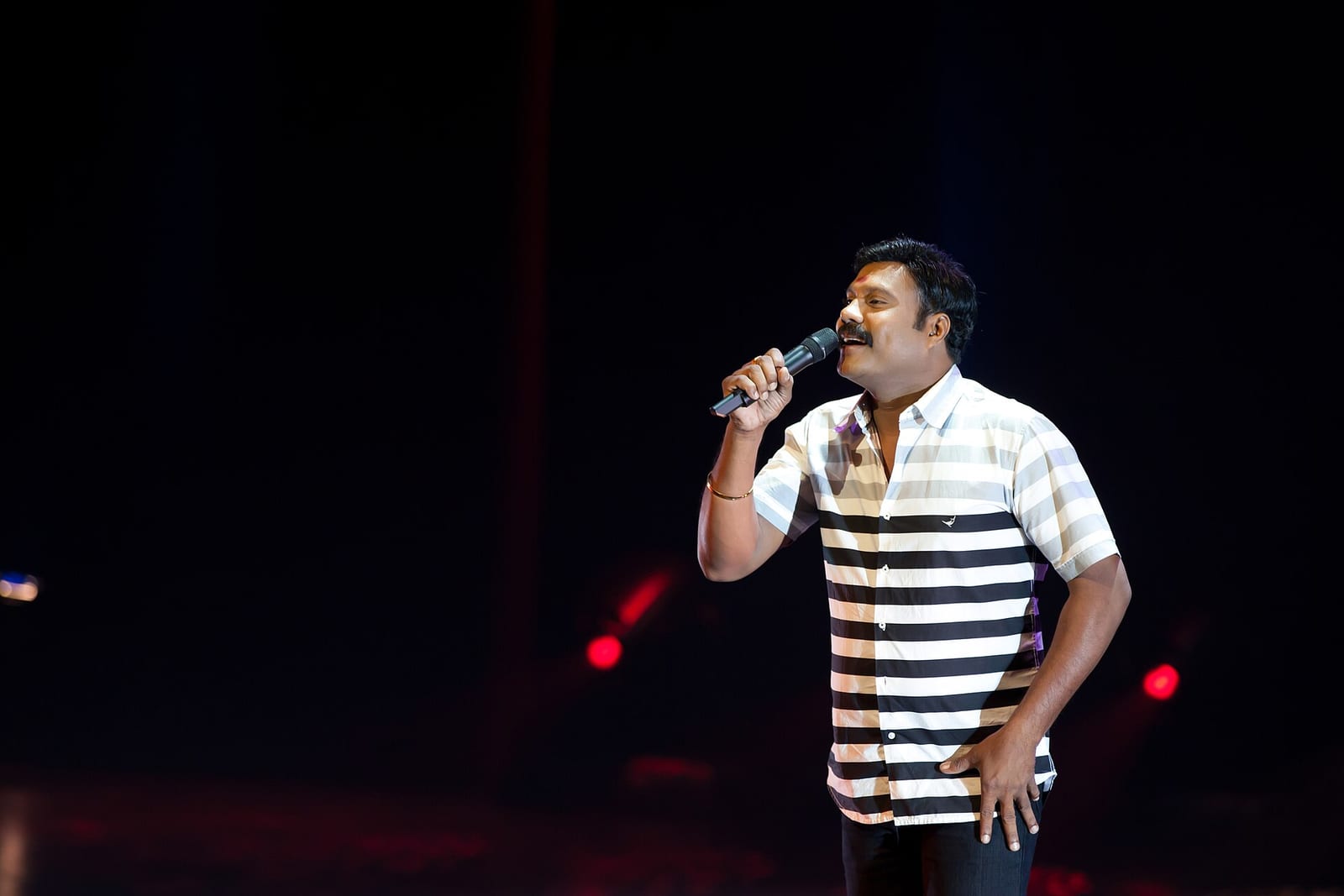
For many Malayalis the voice mattered more than the films. His folk-song albums, released first by Maruthi Audios and Sargam Audios and later by Mani himself, sold more than 5 million copies in Kerala alone, Silverscreen reported in 2016, and were “an instant hit among the working class comprising of autorickshaw drivers and daily-wage earners.” Songs such as Kannimanga Prayathil and Chalakudy Chanthakku Poyappol connected easily with listeners, and at song programmes and other events, ETV Bharat recalls, audiences would not let him leave without singing.
More than 5 million: copies of Mani’s folk albums sold in Kerala alone, according to Silverscreen India (2016).
He sang nadan pattu, Kerala’s folk songs, often to lyrics by his collaborator Arumughan. “This man would go to old folk artistes, learn songs, words and pronunciations from them, and sing their songs in public, making them famous,” Vinayan said. “Who else has done that?” One of the songs he loved most, his brother said, was Umbayi Kuchaandu, “a folk song about hunger and poverty”. Joseph argued that the songs should be heard as poems with a contemporary social background, not merely as folk songs, and Baburaj that they “signify a new collective formation for the community”. His voice could stand in for him: when he could not take a role in the director Blessy’s Kazhcha (2004), he sang the character’s song instead.
i
CC BY-SA 4.0Original on Wikimedia CommonsNot everyone in folk music admired them. The folk singer Jayachandran Kadappanad told Silverscreen that “the lyrics reek of misogyny”, that most “compared women to fruits and other things, ridiculed them, carried sexual innuendos, and glorified drunkards and stalkers”, and that Mani “bought the popular tunes”, including one by C.J. Kuttappan, a singer who led a movement for folk musicians. He also said “the upper class in Kerala wasn’t fond of them”. Vinayan replied by asking whether many songs by the celebrated film lyricist Vayalar Rama Varma were not misogynistic too. “It’s just hypocrisy,” he said.
Chalakudy’s man
Mani stayed in Chalakudy. In 2009, Onmanorama recalled, he gave a bus to the Government Girls High School there; in 2011 he celebrated Onam, Kerala’s harvest festival, with more than 1,000 Adivasi people at Athirappilly, near Chalakudy, with a feast and gifts of clothes. When a newspaper reported in 2011 on the state of the town market, he came home from a shoot in Chennai and cleaned it with his friends.
He was a man of the left, with what Edachira calls a “Marxist background”. In 2010 he asked the Communist Party of India (Marxist), the CPI(M), to give him two seats in the Chalakudy municipal elections, picked the candidates and campaigned door to door for them, his friend and councillor C.S. Suresh told Onmanorama in 2025. Suresh credits him with a club for older residents, an ambulance service and a new anganwadi, a village childcare centre, and with paying for some works himself when the council had no money.
His last years were harder. Silverscreen counted three police complaints against him in three years, the last in April 2013, when police registered a case over an alleged assault on two forest officials near Athirappilly. Silverscreen did not report how those cases ended. Friends told Silverscreen of failing films and of a liver illness that, one said, everyone in the industry knew about.
His death
Mani died on 6 March 2016, aged 45, at the Amrita Institute of Medical Sciences in Kochi, where he had been treated for liver and kidney ailments. Because doctors found methanol in his blood, police registered a case of unnatural death and set up a special investigation team. He was cremated with full state honours at his home in Chalakudy as thousands of mourners gathered.
Forensic reports found methanol and an insecticide in his body, and his family pressed for a fuller inquiry; a year on, the police investigation had found nothing substantial. His wife Nimmi and brother Ramakrishnan petitioned the court for an inquiry by the Central Bureau of Investigation (CBI), India’s federal investigating agency, and in April 2017 the court ordered the CBI to take the case. The First Information Report (FIR), the police complaint that opens a criminal case, which the CBI filed that May, named no one.
In December 2019 the CBI filed a 35-page final report in the Chief Judicial Magistrate’s court in Ernakulam, a district criminal court. It found that Mani died of liver disease worsened by heavy drinking: he had liver cirrhosis, kidney dysfunction, type 2 diabetes and other illnesses. The chemicals found in his body, it concluded, were not present in quantities that could cause death. A medical board linked the methanol to his drinking, since his damaged liver could not clear it, and the CBI said a pesticide residue had come from uncooked vegetables. The report ruled out homicide.
In his own words
Edachira, who has studied his television interviews, says he was careful not to reveal his caste in public; other critics read him differently. In the interviews Silverscreen and others have quoted, he spoke of hunger, of his father’s labour, and of his colour. He “has, in several interviews, lamented that actresses refuse to star alongside him,” Silverscreen reported. Vinayan’s 2018 biopic about him dramatised a story, which Mani told people close to him but which was never officially confirmed, of an actress who turned down a role as his heroine because of his dark complexion.
One account in which he did speak of caste comes through Vinayan. In April 2026 the director recalled a conversation on the set of Karumadikuttan, where Mani, joking but in pain, told him about his school days. These are Mani’s words as Vinayan recalls them, in our translation from Malayalam:
“They say there’s no discrimination in our land now over caste or colour; even the schoolmasters teach that the whole place has changed. But there’s one problem, sir. Back then, when exam results came out in class, my marks were always low. Mostly I got a zero. The master would scold everyone who got no marks. But some of us he wouldn’t scold. He’d mock us instead, mockery that strips the skin off you. When the other children laughed, the master laughed too. The master said schooling was never meant for Pulayans and Parayans. Hearing that, I felt such sorrow. I have felt contempt for this very birth of mine.”
The Pulayas and Parayas are two of Kerala’s Scheduled Castes, the official category for Dalit communities. The schoolmaster’s words used their names as an insult. In the version Vinayan gives, Mani does not say which community was his.
On talk shows, Edachira argues, the industry’s caste habits showed in the questions. She describes the JB Junction episode in which Brittas, showing a clip of Mani’s toddy tapper in Sallapam, asks “This is Mani, isn’t this?”, and Mani agrees. Brittas adds, in her account, that “when we think of Mani, the first thing that comes to our mind is an auto driver’s face.” In that moment, she writes, Mani “was ‘reduced to his immediate identity and nearest possibility’”, borrowing the words of Rohith Vemula, the Dalit research scholar.
How others read him
The sharpest disagreement is over how Mani carried his caste in public. Edachira reads him as careful. Mani, “with a Marxist background, foregrounded the issues of class and not caste in the Kerala public sphere,” she writes. “He was strategic in not revealing his caste identity.” He was accepted as Manichettan, she argues, “mainly because he presented himself in a way that the elite Kerala public wanted a Dalit actor to be.” His laughter may have been the answer: he “actually laughed at the Malayalee narrow mindedness”, or “understood what needs to be spoken to the Malayalee public, and laughed along with them, even on himself.”
Baburaj reads the same career as a refusal. Mani “neither sanskritized his Dalit identity nor neutralized it by showing any liberalistic attitude,” he wrote. “Conversely, he transformed his Dalit identity as a two-way communication channel to reach others and for others to reach him.” Venkiteswaran agrees: “Never flinching away from his caste roots and skin colour, there was a certain audacity and irrepressible energy to his performances that was unparalleled in Malayalam cinema.”
“It created a space for the visualization, sound modulation and movements of an assertive Dalit body for the first time.” — K.K. Baburaj, Dalit writer and activist, on Mani’s 1998 television dance show with the actor Manju Warrier, Round Table India, 2016
The people around him saw the cost. “Mollywood [the Malayalam film industry] is infamous for being casteist,” Vinayan told Silverscreen. “Mani was often subjected to it, and he never considered himself equal to the other stars in the industry. In his head, he was always a lesser being.” A fan, Ajil, who once went with him to a temple stage show, told Silverscreen that there “a group of people humiliated him in public, calling him a DHRM person”. DHRM stands for the Dalit Human Rights Movement. His brother, the dancer R.L.V. Ramakrishnan, put it differently: “He never let himself bogged down by casteist people. He was always respected even inside the industry.”
The Dalit poet S. Joseph, as Baburaj reports, answered critics who said Mani’s subaltern roles showed only victims. “Most of the Malayalam actors including super stars follow some high level acting procedure. But Mani did an open acting which is really contrary to this,” Joseph said. “He performed genuinely when enacting the roles of suppressed subaltern characters.”
After him
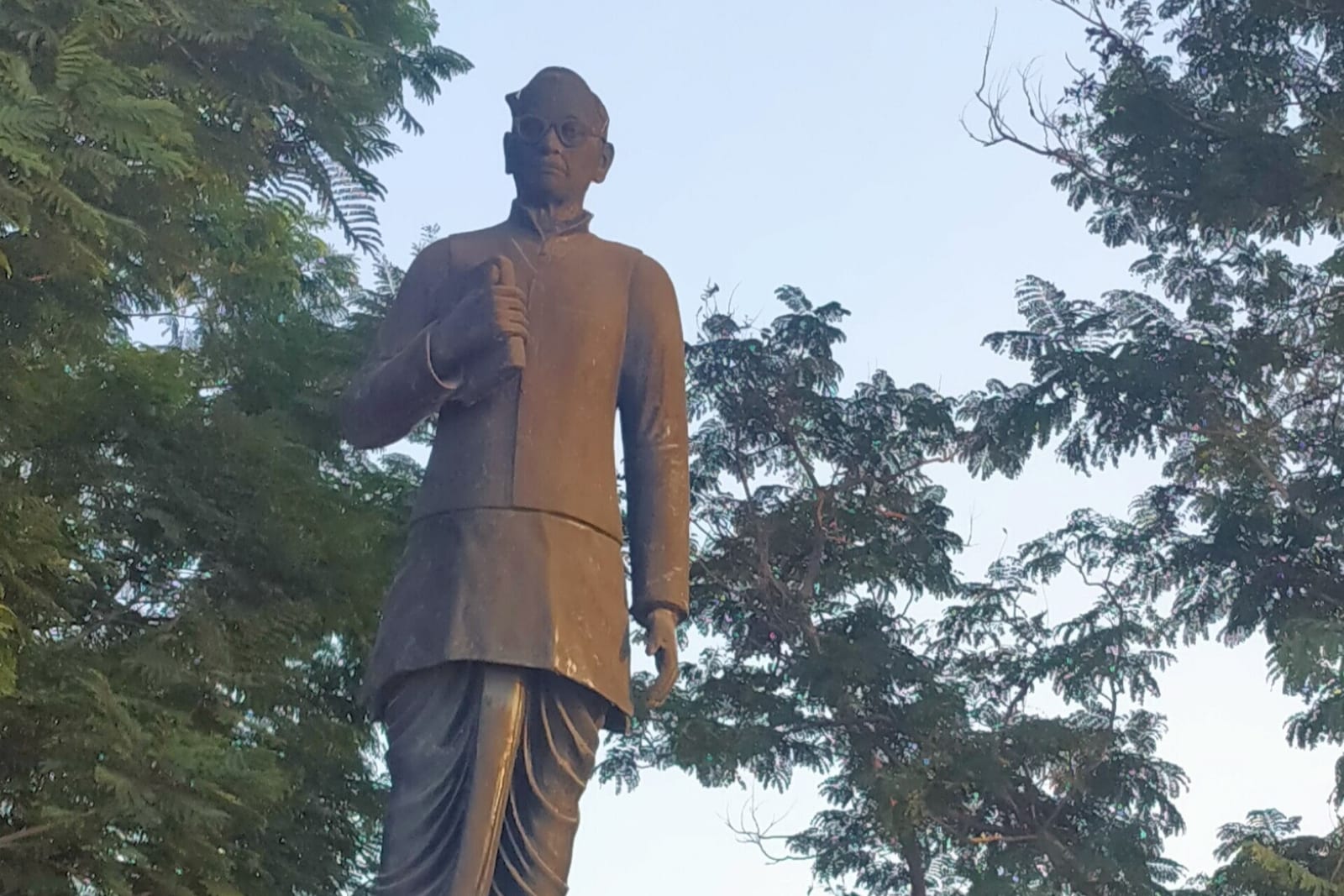
Chalakudy remembers him in public. On his first death anniversary, his friend the artist Da Vinci Suresh dedicated an 8-foot, golden-coloured fibre statue to him in front of the library near his house; the actor Manikandan of Kammatipaadam unveiled it. The municipality’s park bears his name. Vinayan’s 2018 film Chalakkudikkaran Changathi follows him from childhood and, Gulf News reported, “talks about the discrimination he faced in the film industry on account of his colour and caste”. A Kalabhavan Mani Memorial Award committee announced its seventh annual film awards to mark his 55th birthday, 1 January 2026.
The state’s own memorial has not come. The Kerala government set aside Rs 5 million in its 2017 budget and later raised the allocation to Rs 30 million across three budgets, Janam TV reported in 2024, when Ramakrishnan threatened protests over the delay. The culture minister had proposed a centre for folklore study in place of a memorial. By the tenth anniversary Vinayan was still calling the site fallow land. In Thrissur that week a folk arts group renewed its demand for Mani’s portrait to hang in the Kerala Sangeetha Nataka Akademi, the state academy for music and drama, and Biju Attor, state secretary of the Rashtriya Janata Dal’s cell for Scheduled Castes and Scheduled Tribes, accused the culture department and the Akademi’s office-holders of following “a policy of untouchability” towards Mani (our translation).
The songs have travelled further than the memorial. Vedan, the Thrissur rapper whose 2020 track Voice of the Voiceless made him, as one profile put it, a musician lauded “for bringing the reality of caste into discussion, coming out as Dalit”, names Mani among the artists who inspired him when he began writing music. “When I began writing music, I got inspired by artists like Arivu [the Tamil rapper], Tamil songs in general, and also Malayalam folk songs,” he told Rolling Stone India in 2025. “I was especially used to being moved and inspired by the performances of Manichettan.” He hums Mani’s songs on stage, the scholars Jaya Thampi and Arjun Ramachandran write, and “expresses his indebtedness to him”. They recall the critic Johny ML’s name for Mani: “the first rockstar of Kerala”.
In 2016, Ramakrishnan told Silverscreen what his brother used to say. “Mani chettan would always say that he would be celebrated after his death,” he said. “It is happening now.” The women at the ghat laughed at the black Yesudas. Ten years after his death, Kerala is still singing his songs.