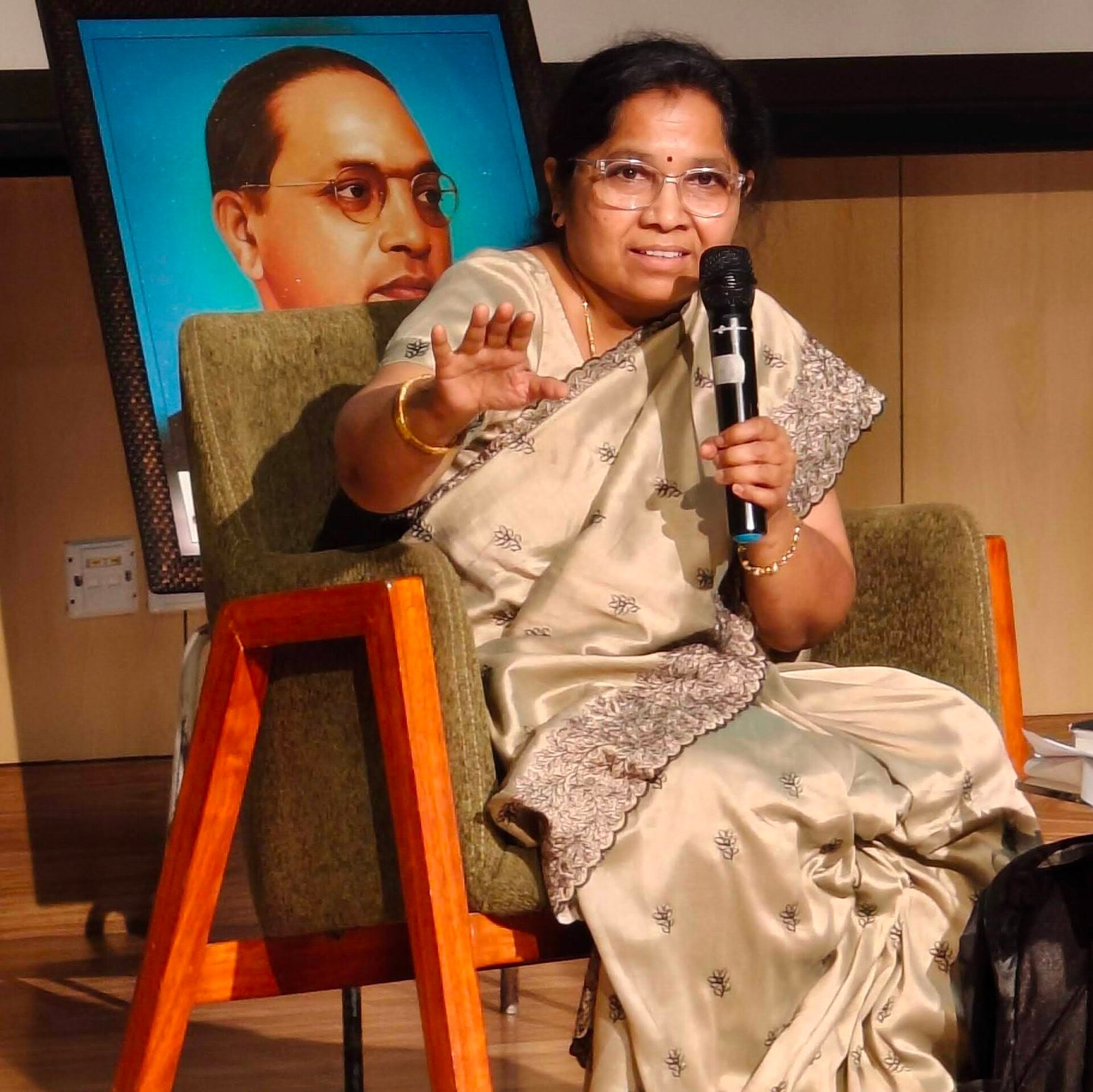
On 14 April 2026, the birth anniversary of B.R. Ambedkar, Gogu Shyamala sat in a low armchair at Azim Premji University in Bengaluru, a microphone in one hand and the other raised mid-sentence. A portrait of Ambedkar, the Dalit jurist who led the drafting of India’s Constitution, hung behind her. Dalits are the communities once branded “untouchable” under South Asia’s caste order. She was there for the university’s Phule-Ambedkar Memorial Week, named for Ambedkar and Jyotirao Phule, a 19th-century anti-caste reformer.
She has spent most of her working life making sure that a particular set of voices reaches rooms like that one. “My words, my expressions are not my own—they come from other women, women without an education,” she told the writer Sampurna Chattarji in a 2023 interview for National Herald. “But they can talk! We are losing the women’s voices—I am writing them down.”
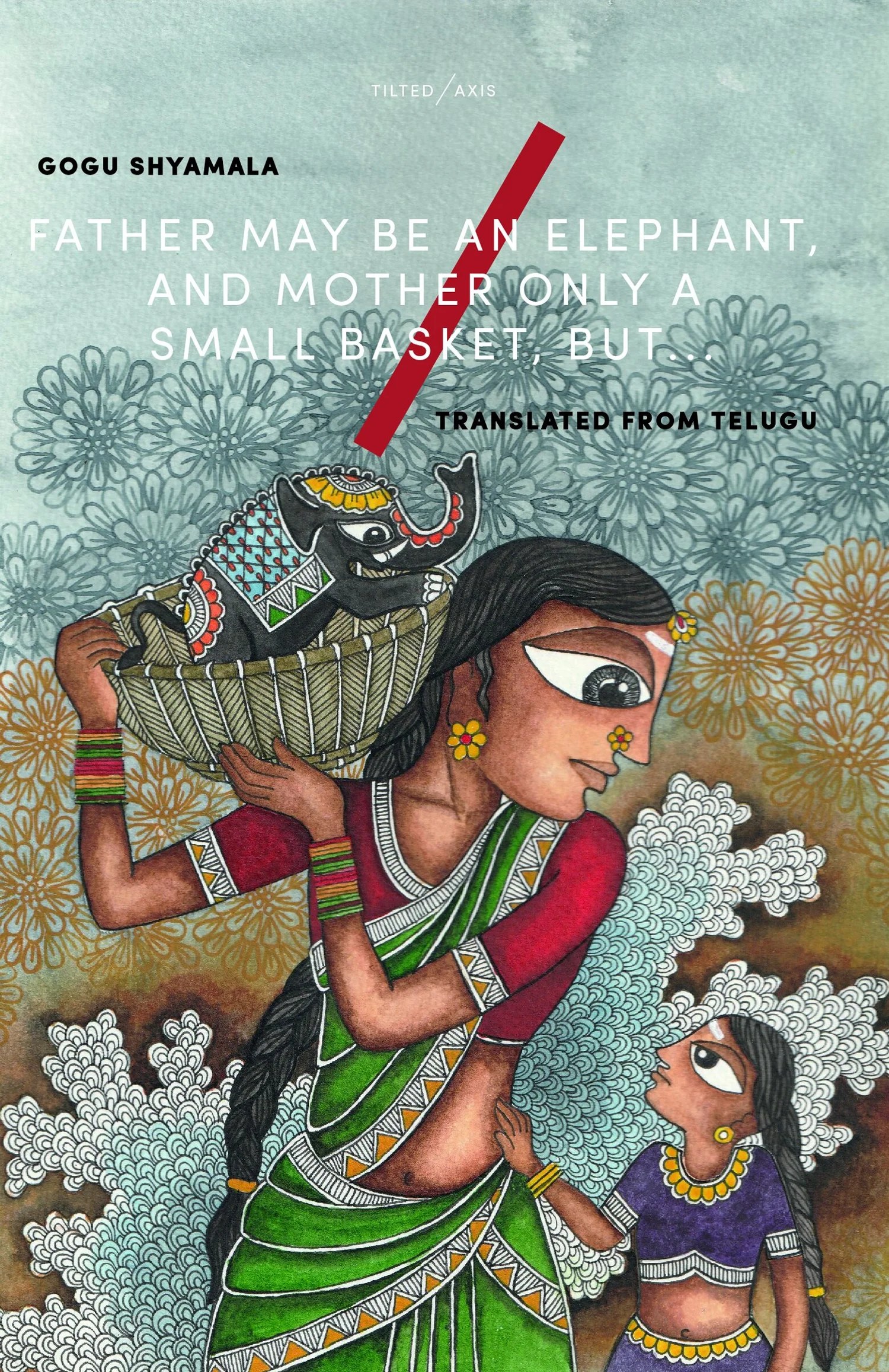
Shyamala, born in 1969 in Peddemul village, writes fiction in Telugu, the language of the southern Indian states of Telangana and Andhra Pradesh. Her publisher, Tilted Axis Press, calls her “a philosopher, poet and prolific story writer”. She grew up among the Madiga, a Dalit community of Telangana, and her stories, Navayana notes, are “set in the madiga quarter of a Telangana village”, among its fields, drums and goddesses. Her first collection, Father May Be an Elephant and Mother Only a Small Basket, But…, is, in Tilted Axis’s words, “hailed as a landmark in Telangana Dalit literature”.
She is also an archivist. At Anveshi Research Centre for Women’s Studies in Hyderabad, Telangana’s capital, she edited a pioneering anthology of Dalit women’s writing in Telugu and wrote the life of a Dalit woman legislator. Her newest story has taken her somewhere else again. “The Phantom Ladder”, a novelette translated by Divya Kalavala, appears in The Blaft Book of Anti-Caste SF, an anthology of speculative fiction. In May 2026 the CADALFEST series, run by the Dalit Adivasi Text project, billed an online conversation with her on why speculative fiction suits writing about caste. Adivasis are India’s Indigenous peoples.
Across all of it, she has made one argument. The Madiga village is a place of knowledge, labour, language and art, and its women are its thinkers, not only its victims.
“A Madiga area to the east of the village”
Shyamala’s parents were agricultural labourers. “I never realized that there was any discrimination as a kid. It was after growing up that I discovered it,” she told Nitin B. of The News Minute in 2016. “We had a Madiga area to the east of the village where we all lived, away from the upper castes.”
She was the only one of three siblings to get a higher education. In the acknowledgements to her collection, quoted by The News Minute, she set down what the village’s powerful men said to her parents: “‘If you get your children educated, who will slog for free in our fields?’ Under such pressure from the karnam, reddy and other dora of the village, my eldest brother Ramachandrappa was forced into agricultural labour.” The News Minute glosses the terms: the karnam kept the land records, the reddy is a landowning farming caste, and the dora is the most powerful landlord in the village.
Her parents kept her in school. “The politics started when my dad put me in a social welfare hostel (Tandur) to continue my schooling,” she said. Tandur is a town in western Telangana. In the hostel she was a student leader, protesting “for clean food and hostel facilities”. After Class 12, the last year of secondary school, money stopped her from going straight to college. She later earned a sociology degree from B.R. Ambedkar Open University.
Around then she joined the Communist Party of India (Marxist-Leninist), one of the parties of India’s revolutionary left. “It was a good change because I was no longer a Dalit. I was a comrade. We were all equal,” she told The News Minute. “But over time, I realized that the caste element still crept in.” Children of dominant-caste families, she said, could pull strings with the police if they were arrested. “We on the other hand, were helpless.”
The break came in 1991. On 6 August that year, The News Minute reports, attackers from dominant castes killed eight Dalits in Tsundur, a village in Guntur district of Andhra Pradesh; Erica X Eisen’s review gives the same toll. “When the massacre happened, I was shocked,” she said. “I saw all the authorities trying to spin the story and say that there were other elements that prompted the killing, while it was clearly caste-based.” She turned to Ambedkar. “I slowly began to read Ambedkar and understood how deep-rooted caste was in Indian society. That’s also when I understood that communism may have removed religion, but the caste divide still existed.”
“This is not a language”
The Telugu she writes is the speech of Dalits around Tandur, in western Telangana. She did not think of herself as a writer, she has said, until the need to record that speech made her one.
“Andhra newspapers never accepted my stories, saying, ‘This is not a language, this is not a story,’” she told National Herald. “Those who wanted to publish wrote in the ‘paper dialect’ (a Sanskritised Telugu). I didn’t want to do that!” Other Dalit women writers met the same wall, she said, “due to the regional, caste-dominant ownership of newspaper publications”. After Telangana became a state of its own, she added, “even Andhra papers are publishing our dialect.”
What she wanted to keep was a language made by work. In the same interview she put it at length:
“When villagers speak to each other, the language is so beautiful because it comes from labour and agricultural production. When they talk to the landowner/landlord, the language is so powerful because it expresses their pain, suppression and vulnerability. It even includes swear words that express anger against the masters, while challenging their power. I wanted to write this down in their own words. I could because I have the alphabet. I didn’t think of myself as a writer. But this [need] made me one.”
The English edition of her stories came first. Navayana, an anti-caste publisher in New Delhi, brought out Father May Be an Elephant in 2012. The critic Erica X Eisen, in a review reprinted by Portside, notes that this happened “before it had even found a Telugu publisher”. The Telugu edition followed from Hyderabad Book Trust in 2013, Anveshi’s list of her work shows. Tilted Axis Press, an independent publisher, brought out its edition on 31 March 2022, crediting nine translators.
The translators chose a formal English, Eisen reports from their note, to grant “the Tandur variant [of Telugu] the status and dignity of a full-fledged language”. Shyamala sees the translation as a pull in her direction. “My language is not strange—it is unique,” she said. “It is an attempt to draw English towards my Telugu.”
She fears for that language. “Industrialisation, urbanisation and Hinduisation are the reasons our language is endangered,” she said. “Words and metaphors are becoming extinct—it causes a lot of pain.”
The village as literature
Her stories, she has said, come from life. “My book is entirely based on my experiences - things that I have seen, heard or felt,” she told The News Minute. She wrote them, she told National Herald, “in my mid-thirties and forties”, against a literary market that wanted one thing. “When I read contemporary writing, it was rare to find those memories, that flavour. Because only pieces about suffering were accepted.”
She describes her aim as a refusal of two stock figures. “There are two types of Dalit narratives that you will read and hear about. Either the person is a hero who fought all odds, or a victim,” she said in 2016. “With my writing, I try to present them as normal people like everyone else, to try and battle the mainstream stereotype.”
“Ellamma Is Distressed”, one of the collection’s twelve stories, translated by P. Pavana and published by Words Without Borders in 2022, shows how this works on the page. Ellamma is a Madiga woman who raised thirteen children and bought twenty acres “while working as a wage laborer on reddy fields”. A dominant-caste boy calls her by the diminutive “Elli”, and his mother asks whether he took the grain “without touching the old bitch”. Then land buyers arrive on motorbikes from Guntur and Vijayawada, in Andhra Pradesh, and call her “Ellamma-garu”, with the respectful suffix the village’s dominant castes have never used for her. They want her fields. She sends them away:
“If I sell my lands, my children will become wage laborers in our own fields. Is that a good thing? Tell me, what do you think? You are like Yama and his messengers, chasing after me and asking me to sell the land, sell the land… Get out of my house, get going!”
— Ellamma, in “Ellamma Is Distressed”, translated by P. Pavana
The insult and the pressure to sell are both in the story, and neither is its centre. The centre is Ellamma’s authority: in the story, the village believes her hands, feet and words carry good fortune, and families call her when a girl comes of age or marries.
Other stories confront the jogini system, under which a Dalit girl is dedicated to a village goddess and made sexually available to dominant-caste men. In “Raw Wound”, Asymptote’s reviewer writes, a father sends his daughter to the hostel in Tandur to save her from being made a jogini, and the patel, a man of a dominant caste, beats him for it. In “But Why Shouldn’t a Baindla Woman Ask for Her Land?”, a jogini named Saayamma refuses to perform at the goddess’s festival until the land owed to her is returned, and pounds the landlord’s table with her fist. In “Braveheart Badeyya”, a mother whose feet are pierced by thorns says, in the translation Asymptote quotes: “I am born in the caste that makes slippers for everybody, but my own feet are left bare.”
Shyamala’s account of what that labour means goes further than grievance. “Dalits are at the centre of the village in terms of agricultural production—they cultivate foodgrains,” she told National Herald. “Dalits are connected to every artisanal activity—they are blacksmiths, goldsmiths, carpenters, weavers… But they are not recognised.” The exclusion, she said, runs deeper than touch:
“They are untouchables to the title. Dalits are untouchables to the land, untouchable to a dignified identity. The caste system never grants that identity. [But] I never found that part in the definition of untouchability.”
When Chattarji said she sensed no anger in the work, rather “a kind of ‘joyful pragmatism’”, Shyamala answered: “Joyful pragmatism means dignity of labour.”
The archivist
Her fiction grew alongside the record-keeping. Anveshi, a feminist research centre in Hyderabad, describes its Dalit studies work as a response to caste violence and the anti-reservation protests of 1990-91, when it became “one of the first women’s organizations to engage with the question of caste”. Shyamala became a senior fellow there, Navayana notes, and a member of its executive committee. In 2001 she represented Anveshi and the Dalit Women’s Forum at the World Conference against Racism in Durban, Anveshi records.
Her first major book was an anthology. Nallapoddu: Dalitha Sthreela Sahithyam 1921–2002, published by Hyderabad Book Trust in 2003, means Black Dawn: Dalit Women’s Writing. Anveshi calls it “a pioneering anthology of hitherto unknown Dalit women’s writings”. It gathered 52 writers, by Anveshi’s count. The publication, the centre says, “created a space for Dalit women and men to pursue endeavours that do not generally find any support in other institutional spaces.”
52 writers: the Dalit women gathered in Nallapoddu (2003), the anthology of Dalit women’s writing in Telugu from 1921 to 2002 that Gogu Shyamala edited, by the count of Anveshi Research Centre for Women’s Studies. Priyanka Kotamraju counts 53.
The writer Priyanka Kotamraju, writing in 2025 for Black Women Radicals, a Black feminist platform, put the book in the line of Dalit feminist organising in Telugu that followed the massacres of Dalits at Karamchedu in 1985 and Tsundur in 1991. “Nallapoddu created a storm in Telugu and anti-caste literature,” she wrote; it went about “excavating, retrieving and restoring nearly forgotten and unacknowledged Dalit women’s writings.”
Three years later Shyamala co-edited Nallaregatisallu, short stories by women of the Madiga community and its sub-castes, translated as Furrows in Black Soil. In 2011 came Nene Balaanni (“I am the force”), her biography of T.N. Sadalakshmi, whom Anveshi describes as the first Dalit woman legislator in Hyderabad. The research, Anveshi says, “raised tough issues about Dalit women’s representation”: Sadalakshmi “saw herself as a leader of everyone, not of Dalits alone”, yet “did everything in her power to secure the interests of the Dalits”. In April 2021 Hyderabad Book Trust presented it in a set of Dalit Bahujan women’s biographies for Dalit History Month.
With Purushotham, Gita Ramaswamy and Mini Krishnan, the names Oxford University Press lists, she co-edited The Oxford India Anthology of Telugu Dalit Writing, which presents the work of “nearly eighty Telugu Dalit writers and public intellectuals”. Its table of contents opens with the Jambavapuranam, an anonymous song. She wrote children’s stories, among them “Braveheart Badeyya”, for an Anveshi series whose Telugu books, the centre says, the Andhra Pradesh government recommended as additional reading for its secondary and high schools. She co-wrote the script for Merit Interrupted, a documentary about Dalit students in social welfare hostels. In 2012-13, with Sujatha Devarapalli and B. Sattemma, she worked on a study of Dalit women and domestic violence, an Oxfam-funded project she led, that sought, in Anveshi’s words, “a Dalit women’s perspective on domestic violence”.
Palm leaves and a phantom ladder
Her recent research goes back to an older archive. “In my village, brahmans [Brahmins, the priestly caste] don’t have palm leaf manuscripts, but Dalits do,” she told National Herald. “So many community singers and storytellers with so much knowledge are never identified as artists, because they are Dalits. That’s why I write stories about them, their instruments, their history preserved on palm leaf scripts.”
From October 2020 to June 2021 she was a fellow at the Institute for Advanced Study in Nantes, France, listed under the name Shyamalamma Gogu. Her project studied the Jambava Puranam, recited by the Dakkali community, which the institute’s page describes as “a kin community” of other Dalit and artisan communities in Telangana. The page says the Puranam is “preserved in palm leaf manuscripts and scroll paintings” and contains “an interesting alternative history from below” of the origins of social classes. The same page records her PhD thesis at the English and Foreign Languages University in Hyderabad, which it dates to 2019, on “Reading Caste Histories through Biographies: A Case Study of the Dalit Women of Telangana”.
“The Phantom Ladder” is the newest turn. The CADALFEST programme for her May 2026 talk describes caste as an ideology “akin to a vertical ladder”, and says she would discuss how speculative fiction “is well suited to explore all these caste contradictions”. Reviewers read her story as open political allegory. Ananya Singh, in Cha: An Asian Literary Journal, wrote that it and another story “interrogate the theological and ideological contortions by which caste is rationalised”. In SFRA Review, Paromita Sarkar argued that including writers like Bama, the Tamil writer whom Blaft calls a “Dalit feminist icon”, and Shyamala points to a speculative imagination already present in Dalit writing, “though they are rarely read as SF writers in India”.
How others read her
The Telugu critic K. Sridevi, a professor at Dravidian University in Kuppam, Andhra Pradesh, wrote in the Telugu magazine Neccheli in 2021 that Shyamala widened Dalit feminist writing by portraying the working lives and courage of women from the Madiga “ashrita” castes. These are the dependent castes, such as the Dakkali and Baindla, that traditionally lived on Madiga patronage. “In none of Shyamala’s stories do the women of the Madiga ashrita castes appear as figures who helplessly endured oppression and fell victim to it,” Sridevi wrote (our translation). “At a time when the cultural values of the castes at the top, the dominant castes, pass as the standard values, it is no ordinary thing to set the cultural and linguistic beauty of the ashrita castes beside them as an alternative” (our translation).
The scholar Susie Tharu, Eisen reports, has called Shyamala an author less of “short stories” than of “little stories”, a nod both to Telugu’s “little magazines” and to work that pushes against the mainstream. In The Guardian, as Tilted Axis quotes her, Claire Kohda wrote that the stories “do not reduce Dalits to their experiences of tragedy and injustice – they show us a world and a people in all their fullness.”
Darla Venkateswara Rao, a Madiga critic and then an assistant professor of Telugu at the University of Hyderabad, included Shyamala in his account of Madiga writing, a tradition in which he places his own poem “Madiga Manifesto”. In an essay posted on his blog in January 2009, he wrote that stories about Madigas by non-Madiga writers were “shaped out of sympathy” and showed little of “the struggle of Madiga life”; he named Shyamala among the Madiga writers in whose stories “Madiga culture and self-respect found expression” (our translation). Of her poetry and that of the writers Joopaka Subhadra and Jajula Gowri, he wrote that “the Telangana idiom and the feelings of the Madiga sub-castes are finely portrayed” (our translation).
The tensions
Not every reader accepts the translation’s choices. Eisen found that the formal English, meant to dignify the dialect, can “pull the reader out of the stories’ realism”, and that some endings feel “abrupt” or “pat”. The objection meets Shyamala’s own account head-on: for her, a translation that does not sound like everyday English is the point, an effort to “draw English towards my Telugu”.
Her politics have their own edges. She left the revolutionary left over caste, but her account of caste still begins with labour and land. “Always thinking about victimisation and reservation is mismatched thinking,” she told National Herald. Reservation is India’s system of quotas for Scheduled Castes and other groups in education, jobs and legislatures. In 2016 she made clear what reservation still does: “Even today, if you see any Dalit parliamentarians, it is only because of reservation.”
She also refuses to romanticise the village she writes. She names what the caste system imposes there: “imposed identities—scavenging and sex slavery (jogini, murali, basavi systems) in the villages.” And the village is changing under her. “Villages have changed now, being replaced by real estate businesses and liquor shops,” she told National Herald. “Farmers now look at land not in terms of farming but as real estate that can be sold for money.” Ellamma’s fight to keep her fields was fiction; the pressure behind it is the one Shyamala describes in her own voice.
Barefoot in the field
In the same interview she gave an example of the language she is trying to save: paska tokkudu tokkocchindi, walking on wild green grass as opposed to concrete roads. “It’s a habit, a philosophy of life that I attempt to bring into my writing,” she said.
Then she described where it came from. “When I used to go to the fields with my father and my mother, they would suggest I remove my chappals and walk barefoot, aware that there won’t be any sharp objects, because it’s a farmer’s field, well maintained by grazing animals, safe for children. In my village, if there are any thorns on the road, people remove them—that’s the culture, you do it without any instruction.”
The liquor shops, she said, have changed that too: “so now you’ll find that broken glass in the grass!” Her writing goes on clearing the path.