Listen to this article
Read by an AI-generated voice · Report a mispronunciation
On 12 November, at a press conference in Lucknow, the capital of the northern state of Uttar Pradesh, Asaduddin Owaisi named Chandrashekhar Azad as the chief ministerial candidate of a new alliance. Azad’s Azad Samaj Party (Kanshi Ram), named for the founder of the Bahujan Samaj Party, and Owaisi’s All India Majlis-e-Ittehadul Muslimeen (AIMIM) will fight the 2027 state election together as the Samajik Parivartan Morcha, the “front for social change”, in all 403 seats of the assembly of India’s most populous state. How many seats each party will contest, Dalit Dastak reported, will be decided later.
Azad is a Dalit, from the communities once branded “untouchable”, and the Member of Parliament for Nagina in western Uttar Pradesh. The Bahujan Samaj Party (BSP) of Mayawati, a four-time chief minister, was, in Outlook’s words, “once the principal political vehicle of Dalit assertion in Uttar Pradesh”. The new front is a bid for the space the BSP’s decline has left: a Dalit leader at the head of a coalition, asking a party with a Muslim base to back him for the state’s top job. It does not settle who leads Dalit politics in Uttar Pradesh. That will be decided by the BSP’s remaining voters, above all the Jatavs, the Dalit community that has been the core of its vote, and by whether they believe Azad can win.
What happened
Owaisi, AIMIM’s president, announced that Azad would be the chief president of the front and its chief ministerial candidate. “I can say with confidence that this will be a strong alternative in Uttar Pradesh to stop the BJP from coming to power for the third time,” he said. The Bharatiya Janata Party (BJP), whose Yogi Adityanath is the state’s chief minister, is seeking a third consecutive term. The BJP, Outlook notes, has traditionally relied on voters from the dominant castes, Other Backward Classes (OBCs) other than the Yadavs, a large OBC community and the SP’s core base, and sections of non-Jatav Dalits. Owaisi said the front would take up the state of education, unemployment among the young and farmers’ problems, and that Dalit and other marginalised communities had so far been used “merely as vote banks”, in Siasat’s paraphrase. Azad, Open reports, put caste violence, reservation (India’s quotas for Scheduled Castes and other groups in education, jobs and legislatures) and access to basic services at the centre of his own pitch, arguing that successive governments had failed to deliver for marginalised communities.
Azad invited the Samajwadi Party (SP) and the Congress, the two main opposition parties in the state, to join: “We invite the Samajwadi Party and Congress to come together and contest the elections with us.” The front announced a rally in Lucknow on 26 November. ThePrint reported that smaller parties, including the Apni Janata Party led by Swami Prasad Maurya, were in touch with the two leaders.
Azad also rejected the label of a third front. “This is not a ‘Third Front’, but a front for social change,” he said, according to Business Today, which carried the remarks with inputs from the news agency ANI.
“This is not a ‘Third Front’, but a front for social change. It is strong, and it will grow even stronger. As more people from the marginalised, deprived, oppressed, exploited and downtrodden sections join, this front will become an even more formidable force for those who are oppressed, helpless, and exploited.” — Chandrashekhar Azad, Lucknow, 12 November 2026, as reported by Business Today
The opening: the BSP’s fall
The front’s arithmetic starts with the BSP. Under Mayawati the party built a durable Dalit base, particularly among Jatavs, and in 2007 won 206 of the 403 assembly seats with 30.43% of the vote, Outlook records. Its share then fell at every assembly election: 25.91% in 2012, 22.23% in 2017 and 12.88% in 2022, when it won a single seat. In the 2024 election to the Lok Sabha, Parliament’s lower house, it won none of the 79 seats it contested in the state.
12.88%: the BSP’s share of the vote in Uttar Pradesh’s 2022 assembly election, down from 30.43% when it won the state in 2007. Source: Outlook.
Even that low share is a large vote. Outlook counts nearly 11.9 million votes for the BSP in 2022 and about 8.25 million in 2024: the residual support Azad’s party would need to win over to establish itself as the BSP’s successor.
Azad’s claim to it rests on one seat. In 2024 he won Nagina, a seat reserved for candidates from the Scheduled Castes, the constitutional list of Dalit communities, with 512,552 votes, beating the BJP’s Om Kumar by 151,473, Open reports. The SP came third. The BSP, which had won Nagina in 2019, came fourth with 13,272 votes. Azad, a Jatav, first came to wide notice leading the Bhim Army, an organisation formed as a platform for Dalit empowerment, during the caste violence in Saharanpur, in western Uttar Pradesh, in 2017, and was booked by the state police under the National Security Act, a preventive-detention law, and later released on bail. His party, ThePrint reports, now has units in all 75 districts of the state and offices in more than 30, most of them rented.
The analysts ThePrint spoke to read the front as a bigger threat to the BSP than to the SP. “Even at its weakest, the BSP has a stronger organisational cadre than the ASP,” said Kaviraj, a professor of political science at Lucknow University. “Mayawati has been a four-time chief minister. However, if this alliance manages to dent even 5,000 Jatav votes in western Uttar Pradesh, it could hurt the BSP more than SP.” Shilp Shikha Singh, a political analyst in the state, said the BSP “remains caught up in its internal issues”, including Mayawati’s repeated removal and reinstatement of her nephew Akash Anand.
Mayawati has answered Azad directly only recently. In September, ThePrint reports, she alleged that he had no independent base, that the BJP had helped him win Nagina, including by tampering with voting machines there, and that he worked at the BJP’s behest. ThePrint’s report carries no reply from Azad to those charges. He has mostly avoided attacking her by name and calls her “Behen ji”, or sister.
Why the arithmetic is not a vote
i
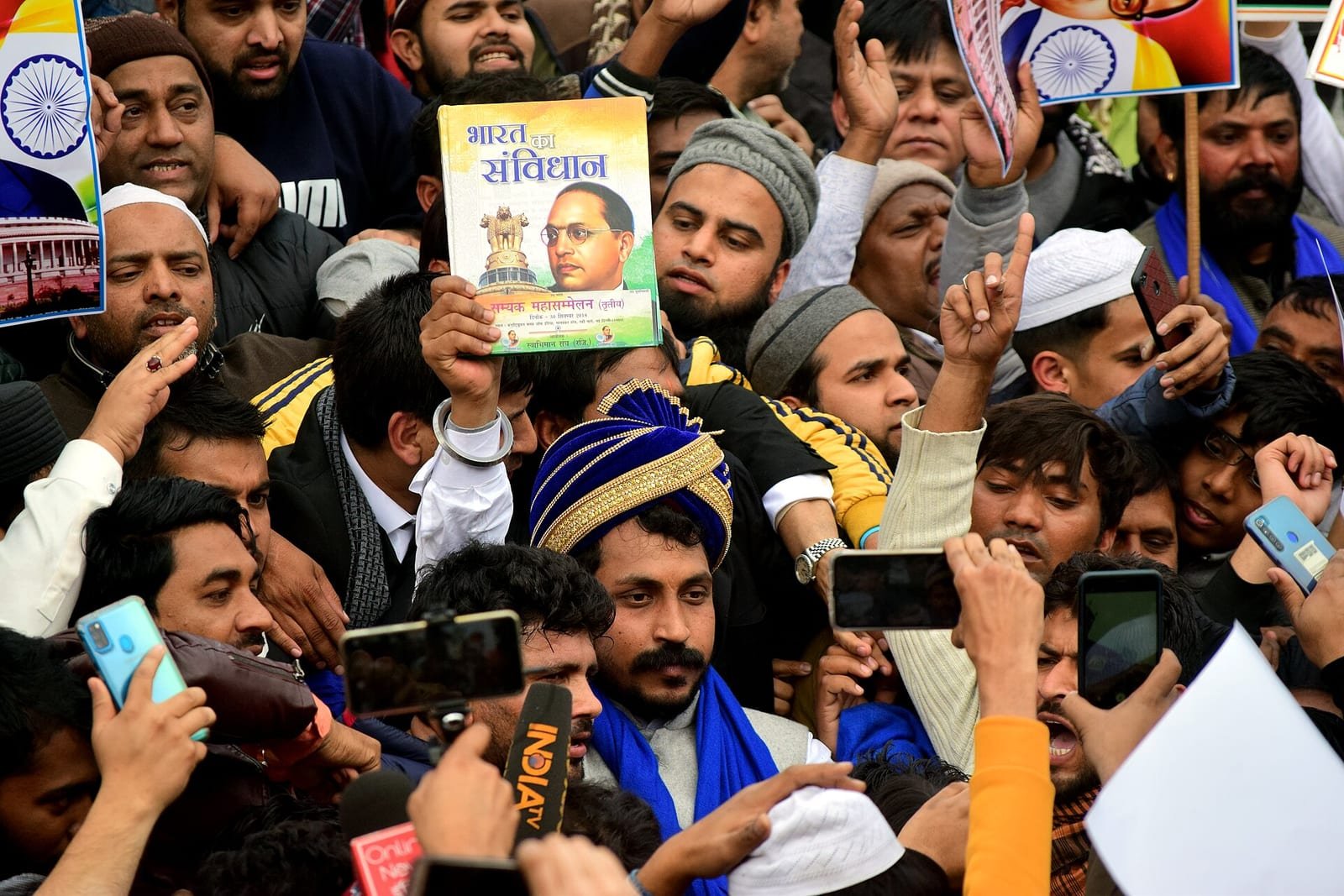
CC BY-SA 4.0Original on Wikimedia CommonsThe front’s pitch is a sum. According to 2011 Census figures reported by Outlook, Scheduled Castes are about 20.7% of Uttar Pradesh’s population and Muslims 19.3%: together close to 40%.
Neither partner has turned its share of that sum into seats. In the 2022 assembly election AIMIM contested 95 seats, polled 450,929 votes, or 0.49%, and won none; all 95 of its candidates lost their deposits, the sum a candidate forfeits on polling too few votes. Azad’s party contested the same election and also won nothing, and all its candidates lost their deposits. Azad himself stood against Adityanath for the Gorakhpur Sadar assembly seat, in the east of the state, and won 7,640 votes. In the 2025 election in neighbouring Bihar the two parties’ returns were uneven: AIMIM won five seats, and Azad’s party lost all 18 it contested, the Free Press Journal reports.
Nor do Dalits or Muslims vote as blocs. In the 2024 Lok Sabha election, the post-poll survey by Lokniti-CSDS, a research programme, cited by Outlook found that 92% of Muslim voters in the state backed the INDIA alliance of the SP and the Congress, as did 56% of non-Jatav Dalit voters and 25% of Jatav voters. Muslim voters, Outlook notes, have often backed whichever party looks best placed to defeat the BJP.
That is the front’s hardest test. It is competing for Dalit voters with three established parties at once. The SP called a Dalit conference in the western city of Agra for 15 November, Live Hindustan reported ahead of it, to bring Dalits into its PDA coalition of OBCs, Dalits and minorities. The same report said the BSP’s national coordinator, Akash Anand, would address a rally at Etmadpur, near Agra, on 22 November. The BJP, the Free Press Journal reports, is courting Dalits through a scheme to develop sites with statues of B.R. Ambedkar, the Dalit leader who chaired the drafting of India’s Constitution, and Mayawati has revived the BSP’s bhaichara (brotherhood) committees to rebuild ties between Dalits and Muslims.
The counter-reading: a vote-splitter
The strongest case against the front is that it will split the vote against the BJP. ThePrint lists 2022 seats where the SP lost by less than AIMIM polled: in the Kursi seat the SP lost by 217 votes while AIMIM took 8,541; in Ramnagar, in Barabanki district, by 261 votes against AIMIM’s 4,940. An SP spokesperson alleged that Owaisi had an understanding with the BJP. Azad rejected the “B team” charge, and Owaisi said the alliance aimed to prevent a third consecutive BJP term, the Free Press Journal reports. Aseem Waqar, once with AIMIM and now in the Congress, alleged that the front had the BJP’s tacit backing and promised “more major revelations”, ThePrint reports.
The charge falls short on its own evidence. ThePrint itself cautions that it is wrong to assume AIMIM’s votes would all have gone to the SP had it not stood. Open makes the same point about other close seats and adds that the effect cuts both ways: where Azad’s candidate becomes the strongest challenger, as he did in Nagina, the BJP faces a harder race and the SP can be pushed into third. Writing in Countercurrents, Mohd Ziyaullah Khan notes that calling the front BJP-backed “would require evidence”, and that the announcement and the reporting so far “do not establish such a claim”. He also makes the point the charge leaves out: established opposition parties “cannot claim exclusive ownership of the votes of Muslims, Dalits or any other community”.
The vote-splitter charge assumes that Dalit and Muslim voters belong to the SP or the BSP by default and that any party of their own is a spoiler. That is the assumption the front is contesting. Whether its contest helps the BJP in close seats is a fair question; it is a question about where the front stands candidates, not about whether Dalits may lead a party.
What to watch
The first test is the candidate list: who stands where, and whether the front puts its strongest people in the five assembly segments that make up the Nagina Lok Sabha seat (Najibabad, Nagina, Dhampur, Nehtaur and Noorpur), where Open suggests it has reason to start, and in the close seats of western Uttar Pradesh. In the Baghpat assembly seat in western Uttar Pradesh, Dainik Jagran reports, Muslims are about 32% of voters and Dalits about 17%. The second is the rally of 26 November, and whether the SP and the Congress answer Azad’s invitation. Kaviraj told ThePrint that naming a chief ministerial candidate before building a cadre across the state was premature.
The last test is the one the press conference cannot settle. The BSP’s 12.88% in 2022 was still nearly 11.9 million votes. If enough of them, and the Jatav votes within them, move to a Dalit leader who can win a seat like Nagina, the question of who leads Dalit politics in Uttar Pradesh will have a new answer. If they stay, or go to whoever looks likeliest to beat the BJP, the front will be one more claimant to voters who have not yet chosen it.