Listen to this article
Read by an AI-generated voice · Report a mispronunciation
“We are happy that electricity is finally reaching our homes, but we cannot celebrate fully when many families are still waiting even for pattas,” M Mullaikodi, a resident, told The New Indian Express in July. Hers was one of five families in Theerthakadu, a Dalit settlement in Madurai, marked for the first electricity connections there in more than 40 years (The New Indian Express, 4 July 2026). All five were among the few families that held a patta, the revenue record that names the holder of a plot.
Theerthakadu lies near Vandiyur, a locality within the limits of the Madurai City Corporation, in the southern state of Tamil Nadu. Its people are Dalits, the communities once branded “untouchable” and listed in law as Scheduled Castes. In February the paper counted nearly 360 families and 1,200 residents living without electricity, drinking water, roads, drainage or sanitation (The New Indian Express, 13 February 2026). By October, pattas had been issued to 68 families and 340 were still waiting, three months after the National Commission for Scheduled Castes (NCSC) wrote to the district a second time (The New Indian Express, 7 October 2026). The counts differ by source: the February figures are the paper’s; the October ones, 408 families in all, come from an official of the Adi Dravidar Welfare Department (Adi Dravidar is the name Tamil Nadu’s government uses for its Dalit communities); and a leader of the residents’ association put the population at more than 600 (7 October 2026).
The order in which the light arrived shows how the state decides who it serves. Power, water, roads and drains all wait on the land title, so a settlement without pattas stays, for the state, unrecognised. A national commission can say that a right has been denied, but the Supreme Court made clear in July that it cannot order the remedy.
What happened
Residents trace the settlement to a grant of land. One of them, Thangapandiyan, told the news agency ANI in March that in 1979, under the then chief minister M.G. Ramachandran, “permission pattas were issued to 357 members of the Adi Dravidar community to reside here” (ANI, via Asianet Newsable, 12 March 2026). None of the reports says what a permission patta gave its holders. The dates and counts differ: residents told The New Indian Express that families had lived there since 1983 (13 February 2026) or 1982 (7 October 2026), and in July the paper said 349 eligible families had been identified in 1982 (4 July 2026). All agree on the four decades.
Residents told The New Indian Express in February that successive governments had promised pattas for nine acres and 13 cents of land (about 3.7 hectares). Only 68 families had received e-pattas, the state’s computerised land titles, from Udhayanidhi Stalin, then Deputy Chief Minister, in December 2025. The residents’ association announced that it would boycott the coming election to the state Assembly (The New Indian Express, 13 February 2026).
The association also went to the NCSC, the body India’s Constitution sets up to guard the rights of Dalits. The district administration did not act on its first notice, sent in March. On 2 July the commission’s director, S Ravivarman, sent a second notice to the Madurai Collector, Nishanth Krishna, the district’s chief administrator, directing action on land rights and basic amenities and an action-taken report within seven days (The New Indian Express, 4 July 2026; 7 October 2026).
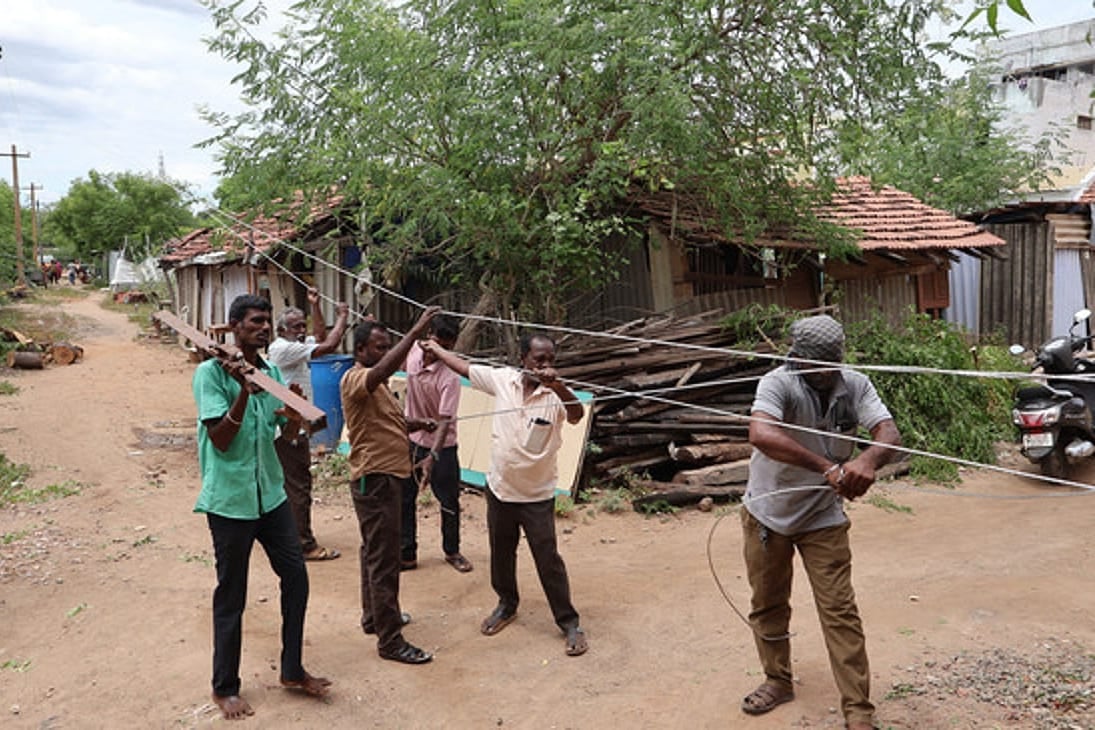
That week Tangedco, the state power utility, began putting up electricity poles in the settlement. Five families were to be connected in the first phase, all from among the 68 that held e-pattas. M Thangapandian, an office-bearer of the Theerthakadu SC Residents Protection Welfare Association, said the state’s Social Justice Minister, Vanni Arasu, had directed the district to speed up the work, and called it the first victory in the community’s long struggle (The New Indian Express, 4 July 2026). The reports spell the name differently: ANI’s March report names a resident, Thangapandiyan, and The New Indian Express names the association’s office-bearer M Thangapandian. Neither says whether they are the same person.
By October, officials of the state’s Adi Dravidar Welfare and Revenue departments had surveyed the hamlet. A senior Adi Dravidar Welfare official told the paper that 68 families had e-pattas for 1.25 cents each, about 50 square metres, and that the other 340 did not. “Officials of the Revenue Department completed a survey of the area and submitted a report to the DRO. Each eligible family will be allotted 1.25 cents,” he said. The District Revenue Officer (DRO), Anbalagan, said the pattas would be issued soon (The New Indian Express, 7 October 2026). Sixty-eight is the December 2025 number: two notices and three months of surveys had not yet produced a new patta.
The mechanism: the title comes first
The patta holds up services in two ways. The first runs between two arms of the state. In February the paper reported a tug-of-war between the two: the delay in issuing pattas had held up the transfer of the settlement’s common land from the state Revenue Department to the city corporation, and with it the basic facilities the corporation would build there (The New Indian Express, 13 February 2026). Until the pattas are issued, the common land stays where it is, and so do the facilities.
The second is the household connection. Orders of the Madras High Court, Tamil Nadu’s highest court, show the state power utility holding back connections from houses on land their occupants hold no title to. In 2017 the utility told A. Lakshmanan, of Sivagangai district, next to Madurai, to come back with a consent letter from the tahsildar, the local revenue officer, and his property tax receipts. In June 2018 the court held that a connection “can be granted irrespective of the fact that the petitioner has constructed a house in poramboke land”, land the state’s records class as government land, once the occupant gives the undertaking the state’s electricity distribution code requires (A. Lakshmanan v. The Assistant Engineer, Madurai Bench, 20 June 2018).
The court had read the code the same way in 2006, for occupants of poramboke land refused because the Public Works Department objected, though neighbours on the same land had been connected. It held that their ration cards and voter identity cards were documents enough, and ordered the connections (S. Rajakumari v. The Chairman, Tamil Nadu Electricity Board, 15 November 2006). In February 2026 the court ordered a connection in Sivagangai within eight weeks, after the utility’s lawyer said the house stood on government poramboke land; the petitioner’s lawyer said houses nearby were already connected (Lilly Pushpam v. The Assistant Engineer, Madurai Bench, 10 February 2026).
i
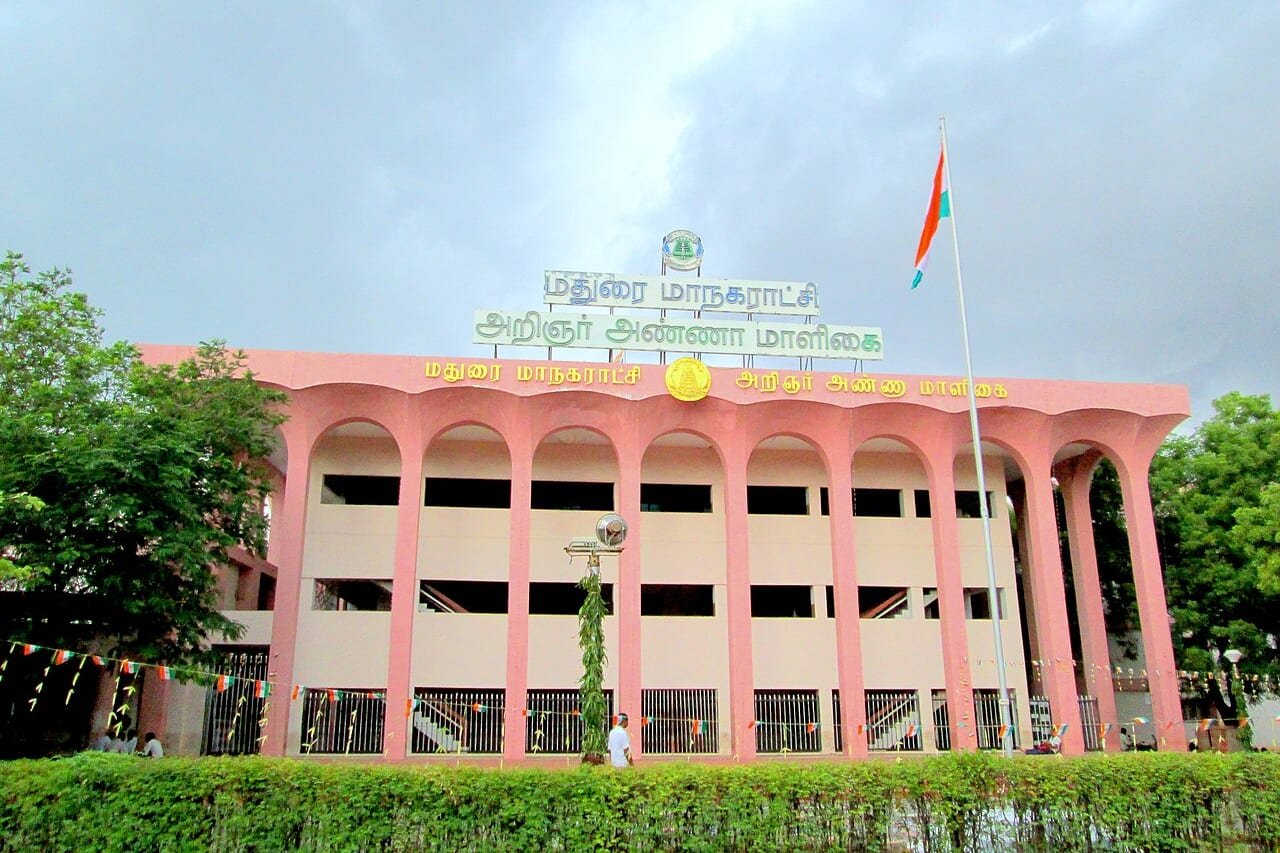
CC BY-SA 3.0Original on Wikimedia CommonsSo in law the patta is not always a precondition for light. It is the precondition the system applies first, and the courts lift it one household and one petition at a time. A settlement of several hundred families cannot litigate its way to power house by house.
The settlement is Dalit by design, not by chance. The land was set aside for Adi Dravidar families, Thangapandiyan told ANI (ANI, via Asianet Newsable). When the title is left undecided for four decades, it is a Dalit settlement that stays inside the city’s limits and outside its services.
“More than 600 people have been living here since 1982. Issuing pattas would pave the way for authorities to provide electricity connections and other basic amenities, including drinking water and sanitation in the settlement.” — M Thangapandian, office-bearer of the Theerthakadu SC Residents Protection Welfare Association, to The New Indian Express, October 2026
340 families: still without a patta in Theerthakadu in October 2026, three months after the NCSC’s second notice; 68 families hold one (The New Indian Express).
What the residents say it costs
In February a 35-year-old resident told the paper that families have to buy borewell water for uses other than drinking by the barrel and drinking water by the pot; that they cannot go to work before sunrise or come home after dark; and that women and girls are harassed when they go out to relieve themselves. Renuka, another resident, said students study by candlelight and cannot use the free laptops given to students (The New Indian Express, 13 February 2026). In March another resident, Menaka, told ANI: “The pattas remain only as documents. If the government could use them to provide us with basic amenities like electricity and water, it would greatly improve our lives” (ANI, via Asianet Newsable).
P. Sivakami founded the Dalit Land Rights Movement in Tamil Nadu (Savari, 2013). A former officer of India’s senior civil service, she is one of India’s most prominent Dalit writers, the news agency IANS has said (IANS, via ummid.com, 4 February 2016). In 2013 she told the website Savari of Panchami land, the land Dalits received from the British: “In the case of Tamil Nadu, whatever lands the Dalits had got from the British as Panchami lands, those were also grabbed by the caste hindus and the government is also not taking any action to retrieve them and give them back to the Dalits” (Savari, 2013). She was speaking of Panchami land, not of Theerthakadu’s house sites.
What the commission can and cannot do
The NCSC’s duty, under Article 338 of the Constitution, is “to inquire into specific complaints with respect to the deprivation of rights and safeguards of the Scheduled Castes”. While it does so it has “all the powers of a civil court trying a suit”: it can summon officials, examine them on oath and requisition public records (Article 338, Constitution of India).
On 28 July, 26 days after the commission’s second notice to Madurai, the Supreme Court set out where those powers stop. In Mumbai Port Authority v. National Commission for Scheduled Castes, a bench of Justices Sanjay Karol and Augustine George Masih held that the commission’s role “is recommendatory and advisory, but certainly not adjudicatory”. The NCSC, the court said, “can record a factual finding and then ask the concerned Government, either the Centre or the State to act thereupon” (Bar and Bench, 28 July 2026). The case was about a promotion, not land, but the ruling is on what Article 338 lets the commission do.
For Theerthakadu, the commission can ask the Collector what has been done, summon officials and record what it finds. It cannot issue the pattas or make the district issue them.
The strongest counter-reading
The administration’s case is that the work is under way and that the commission helped. Poles went up in July, a minister intervened, the Revenue Department’s survey is with the DRO, each eligible family has a plot size, and the DRO says the pattas are coming soon. Titling occupied land needs a survey and a decision on who is eligible, and months are not long for that.
That reading accounts for this year, not the 40 before it. Many of those who received permission pattas in 1979 have since died, Thangapandiyan told ANI, and their children and grandchildren still live without basic facilities (ANI, via Asianet Newsable). The 68 e-pattas came in December 2025, after decades of petitions and protests, and the officials quoted in October gave no date for the other 340.
What to watch
Whether the 340 pattas are issued, and on what terms: whether every family identified in 1982, and its descendants, is found eligible. Whether the five connections begun in July reach the other 63 patta holders, and then the families still without one. Whether the Revenue Department hands the common land to the corporation, so that roads, drains and water lines can follow. And whether the NCSC, after the Supreme Court’s ruling, records a finding on Theerthakadu and sends it to the Tamil Nadu government.
M Mullaikodi’s home was among the first five marked for power. In July she said she could not celebrate fully while many families were still waiting even for pattas: the title that, in Theerthakadu, has come before the light.