Listen to this article
Read by an AI-generated voice · Report a mispronunciation
On 11 November 2026, Ajay Singhal, the Director General of Police, the head of the police force in the northern state of Haryana, gave the state’s committee on caste atrocities a piece of good news. Cases of crimes against Scheduled Castes and Scheduled Tribes in the state had fallen by “approximately 28 percent”, he told the meeting in Chandigarh, the state capital, according to News On Air, the news service of India’s public broadcaster. Scheduled Castes is the legal name for Dalits, the communities once branded “untouchable” under India’s caste order; Scheduled Tribes is the legal name for many of India’s Adivasi, or Indigenous, communities. He also said action had been taken against 10 police personnel for negligence in ensuring justice for victims.
The meeting was chaired by Nayab Singh Saini, Haryana’s chief minister, the head of the state government, who ordered special courts for these cases in five of the state’s districts, Hisar, Faridabad, Palwal, Rohtak and Bhiwani, and said every charge sheet, the police’s formal accusation that sends a case to trial, must be filed within 60 days. None of the reports of the meeting says over what period the 28% fall was measured, or against what.
A fall in recorded cases can mean fewer attacks on Dalits. It can also mean fewer complaints written down. Haryana’s figures cannot say which, but they show how much of the count turns on police decisions. In 2024 the same police force that reports the fall closed almost two in five of the complaints it finished investigating as false, and the state’s courts convicted in fewer than one trial in five. Before the 28% figure can be read as good news, it has to be read against that record.
What the committee heard
The State-Level Vigilance and Monitoring Committee reviews how Haryana applies the Scheduled Castes and Scheduled Tribes (Prevention of Atrocities) Act, India’s 1989 law against caste violence, and the Protection of Civil Rights Act of 1955, the older law against the practice of untouchability, the Indian daily Hindustan Times reported, citing an official statement. Krishan Kumar Bedi, the state’s Social Justice and Empowerment Minister, and seven of the state’s legislators attended.
Saini said negligence or dereliction of duty “at any level” would not be tolerated, News On Air reported. He directed special review drives in districts with more cases, and said police stations that register more such cases should be identified and placed under close watch by senior officers, according to the Hindustan Times. He also suggested recognising village councils, or panchayats, where no atrocity case had been reported in the past two years, the Indian daily The Tribune reported. The committee was told that relief and rehabilitation payments had been made to 1,046 victims of atrocities so far in the financial year that began in April 2026, the Hindustan Times reported.
According to The Tribune, the action against the 10 police personnel was disciplinary. The reports do not name them, say what they did or failed to do, or say whether any faces prosecution.
What the national record shows
The latest full figures come from the National Crime Records Bureau (NCRB), the crime-data agency of India’s central government, for 2024. Haryana’s police registered 1,076 crimes against Scheduled Castes that year, down from 1,539 in 2023 and 1,633 in 2022, NCRB Table 7A.1 shows. That is a fall of 30% in a year, close to the figure the police chief gave, though he did not say it was the same measure.
The same table shows that of the cases Haryana’s police finished investigating in 2024, 55.5% ended in a charge sheet. Across India the rate was 82%.
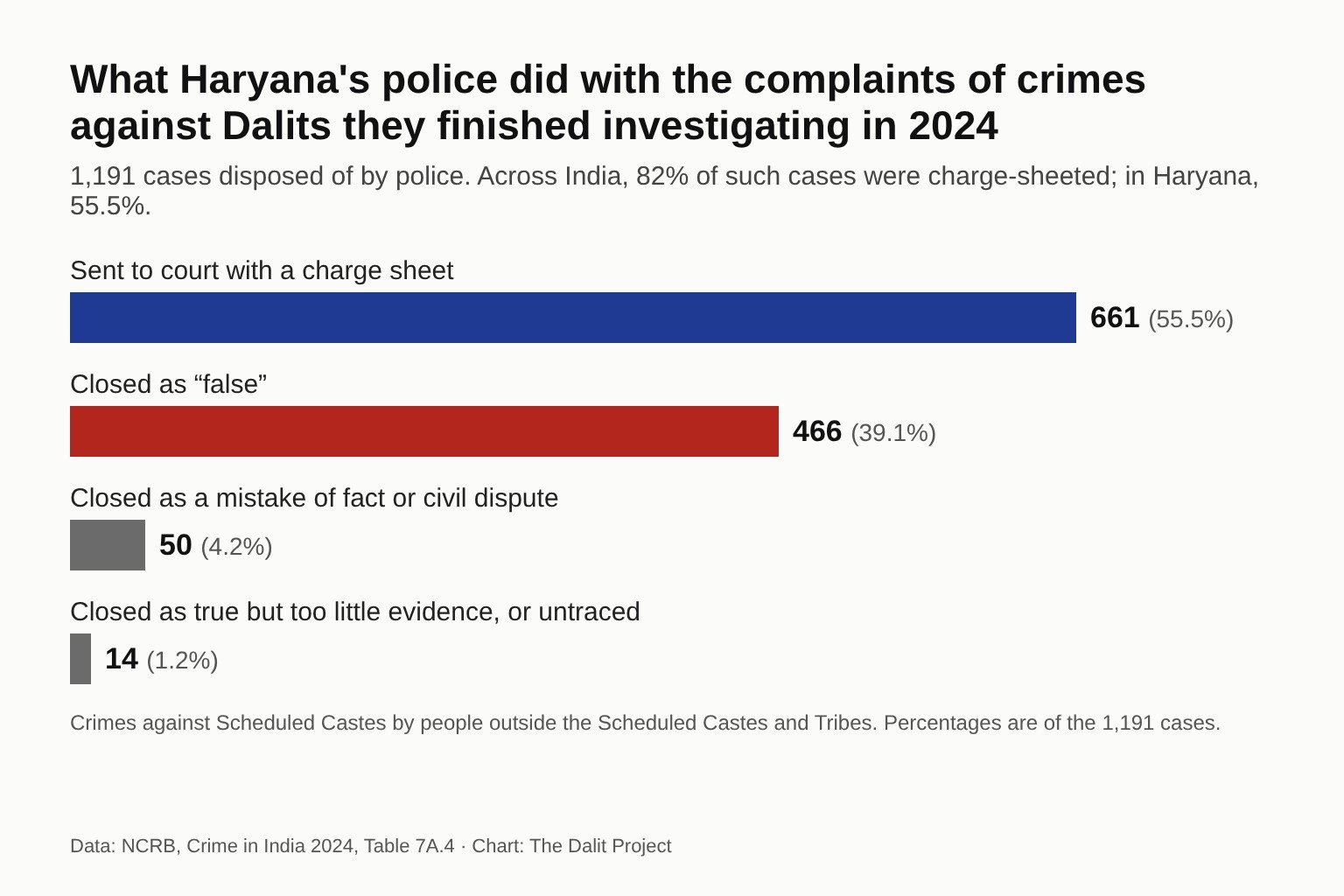
Where the rest went is set out in the NCRB’s table of police disposals. Haryana’s police disposed of 1,191 cases in 2024. They sent 661 to court. They closed 466 with a final report calling the complaint false, Table 7A.4 shows, 39% of the cases they disposed of. Another 50 were closed as a mistake of fact or a civil dispute, and 14 as true but with too little evidence, or untraced.
466 complaints of crimes against Dalits were closed as “false” by Haryana’s police in 2024, 39% of the cases they disposed of — NCRB, Crime in India 2024, Table 7A.4
Haryana registered about 2% of India’s 55,698 such cases that year, but made almost 8% of the country’s 6,055 “false” closures, by the same tables (7A.1 and 7A.4). The Dalit Project found in September that Haryana and its neighbour Rajasthan together account for 68% of those closures nationally.
Why a smaller count is a police number
i
CC BY 4.0Original on ncrb.gov.inEvery number in these tables passes through a police station first. A complaint becomes a case only when an officer writes it down as a First Information Report (FIR), the police complaint that opens a criminal case, and records it under the atrocities law. It goes to trial when the investigating officer files a charge sheet, and is closed when the officer files a final report instead. The 466 “false” closures and the 55.5% charge-sheet rate are counts of what one police force decided, and the 28% fall, whatever it measures, was reported by the same force.
The law knows this. Section 4 of the Act, as amended by Parliament in 2015, makes it a crime for a public servant who is not from a Scheduled Caste or Scheduled Tribe to wilfully neglect the duties the Act sets, with a prison term of six months to a year. Those duties begin at the station: to register the complaint or FIR “under appropriate sections of this Act”, to give the informant a copy, to record the statements of victims and witnesses, and to “conduct the investigation and file charge sheet in the Special Court or the Exclusive Special Court within a period of sixty days, and to explain the delay if any, in writing”.
So the 60-day charge sheet the chief minister asked for is not a new promise. Parliament wrote it into the Act in an amendment passed at the end of 2015. Under Section 4, a charge of neglect is brought on the recommendation of an administrative enquiry, and the special court is to take cognizance of the neglect and direct penal proceedings against the officer. The reports of the meeting do not say whether that has happened in any of the 10 cases.
Dalit women’s organisers have documented the same thing from the complainant’s side of the counter. Asha Kowtal, of the All India Dalit Mahila Adhikar Manch (All India Dalit Women’s Rights Forum), told The Indian Express, a national daily, in April 2018 that in studying 200 cases of caste crimes against Dalit women over the previous year, “we found that FIRs were not filed immediately”.
“Quite apart from the high pendency and acquittals in court, police often do not file cases under the Atrocities Act because they want to play down caste violence.”
— Asha Kowtal, of the All India Dalit Mahila Adhikar Manchi
Source: The Indian Express, April 2018
She said “socio-economic boycotts, threats and intimidation, and pressure to compromise” lead witnesses and victims to change their stand, and that “many cases are withdrawn or termed false by police after investigations”.
What happens to the cases that reach a court
The special courts the chief minister ordered are meant to move these cases faster. Haryana’s courts had 4,229 atrocity cases before them in 2024, including 3,568 left over from earlier years. They completed 303 trials. Fifty-five ended in conviction, a rate of 18.2%, against 33.9% nationally, and 3,910 cases, 92.5%, were still waiting for trial at the end of the year, NCRB Table 7A.6 shows. At the year’s pace of 319 cases disposed of, clearing that backlog would take more than 12 years, even if no new case arrived.
The 2015 amendment asks for more than that. Section 14 of the Act, as the amendment rewrote it, requires each state government to set up an Exclusive Special Court for one or more districts, with the concurrence of the Chief Justice of its High Court, the state’s highest court. In districts where few cases are recorded, it is to name a sessions court, a district’s senior criminal court, as the Special Court instead. The state must “establish adequate number of Courts to ensure that cases under this Act are disposed of within a period of two months, as far as possible”, and each trial is to be completed, as far as possible, within two months of the charge sheet, the amendment says. The reports of the meeting do not say how many such courts Haryana already has, or whether the five new ones will try only these cases.
Haryana’s own history shows how long such a case can take to reach a verdict on appeal. In April 2010, a mob of nearly 1,000 people from the Jat caste, which the news site Scroll describes as the dominant community, burned 18 homes in the Dalit colony of Mirchpur, a village in Hisar district, and killed two members of a Dalit family, Scroll reported. The case was tried in Delhi, where a court convicted 15 of the 84 accused in September 2011. In August 2018, more than eight years after the killings, the Delhi High Court, the highest court of India’s capital territory, convicted 20 people who had been acquitted, and asked the Haryana government to rehabilitate the Dalit families who had fled the village.
The strongest reading for the state
The best case for the government’s figure is that the fall is real, and that closer supervision by senior officers assigned to monitor investigations at district and subdivision level, as the official statement described, and the threat of discipline, have made attacks less common or police more careful. If fewer false complaints were made, that too would lower the count, and the state’s high closure rate could be read as police weeding out weak cases.
That reading has to explain the rest of the record. If Haryana’s police were simply more careful than others, one would expect the cases they do send to court to do better there. They do worse: the state’s conviction rate is about half the national rate. A force that closes 39% of complaints as false, charges 55.5% and sees fewer than one in five of its completed trials end in conviction is not evidence of a justice system that works better. The NCRB itself warns, under its tables, that states “may not be compared purely on the basis of crime figures”, Table 7A.1 notes. A state’s own figures from year to year call for the same care, because they too turn on what its police write down.
What to watch
- The period and the measure. Whether the state publishes what the 28% fall compares, and how many complaints were closed as false over the same period.
- The 10 officers. Whether any faces a charge of neglect under Section 4, or only internal discipline.
- The special courts. Whether the five new courts are notified as exclusive courts under Section 14 of the Act, and how many such courts Haryana has now.
- The 60-day rule. Whether the state reports how many charge sheets met the deadline the 2015 amendment set.
- The 2025 figures. The NCRB’s next report will show whether the fall continued, and whether the “false” closures fell with it.
The committee heard that cases had fallen. Its own law asks it a different question: how many of the people who did report one got a charge sheet within 60 days, a trial within two months and a verdict. On the state’s last full year of figures, more than four in ten of the cases its police finished investigating were closed without a charge sheet, and fewer than one in ten of the cases before its courts reached a verdict that year.