Listen to this article
Read by an AI-generated voice · Report a mispronunciation
On the afternoon of 11 November 2026, Anil Rathod and his friend Nilesh went to cut grass at a party plot, a ground hired out for functions, in Saniya Kande, a village on the edge of Surat, a city in the western state of Gujarat. Six men took the two for thieves, according to the police account reported by Loktej. The six are alleged to have abused them with casteist slurs, forced them into a vehicle and tied them to poles at another party plot in nearby Karadva. There, the police say, the men beat them with wooden sticks and electric wires, and Anil died of his injuries. Both men are Dalit, from the communities once branded “untouchable”, Varthabharati reported.
Within hours the police in Dindoli, the area of Surat where the killing took place, had arrested all six and registered a murder case together with charges under the Scheduled Castes and Scheduled Tribes (Prevention of Atrocities) Act, India’s 1989 law against caste violence, The Wire reported.
That speed is the part of the system that worked here. The suspicion that two Dalit men cutting grass on someone else’s ground must be thieves, and that a crowd may punish them on the spot, is how caste turns an accusation into a sentence. What follows the arrests, in Gujarat, rarely ends in a conviction: the state’s courts have convicted in about one in twenty finished caste-atrocity trials, an earlier Dalit Project analysis of data from the National Crime Records Bureau (NCRB), India’s official crime statistics agency, found.
What the police say happened
The account so far is the police’s, given to reporters in the days after the killing. Anil Bhikhubhai Rathod and Nilesh had gone to cut grass at the Krishna Seven Star Party Plot in Saniya Kande when some people mistook them for thieves, Loktej reported. The six men allegedly abused them with casteist slurs and took them in a vehicle to the Radha Krishna Party Plot in Karadva, where they tied them to poles with ropes and beat them. Anil died of his injuries. The police seized the rope used to tie the two men, the same report says.
Sunil Tarde, an assistant commissioner of police (ACP) in Surat, told The New Indian Express that the two had gone to the party plot to cut grass when the accused labelled them thieves, The Wire reported. “The accused allegedly formed an unlawful assembly, abducted the victims and took them to another party plot, where they tied them up and brutally assaulted them with electric wires and wooden sticks. The assault proved fatal for Anil,” he said.
A police surveillance team, using technical monitoring and informants, arrested all six within a few hours, according to Loktej, and the police said they would ask a court to remand them in custody. “Preliminary investigations have not revealed any previous criminal record against the accused. However, their individual roles, the circumstances leading to the assault and other aspects of the crime are being examined through further interrogation,” Tarde said, as The Wire reported. None of the six has been tried, and no response from them or their lawyers has been published.
A theft accusation as a licence
On the police’s account, the theft accusation is what turned two men cutting grass into targets. None of the reports so far says anything had been stolen. What the police describe is a group that decided on the spot who the two men were and what they deserved, then took them away to punish them.
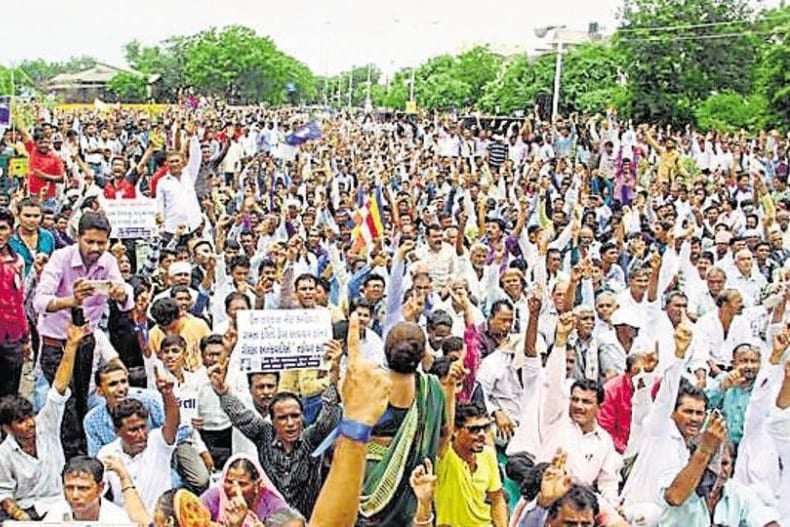
Gujarat has seen the same sequence before. In May 2018, near the town of Shapar in Rajkot district, also in Gujarat, a factory owner accused Mukesh Vaniya, a 35-year-old Dalit ragpicker, and his wife of theft; a video purportedly showed men beating him with a stick while another held him by a rope tied to his waist, and he died on the way to hospital, The Wire reported at the time. In July 2016, men who called themselves cow protectors accused four Dalit men in Una, a town in Gujarat’s Gir Somnath district, of killing a cow, tied them to a vehicle, beat them and paraded them through the town, as an earlier Dalit Project explainer sets out. The flogging set off protests across India, among them the Chalo Una march in Gujarat in August 2016, the explainer records. The pattern is the same each time: an accusation, a rope, a public beating. Caste supplies the presumption of guilt, and the crowd supplies the punishment.
Gujarat recorded 1,373 crimes against Scheduled Castes (SCs), the legal category for Dalits, in 2023, a rate of 33.7 for every 100,000 SC residents and the seventh highest among India’s states, according to an analysis of NCRB data by the National Campaign on Dalit Human Rights (NCDHR), a Dalit rights network. Across India that year, 908 murders of Dalits were registered, the same analysis shows.
Where cases like this go next
i
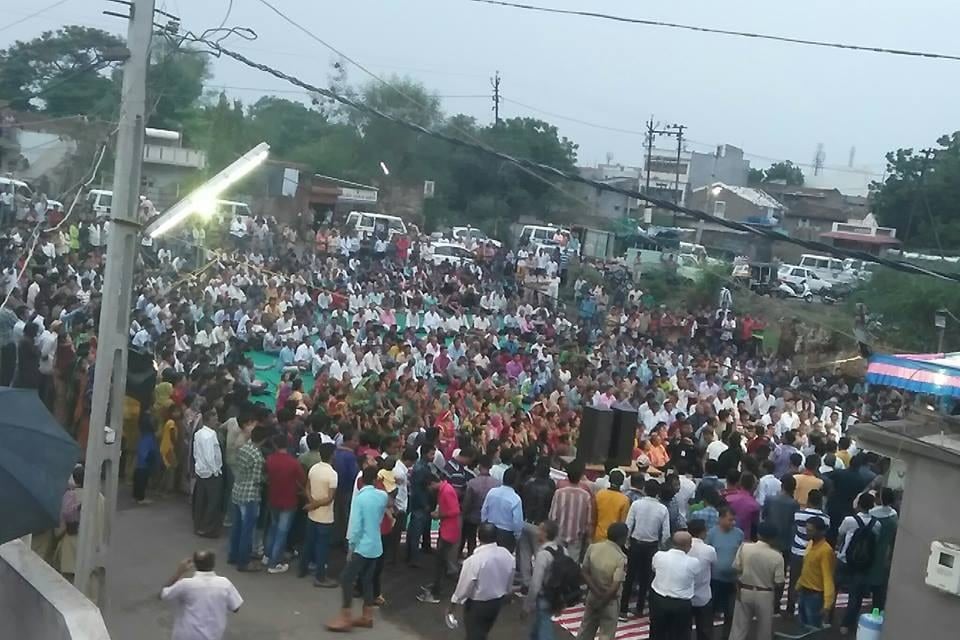
Shared with creditOriginal on sabrangindia.inThe Atrocities Act sets out what should happen now. Police are to file a charge sheet, the document that sends a case to trial, within 60 days, under Rule 7(2) of the rules made under the Act, and section 14 lets each state, with the agreement of its High Court, the state’s highest court, set up exclusive special courts to try these cases quickly, NCDHR’s report notes. NCDHR calls for one in every district. On the first, Gujarat’s police mostly meet the deadline: in 2022 they filed 1,036 charge sheets within 60 days and 192 after it, according to the 2022 report under the Act by the central government’s Ministry of Social Justice and Empowerment, as tabulated by NCDHR. On the second, 16 of Gujarat’s 33 districts had an exclusive special court in the same 2022 report, NCDHR’s table shows.
The trial is where cases stall. Across India, at the end of 2023, 93.3% of the murder cases of Dalits before the courts were still awaiting a verdict, and of the murder trials that did finish, 48.8% ended in conviction and 47.6% in acquittal, the NCDHR analysis of NCRB data shows.
93.3% of murder cases of Dalits before India’s courts were still awaiting a verdict at the end of 2023. Source: National Campaign on Dalit Human Rights, from NCRB’s Crime in India 2023
Gujarat’s record is worse than the national one. In 2024 its courts convicted in 5.4% of finished caste-atrocity trials, and only Andhra Pradesh, Karnataka and Telangana, in the south, among the states that finished more than 750 trials, convicted less often, an earlier Dalit Project analysis of NCRB’s 2024 tables found. Over the nine years to 2024, Gujarat’s courts convicted in 169 of 3,684 finished trials (4.6%), a second analysis of NCRB’s court tables shows. The Una case shows the timescale: the charge sheet was filed in December 2016 and the special court in Veraval, a city in Gujarat, ruled in March 2026, convicting five men and acquitting 35, as the explainer records.
“It is common sense that a Dalit landless labourer, even if he musters up the courage to file a complaint against powerful people for committing an atrocity, would not be able to withstand their threats over a long time.” Anand Teltumbde, a Dalit scholar and writer, writing in the Indian news site Scroll, April 2018
The strongest objection
The objection is that this was a crime of suspicion, not of caste: a group mistook two men for thieves, as the police first put it, and the murder charge would follow whoever the men were. On that reading the Atrocities Act charge is incidental.
It falls short on the police’s own account. The six men are alleged to have abused the two with casteist slurs before taking them away, which is why the Act’s provisions are in the case at all. And a theft suspicion does not explain the rest: why two men cutting grass were assumed to be thieves, and why, on the police’s account, the men who assumed it felt free to tie them to poles and beat them rather than call the police. That freedom is what the Act exists to remove, and what Gujarat’s conviction record leaves in place. Whether caste motivated each of the accused is for the court to decide, on evidence the police are still gathering.
What to watch
The first marker is the charge sheet: whether the Dindoli police file it within 60 days, around 10 January 2027, and whether it keeps the Atrocities Act charges. The second is the court: whether the case goes to an exclusive special court and how long it waits for a trial date. The third is the family and Nilesh, the surviving witness. NCDHR’s report calls for the compensation set in the rules under the Act to be paid promptly at each stage, from the registration of the police complaint to the charge sheet and conviction, and for victims and witnesses to be protected from intimidation until the trial ends, as its recommendations set out. No report so far says what the family has received or asked for.
Six men were in custody within hours of Anil Rathod’s death. The arrests came fast. In Gujarat, the verdict is the part of an atrocity case that usually does not come.