Listen to this article
Read by an AI-generated voice · Report a mispronunciation
On 6 October, a Class 11 student (usually about 16 years old) in Ghaziabad, a city on Delhi’s eastern edge in the state of Uttar Pradesh, came home from school with injuries, his father says. The father belongs to a Dalit community, among the communities once branded “untouchable”. He told The Indian Express, a national daily newspaper, that classmates had taunted the boy for over a month with lines such as “Do you want to be Ambedkar?” and “We won’t let you study”. On that day, he says, they and friends they called in beat him with kicks, punches and a belt, and the boy fell unconscious. These are his allegations; the police say they are investigating them.
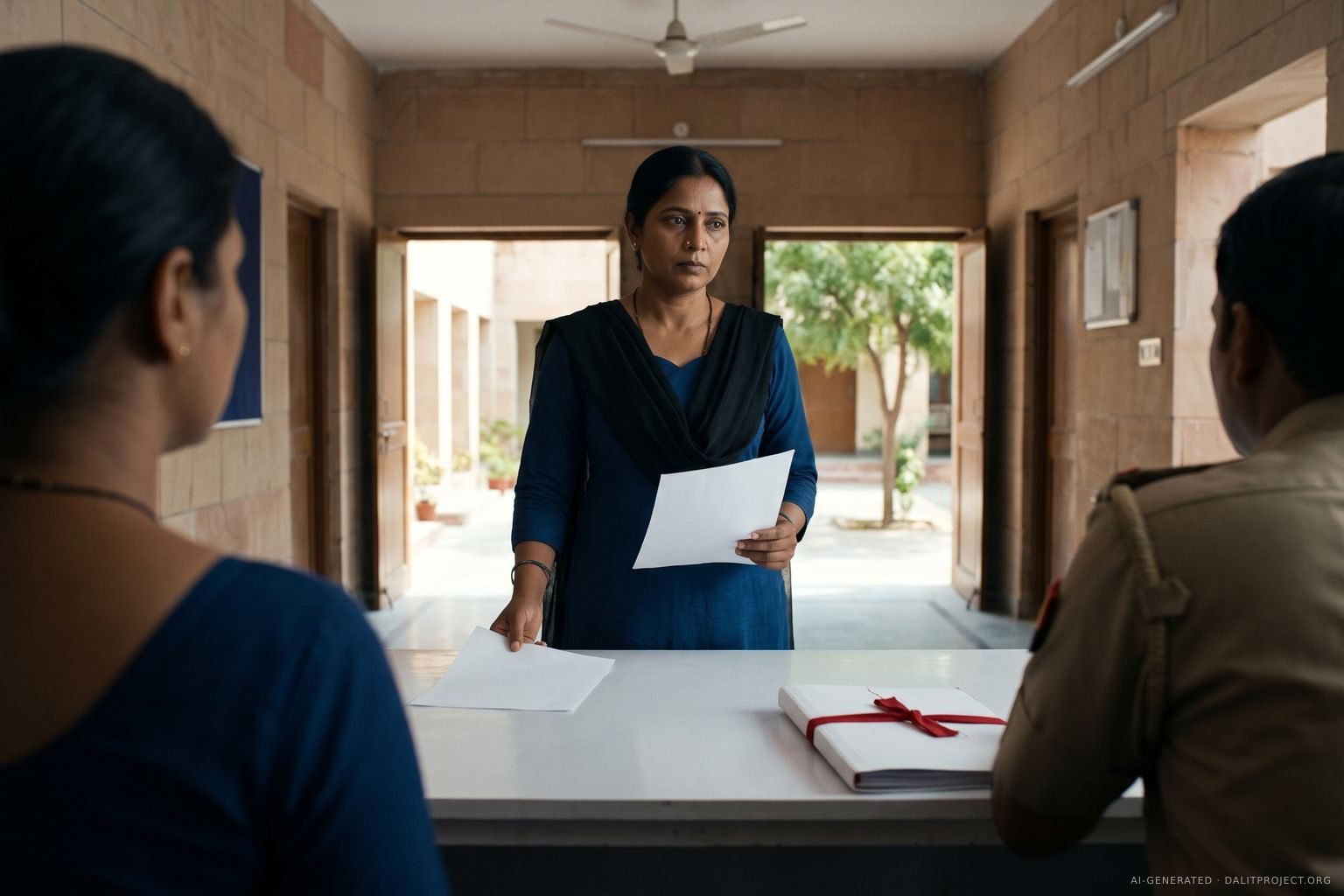
He says he went to the police on 8 October. The First Information Report (FIR), the police record that opens a criminal case, was registered “on Sunday”, according to the same report. It was published on Tuesday 20 October, so that Sunday was 18 October. That gap matters because the law that governs this case, the Scheduled Castes and Scheduled Tribes (Prevention of Atrocities) Act, India’s 1989 law against caste violence, was amended to make registering such a complaint a police duty, with a penalty for neglecting it. The ten days he describes are not a detail of one case: they are the step the law was changed to protect, taken before any court sees a file.
What happened
The boy’s father told The Indian Express that the harassment had gone on “for over a month”. “His classmates have been making unnecessary casteist comments about my child in school like ‘Do you want to be Ambedkar?’ and ‘We won’t let you study’,” he said, referring to B.R. Ambedkar, the Dalit jurist who led the drafting of India’s Constitution. He said that on 6 October, as school was ending, the classmates abused his son again, “called five-seven friends” and beat him.
Since then, he said, the boy had been to school only once, and a teacher called the father to take him home after two hours because he was in pain. The father also said his son had been “irregular to school” before the assault, and that he used to scold him for it, “But he says that his classmates harassed him incessantly.”
The FIR names “several students of the school and others”, the report says. The report lists section 3(2)(va) of the Atrocities Act, as the 1989 law is commonly called, along with provisions on “culpable homicide”, intentional insult with intent to provoke a breach of the peace, and aggravated criminal intimidation. “We have registered an FIR and are investigating the allegations,” a senior police officer told the paper. The report does not say when the police received the complaint, or why registration came when it did.
The mechanism: a law built against the wait
The Act’s rules spell out the first step. When a complaint of an offence under the Act is made orally, the officer in charge of the police station must write it down, read it back to the complainant, have it signed and enter it in the station’s book, and give the complainant a free copy “forth-with”, under rule 5 of the Act’s 1995 rules. If the station refuses, the complainant can send the complaint by post to the district’s Superintendent of Police, the officer who heads a district’s police. After an investigation, by the Superintendent or an officer of Deputy Superintendent rank, the Superintendent must order it entered.
In an amendment passed at the end of 2015, Parliament turned those steps into duties with a penalty. Section 4 of the Act, as amended then, says a public servant who is not a Dalit or Adivasi (a member of India’s Indigenous communities) and who “wilfully neglects” duties under the Act faces six months to a year in prison. The duties it lists include “to register a complaint or a First Information Report under this Act” and “to register it under appropriate sections of this Act”, and to finish the investigation and file a charge sheet, the police’s formal list of charges, in a special court “within a period of sixty days, and to explain the delay if any, in writing”. Charges against the officer need an administrative inquiry’s recommendation first.
There is a further bar. Section 18A(1)(a) of the Act forbids any preliminary inquiry before an FIR when a complaint discloses an offence under the Act. India’s Supreme Court has held that no such inquiry is allowed, either under the Act or under the Code of Criminal Procedure, India’s main law on how crimes are investigated and tried. The Madras High Court restated that ruling in a case filed in 2025; it is the high court of the southern state of Tamil Nadu. The same court reminded police that only an officer of Deputy Superintendent rank or higher, a senior grade below the district chief, may investigate such a case.
Read together, these provisions leave little room for a ten-day pause. A complaint that alleges a caste-motivated assault is either registered or, if police think it discloses no offence, refused in a way the complainant can take higher. A pause to check it first is the one thing the law rules out.
The wait matters because of what comes after it. National Crime Records Bureau (NCRB) data, India’s official crime statistics, tabled in Parliament on 30 July 2026 show police registered 48,669 cases under the Act in 2024, and 5,192 cases ended in conviction that year, a five-year high, as SCC Online reported.
Few of those trials end at all.
What the school taunts say
The words the father reports are not random insults. “Do you want to be Ambedkar?” mocks a Dalit boy for aspiring to what education made possible for Ambedkar. “We won’t let you study”, if it was said, states plainly what the harassment he alleges was for. The Dalit writer Yashica Dutt names that logic in Coming Out as Dalit: those who fail to exhibit “satisfactory signs of upper-casteness”, she writes, “are punished for trespassing, for being where they don’t belong”. A Dalit boy told at school that he will not be allowed to study is being told he is trespassing. Whether a court finds the taunts proved is for the trial, but as reported they describe exclusion from school, not a playground fight.
“My civics textbook educated me about “the evils of the caste system” but didn’t equip me to deal with its manifestations in my own classroom.” — Yashica Dutt, Coming Out as Dalit
Fifteen days after the assault the Ghaziabad father describes, on 21 October, a 16-year-old Dalit Class 11 student in Coimbatore, in the southern state of Tamil Nadu, died by suicide after what his family alleges was repeated caste-based harassment by classmates, Sabrang India reported on 22 October, citing DT Next, South First and NDTV. His family had complained to the school management, and the taunts stopped for a few days before resuming, according to that report. Police there registered a case under the Atrocities Act against the headmaster, the class teacher and two students. The allegations are under investigation. The two cases differ in their facts. Both, as reported, began with taunts from classmates about caste that went on for weeks.
The strongest counter-reading
The best case for the Ghaziabad police is that this complaint is unusual. The accused are schoolchildren and their friends, the alleged victim is a child, and an officer may reasonably want to establish who did what before naming several teenagers in a criminal case that carries the caste stigma of an atrocity charge. The father himself told the paper his son had been irregular at school before the assault, which an investigator would want to understand.
That reading falls short on the law’s own terms. Section 18A was written to remove exactly that discretion: the check comes after the FIR, in an investigation led by a senior officer within a deadline, not before it. Care for the accused children is served by how the investigation is run and by keeping them unidentified, not by delaying the record that starts it. And the father’s account of his son’s attendance is a reason to investigate, not a reason to wait.
What to watch
Three things will show whether the ten days he describes were an exception or the pattern of this case.
- The clock. Section 4 expects the investigation finished and a charge sheet filed within 60 days, or the delay explained in writing, and the Act’s rules, as amended in 2016, also set completion of investigation and filing of charge sheet in the court within sixty days, according to the social justice ministry’s announcement. Neither text says when the count starts. Counted from the FIR on 18 October, the 60 days run to about 17 December.
- The sections. The Indian Express report lists section 3(2)(va), which applies when an offence in the Act’s schedule is committed against someone known to be Dalit. It does not mention sections 3(1)(r) and 3(1)(s) of the Act. Those cover insult with intent to humiliate, and abuse by caste name, “in any place within public view”. Whether the FIR includes them is not public. Courts keep testing what “public view” covers, and a school during school hours is a place the question will arise.
- The school. The report does not name the school or say what, if anything, it did after the month of harassment the father describes. The complaint routes for students are written for colleges and universities; for a Class 11 student, the police and the Atrocities Act are the route the father took.
The father says he went to the police two days after his son came home hurt. The law he relied on makes the next step a police duty, with no inquiry first. His son, he says, has been to school only once since the assault. For a boy his father says was told “We won’t let you study”, those were ten more days of waiting for the law to start.
If you or someone you know is struggling, help is available. In India, call Tele-MANAS on 14416. In Australia, call Lifeline on 13 11 14.