Listen to this article
Read by an AI-generated voice · Report a mispronunciation
Who writes the list?
Article 341 of the Constitution of India lets the President specify which castes, races or tribes, or parts of them, count as Scheduled Castes. The 1950 Order says it is made under clause (1) of article 341. Its paragraph 2 limits each caste named in the Schedule to people resident in the localities specified for it. A caste can be on the list in one State or district and absent from the next. The Schedule is arranged in Parts by State, from Part I, Andhra Pradesh, to Part XXV, Telangana. Paragraph 4 reads every reference to a State or district as the State or district as constituted on 1 May 1976.
Why it matters: who the list leaves out
Paragraph 3 of the Order bars anyone who professes a religion other than Hinduism, Sikhism or Buddhism from being treated as a member of a Scheduled Caste. A Dalit who is Christian or Muslim remains outside the list. The Order’s footnotes record that an Act of Parliament, Act 63 of 1956, replaced paragraph 3, and that Act 15 of 1990 changed the words “or the Sikh” to “the Sikh or the Buddhist”.
“What you have given in the name of caste, you are now taking away in the name of religion.” — Dr Ruth Manorama, a member of the National Federation of Dalit Women and the Christian Dalit Liberation Movement, who says she is a Dalit Christian, with Countercurrents (Saransh Dash, 8 April 2026), an interview after the Supreme Court’s 24 March 2026 judgment on Scheduled Caste status and conversion to Christianity
On 6 October 2022 the central government appointed a Commission of Inquiry under Justice K. G. Balakrishnan, a former Chief Justice of India, to examine extending the status to people who, in the words of the central government’s Department of Social Justice and Empowerment, “claim to historically have belonged to the Scheduled Castes” but have converted to other religions. The notice gives the Commission two years from the day its chairperson takes charge to report, and asks it to examine what adding such people would mean for the existing Scheduled Castes. It records that certain groups have raised the question, that many others have opposed it, and that certain representatives of the existing Scheduled Castes have objected. The department’s page lists notifications extending its tenure on 30 October 2024, 4 November 2025 and 9 April 2026, and lists no report. The department’s consolidated text, updated up to 18 September 2025, still carries paragraph 3.
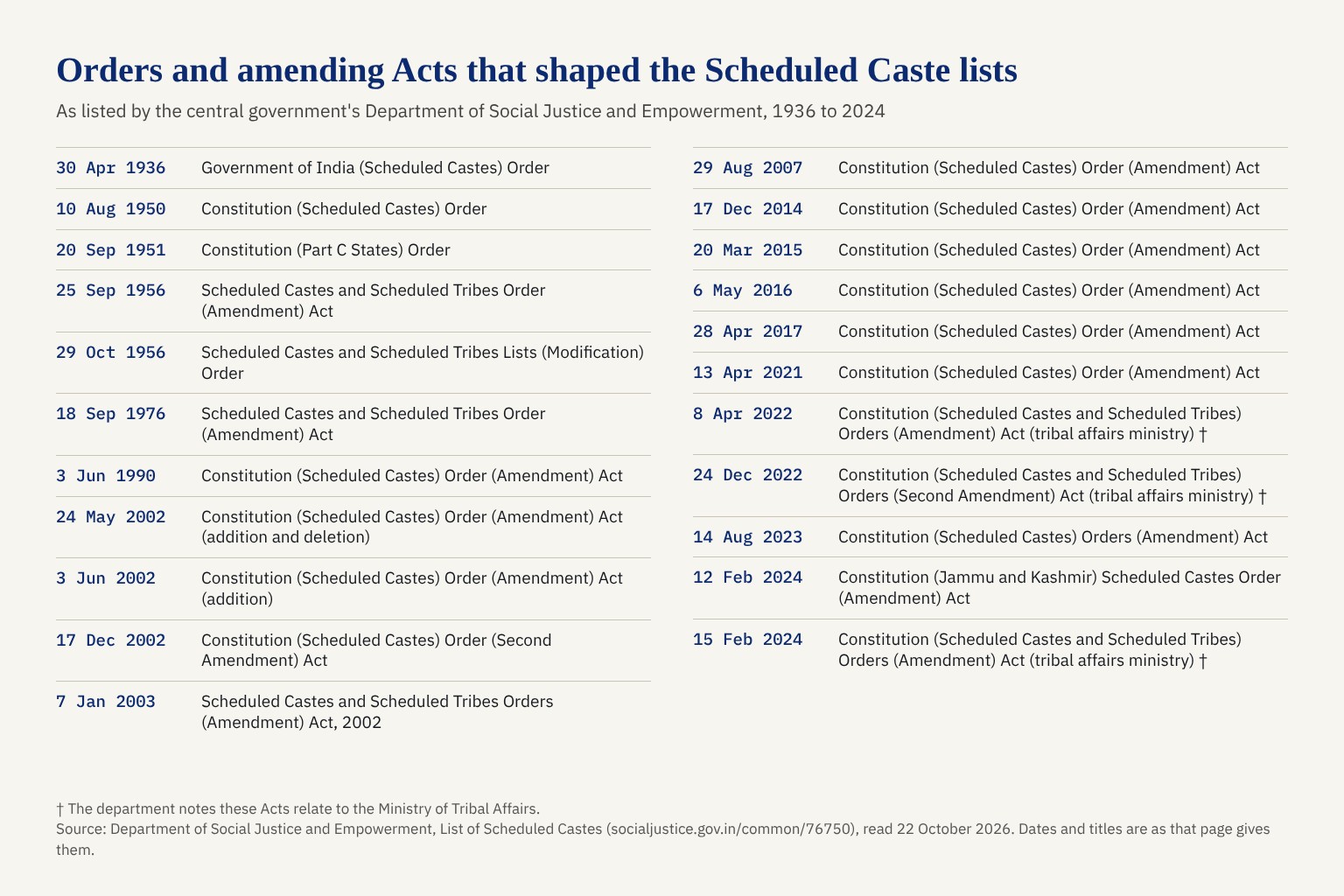
How was the list built, 1936 to 2025?
i
Original table by The Dalit ProjectOriginal on socialjustice.gov.inThe department’s list of Orders begins with the Government of India (Scheduled Castes) Order, 1936, dated 30 April 1936. It then lists the Constitution (Scheduled Castes) Order, 1950, a 1951 Order, an amending Act dated 25 September 1956 and the Scheduled Castes and Scheduled Tribes Lists (Modification) Order of 29 October 1956. After that come amending Acts, which the department dates to 1976, 3 June 1990, three in 2002, 7 January 2003, and then 2007, 2014, 2015, 2016, 2017, 2021, 2022, 2023 and 2024. Some of the 2022 and 2024 Acts concern the tribal affairs ministry and Scheduled Tribes, according to the same page.
Separate Orders cover the Union Territories, which the central government runs directly, and Jammu and Kashmir, Dadra and Nagar Haveli, Puducherry and Sikkim, the department’s list shows.
The same page links a report by the Lokur Committee, titled the Report of the Advisory Committee on the revision of the lists of Scheduled Castes and Scheduled Tribes, and a document on the modalities for deciding claims for inclusion in, exclusion from and other modifications to the Orders. It also carries state-by-state lists, updated up to November 2025.
Key terms
- Article 341: the Constitution’s provision under which the President specifies Scheduled Castes.
- Presidential Order: the document that lists the castes, here the Constitution (Scheduled Castes) Order, 1950.
- Schedule: the list of castes inside the Order.
- Paragraph 3: the clause that bars anyone outside the Hindu, Sikh and Buddhist religions from Scheduled Caste status.
- Commission of Inquiry: a body the central government appoints to examine a question.
What to watch
Watch the Commission’s report: its tenure has been extended three times. Watch also for the next amending Act: the department’s list shows the latest one for Scheduled Castes, covering Jammu and Kashmir, dated 12 February 2024. Proposals for such changes from a State or Union Territory follow a format the department publishes.