Listen to this article
Read by an AI-generated voice · Report a mispronunciation
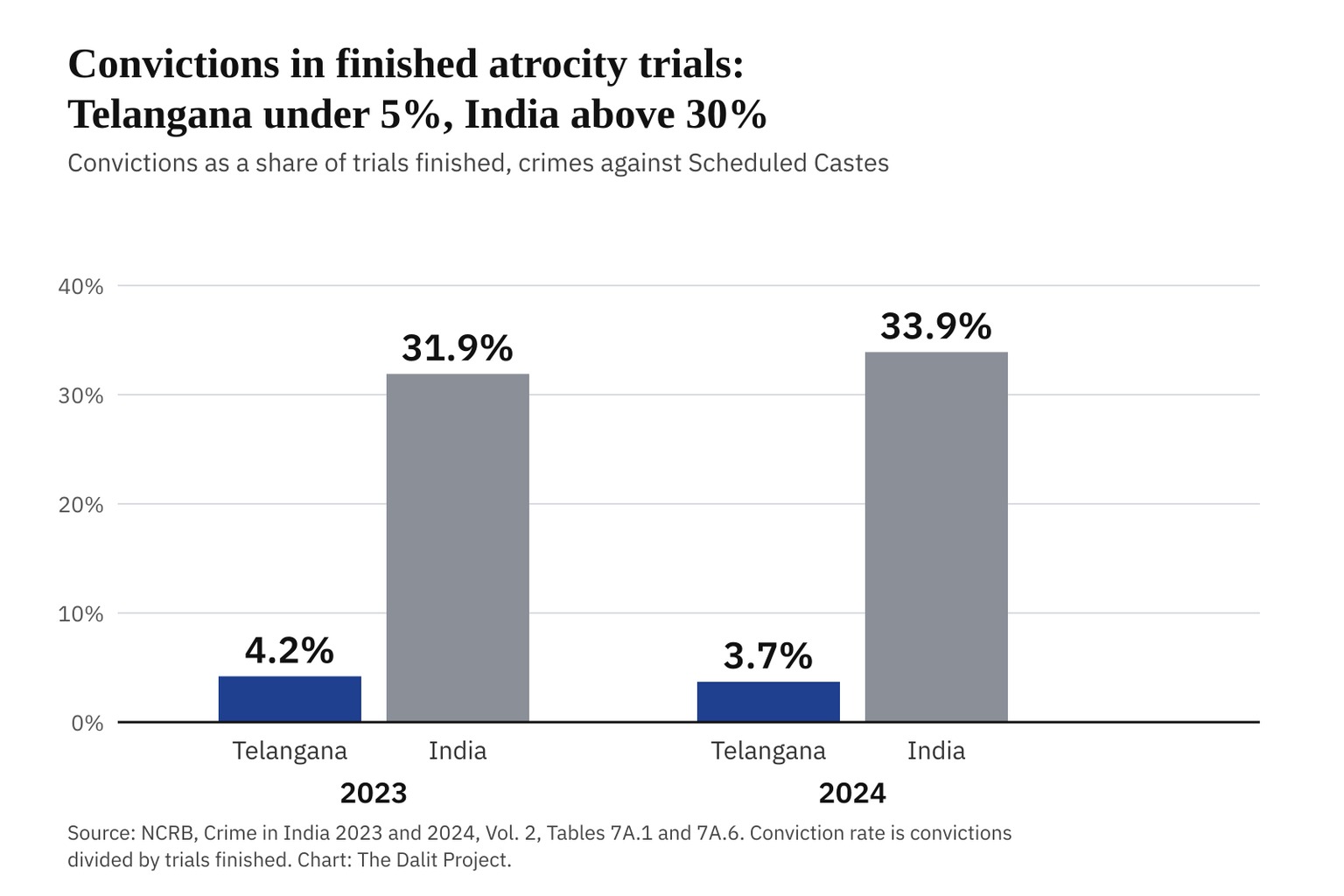
Telangana, the south Indian state whose capital is Hyderabad, has a state commission for Scheduled Castes (SCs, the legal category that includes Dalits, the communities once branded “untouchable”) and Scheduled Tribes (STs, India’s legal category for Adivasi, or Indigenous, communities). The central government’s crime-data agency, the NCRB, records that in 2024 Telangana’s courts finished 1,068 trials of crimes against Scheduled Castes and convicted in 40, or 3.7%. The national rate was 33.9%. Separately, in its three-year report, released on 1 October 2026, the Telangana State SC/ST Commission put two numbers side by side, as Hyderabad Mail reports them: 9,102 cases of offences against SCs and STs registered from 2023 to 2026, and 32 people convicted.
3.7% Telangana’s conviction rate in finished trials of crimes against Scheduled Castes in 2024, against 33.9% for India — NCRB, Crime in India 2024, Vol. 2, Table 7A.6
What the Commission reports
The Commission says it drew these figures from government records. The 9,102 cases include 213 murders and 1,305 reports of sexual assault against women and girls. Over the same three years the Commission received 5,867 petitions on land disputes, atrocities, service matters and other grievances.
These numbers come from Hyderabad Mail’s account of the report, which names the Commission’s chairman as Bakki Venkatayya. The report itself was not available.
Why 32 against 9,102 matters
The Scheduled Castes and Scheduled Tribes (Prevention of Atrocities) Act, India’s 1989 law against caste violence, runs through a chain of stages: police register a complaint, investigate and file a charge sheet (the police’s formal report to the court), and a court then tries the case. A conviction count is the last link, and a state body that reviews how the Act is applied has reported it beside the first.
The Commission’s own list of shortcomings says where it sees the chain failing. It said that caste discrimination persists, including denial of temple entry and discrimination during festivals, that couples who marry across caste lines face killings and neglect of promised assistance, that police and revenue officials are often negligent, and that police are lax in registering cases. Victims, it said, make rounds of government offices for years to get compensation.
On courts, the Commission asked the government to set up special SC/ST courts in all 33 districts, with judges assigned only to such cases. Hyderabad Mail reports that such courts currently exist only in the “erstwhile combined districts”. The Commission also said it had travelled to Delhi to urge the central government’s social justice minister and the National Commission for Scheduled Castes and Scheduled Tribes to seek an exemption for atrocity cases from the Supreme Court of India’s restriction on arrests in offences punishable with less than seven years, and said police were using that restriction as a pretext not to arrest accused persons.
What the courts’ own tables show
The NCRB, the central government’s crime-data agency, publishes court tables for crimes against Scheduled Castes in its annual Crime in India volumes. Its definition of atrocities covers crimes against SCs by people who are not SCs or STs, and cases booked under the ordinary penal code alone are left out, as The Dalit Project’s earlier analysis of the same tables explains. The tables cover crimes against Scheduled Castes only.
For Telangana, the tables show a much lower share of convictions than the national figure, in both years the Commission’s window overlaps with them:
| Telangana 2023 | Telangana 2024 | India 2023 | India 2024 | |
|---|---|---|---|---|
| Cases registered | 1,709 | 2,059 | 57,789 | 55,698 |
| Cases before the courts | 8,034 | 8,761 | 332,606 | 357,009 |
| Trials finished | 849 | 1,068 | 20,297 | 16,973 |
| Convictions | 36 | 40 | 6,474 | 5,757 |
| Acquittals | 813 | 1,027 | 12,809 | 10,679 |
| Discharges | 0 | 1 | 1,014 | 537 |
| Conviction rate, finished trials | 4.2% | 3.7% | 31.9% | 33.9% |
| Cases still pending at year end | 7,169 | 7,672 | 311,986 | 339,853 |
Source: NCRB, Crime in India 2024, Vol. 2, Table 7A.1 and Table 7A.6; Crime in India 2023, Vol. 2, Table 7A.1 and Table 7A.6 (the OpenCity data portal’s copy). Compiled by The Dalit Project.
i
Original chart by The Dalit ProjectOriginal on ncrb.gov.inTwo things stand out. First, Telangana’s courts do finish trials: 1,068 of 8,761 cases in 2024, about 12 of every 100, against fewer than 5 of every 100 across India. What they do with a finished trial is the difference. Of those 1,068, 40 ended in conviction and 1,027 in acquittal, roughly 26 acquittals for every conviction, a Dalit Project calculation from the table. Across India the ratio is under two acquittals to one conviction.
Second, the national rate flatters the rest of the country. Uttar Pradesh, in northern India, convicted in 73.3% of its finished trials in 2024 and accounts for 55% of India’s convictions. Without it, the national rate is 20.6%. Telangana sits well below either figure, and in the 2022, 2023 and 2024 editions of the tables its rate stayed under 5%.
The caseload is heavy too. Measured against its Dalit population, Telangana’s 2024 registration rate, 37.9 cases per 100,000 Dalits, was one of the five heaviest burdens that analysis found, behind Madhya Pradesh in central India, Rajasthan in the north-west and Bihar in the east.
“This shows how difficult it is for Dalits to get justice. This is eroding the trust in the justice system and the guarantee of justice that our constitution gives us.” — Bhanwar Meghwanshi, activist, after a Rajasthan court acquitted all 40 accused in the Dangawas massacre case, The Wire, 7 August 2026
What the Commission says it won
The report is not only a record of failure. The Commission says it urged the government to issue a special order allocating double-bedroom houses to 1,000 atrocity victims in the areas of the Hyderabad, Cyberabad and Malkajgiri police commissionerates (city police jurisdictions), and that about 500 have been handed over so far. It describes this as unprecedented in the country.
It reports other interventions: assigned land in the Patancheru area, which had been illegally alienated, restored to Dalit beneficiaries; Scheduled Caste people helped to enter temples in the districts of Siddipet and Narayanpet, with a priest who was also a government employee suspended in Narayanpet; and, in Medak district, a public inquiry into the social boycott of a family, which led to cases against more than 30 people. These are the Commission’s own accounts, as Hyderabad Mail reports them.
What the Commission asks for
Alongside the 33 special courts, the Commission recommended a state-level SC/ST Vigilance and Monitoring Committee that includes civil society representatives, district-level meetings every three months, and a monthly Civil Rights Day in villages and urban areas, which the tahsildar, the local revenue officer, and the sub-inspector, the local police officer, would be required to attend. It also urged that compensation and rehabilitation be paid on time, as a matter of right.
Method
The Commission’s figures are as Hyderabad Mail reports them from the Commission’s three-year report, which the Commission says drew on government records. The Telangana and India figures are from the NCRB’s court tables for crimes against Scheduled Castes, Crime in India 2023 and 2024, each covering one calendar year. The Dalit Project took them from its own dataset of those tables, which records the table, column and page of each value; the tables’ PDF files could not be opened for a fresh check when this piece was prepared. The NCRB conviction rate is convictions divided by trials finished, not by cases before the courts. The shares of cases with a finished trial, the acquittal-to-conviction ratios and the two-year totals are Dalit Project calculations from the same tables. The NCRB counts only crime that police record.
What the figures cannot tell us
The Commission’s 32 and the NCRB’s numbers do not match, and Hyderabad Mail’s account does not explain why. The NCRB records 36 convictions in 2023 and 40 in 2024 for crimes against Scheduled Castes in Telangana alone, 76 in two years. The Commission reports 32 people convicted over three years for offences against Scheduled Castes and Scheduled Tribes together. Several differences could be at work: the Commission counts people while the NCRB counts cases; the Commission’s window is 2023 to 2026 while the NCRB’s editions each cover one calendar year; the NCRB table counts only atrocity cases as it defines them; and the Hyderabad Mail account does not name the government records the Commission used. Without the report, which of these, if any, explains the gap cannot be told, and neither number can be used to correct the other.
The NCRB’s conviction rate also describes only trials that finished. It says nothing about the 7,672 Telangana cases still pending at the end of 2024, or about why a trial ends in acquittal. The NCRB itself warns that states may not be compared purely on the basis of crime figures, and its figures count only crime that police record.