Listen to this article
Read by an AI-generated voice · Report a mispronunciation
In the summer of 2020, after the police murder of George Floyd in May, South Asian Americans joined anti-racist action in numbers the community had not seen before, the researcher Maya Bhardwaj found in a study of that summer’s organising. That same summer, California’s civil rights agency sued Cisco Systems, alleging that a Dalit engineer, from the communities once branded “untouchable” under South Asia’s caste order, was expected to accept a caste hierarchy at work in which he held “the lowest status within a team of higher-caste colleagues”. Cisco denies wrongdoing and has said its internal investigation “found no evidence” of caste discrimination or retaliation. As of July 2026 the case was still open, with no verdict.
The two stories ran side by side, and Dalit organisers saw the gap between them. Writers including Thenmozhi Soundararajan of Equality Labs, a Dalit-led civil rights group, found the solidarity offered by caste- and class-privileged South Asian Americans shallow, “in its disregard of the linkages between casteism and anti-Blackness”, in the words of Bhardwaj’s summary.
That gap is structural. Solidarity offered in the name of “South Asians” treats brownness as a single shared wound. But survey data show that most Hindu Indian Americans who name a caste belong to the dominant castes, those at the top of the caste order. Dalits describe caste following them into workplaces in the US, as the Cisco case alleges, and into rented rooms, relationships and religious rites in Australia, as ABC News reported. Black and Indigenous movements are struggles against hierarchies of birth and land. A partner that will not name its own hierarchy is hard to trust.
The solidarity that held
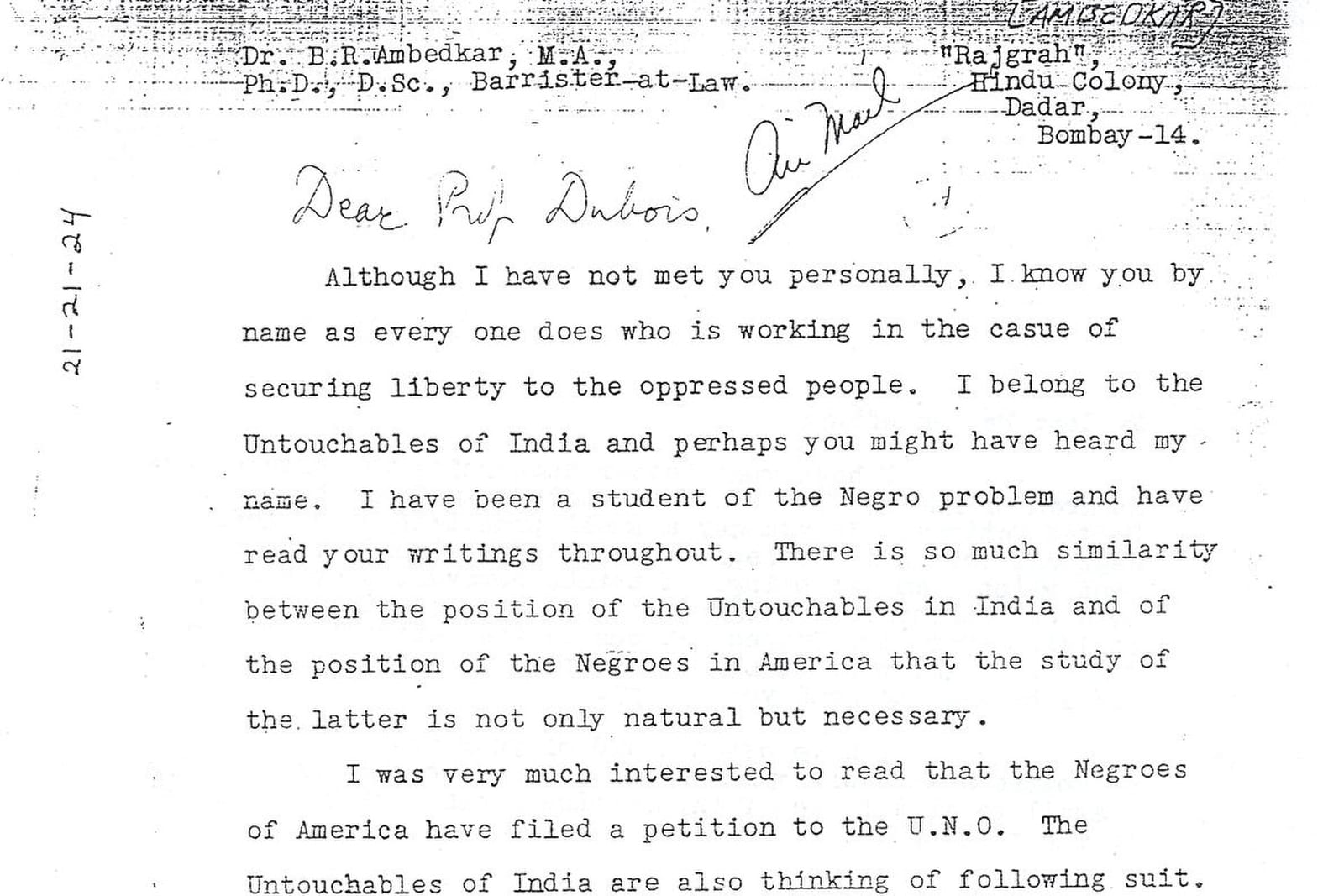
The record of Dalit and Black solidarity is long. In July 1946 B.R. Ambedkar, the Dalit jurist often called the architect of India’s Constitution, wrote to W.E.B. Du Bois calling himself “a student of the Negro problem” and asking to see the petition the National Association for the Advancement of Colored People (NAACP), the US civil rights organisation, was preparing for the United Nations; the letters survive in the Du Bois papers at the University of Massachusetts Amherst, as The Dalit Project reported in 2025. In 1972 young Dalit writers, among them Namdeo Dhasal, founded the Dalit Panthers. They took their name from the Black Panthers, the US movement that had been fighting since 1966 for “human, socio-economic and political rights”, though their ideology, Forward Press notes, was “purely Ambedkarite”, rooted in Ambedkar’s thought.
Sharmin, Equality Labs’ political director at the time, told Bhardwaj that “Dalit activists have always built authentic relationships with Black leaders that weren’t transactional but were rooted in transformative solidarity”, from the Panthers to joint protests by Dalit feminists and Black organisers. Bhardwaj links this to the scholar Shailaja Paik’s idea of “margin-to-margin” solidarity: people at the bottom of two systems meeting as equals, not one community lending support to another from above.
Who speaks as “South Asian”
The Carnegie Endowment for International Peace, a Washington think tank, ran the 2020 Indian American Attitudes Survey, with the polling firm YouGov among 1,200 Indian Americans, and asked Hindu respondents about caste. Fewer than half, 47%, said they identified with a caste group.
83% of Hindu Indian Americans who named a caste group placed themselves in the “General or upper caste” category; 16% said Other Backward Classes (OBC), India’s official category for a middle band of castes, and 1% each said Adivasi, the Indigenous peoples of the Indian subcontinent, or Dalit. Carnegie Endowment, 2020 Indian American Attitudes Survey (293 Hindu respondents who named a caste group), published June 2021.
The authors warn that the caste sample is small and that some respondents may have declined to disclose. But the survey also found that 74% of Hindus who said they did not identify with any caste could still name the caste make-up of their circle of Indian friends. Saying “I have no caste” is not the same as not knowing where everyone stands.
Bhardwaj traces how this composition was built. In 1923 Bhagat Singh Thind, an Indian immigrant, asked the US Supreme Court for citizenship on the ground, as Bhardwaj puts it, that being caste-privileged made him Aryan and so white. The 1965 immigration law admitted South Asians with advanced technical qualifications, which, she argues, made it more likely that migrants would be caste-privileged and stay away from Black-led politics. The historian Vijay Prashad, in The Karma of Brown Folk, named the result, as Bhardwaj notes: South Asians held up as the “solution” to what white America called the “problem” of Black resistance.
Yashica Dutt, a Dalit journalist, described the double position in Foreign Policy in 2020: “As a Dalit woman and immigrant from a formerly untouchable manual scavenging caste in India, my place in the Indian social order lies at the very bottom. But as a brown resident in the United States, I fall somewhere in the middle of the racial caste pyramid.” Manual scavenging, the cleaning of human waste by hand, is work the caste order assigns to Dalits.
When Dalits ask for that position to be named in law, the loudest objections come from inside the community. The Hindu American Foundation and the Coalition of Hindus of North America, two advocacy groups, oppose caste protections, arguing that they would target Hindus and Indian Americans and that existing protections for national origin already cover caste. Carnegie’s 2024 survey report notes that pro-Hindu groups have been the most vocally opposed to caste-based regulation in the US, “on the grounds that it demonizes Hindus”.
“Caste oppressed people are essentially a minority within a minority. We are racialized as South Asian, but actually all of this baggage from all of our historical trauma has come with us.” — Thenmozhi Soundararajan, Dalit American activist and author of The Trauma of Caste, California Institute of Integral Studies (CIIS) Public Programs interview, 2023
An older version of the same failure
The gap is older than the diaspora. Mohandas Gandhi, the leader of India’s independence movement, lived and worked in South Africa from 1893 to 1915. In 2016 professors at the University of Ghana petitioned against a new statue of him on their campus, citing his writings from those years that ranked Indians above Black Africans and used a racist slur for them. Ela Gandhi, his granddaughter, said those words could not be justified, and pointed to his later ideals on caste, class and race. The university removed the statue in December 2018. “This is a victory for black dignity and self-respect,” said Obadele Kambon of its Institute of African Studies.
It is an earlier form of what Dalit organisers criticised in 2020: an anti-colonial claim to dignity for Indians that left Black people below them.
Australia: on Aboriginal land, with caste left out
i
Public domainOriginal on Wikimedia CommonsAustralia has the newest evidence that caste travels. Caste in Australia: A Phenomenology of Casteism, a study led by Asang Wankhede, a doctoral researcher at Oxford University’s Faculty of Law, with two groups from oppressed-caste communities, and funded by the Australian Human Rights Commission, the country’s national human rights body, and the Federation of Ethnic Communities’ Councils of Australia, the national body for migrant community groups, interviewed 146 people from oppressed castes about discrimination within Australia’s South Asian diaspora. Participants reported physical assault, children treated as “untouchables” and boycotts of their businesses, and many conceal their caste, some by changing their surnames.
Caste contempt in Australia can borrow the local language of racism. A woman in a focus group in Adelaide, South Australia, told the study that her partner, who was hiding his own identity, told her she looked “like an Aboriginal”: “this is like treating me like I am very low, and he is high.” The insult borrowed Australian racism’s contempt for Aboriginal people to say what caste says about Dalits.
Aparna Ramteke, a Dalit human resources professional and advocate for Dalit rights, told ABC News in 2021 why she thinks Indians in Australia do not support Dalit causes: “People are a bit ashamed, because I think supporting a Dalit is below [their] dignity.”
The law has not caught up. The Australian Human Rights Commission’s National Anti-Racism Framework now recommends that the government “investigate options for legal protections against caste discrimination”, Oxford’s law faculty reported in May 2025. In New South Wales, a coalition of anti-caste community groups has asked the Law Reform Commission, the state’s official law review body, to add caste as a protected attribute to the Anti-Discrimination Act 1977.
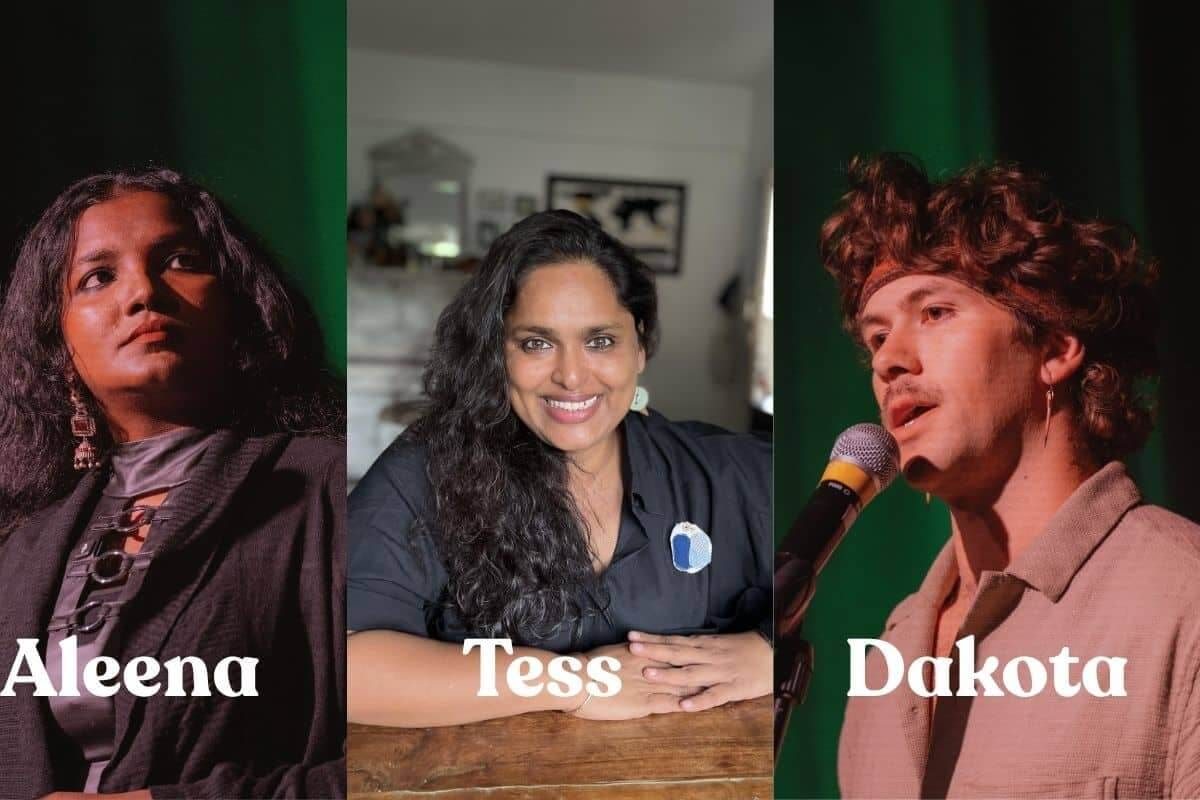
On solidarity with Aboriginal people, the public record is thin, and much of it is Dalit-led and cultural. Cordite Poetry Review published poems by twenty-five Indigenous Australian and twenty-six Dalit and Adivasi authors, each in its original language and in translation. At the 2026 Adelaide Fringe, an annual arts festival in South Australia, We Belong, a spoken-word show pairing the First Nations poet Dakota Feirer with the Dalit poet Aleena Sabu, won the 2026 Award for Excellence in Poetry. For Feirer, the show’s tone was set by “a provocation of solidarity across oceans”. “We did not merge experiences,” Sabu said, “we allowed them to stand alongside one another in conversation.”
One participant in a focus group in Canberra, Australia’s capital, answering a friend’s casteist remark, pointed to the way their child’s school teaches pupils to acknowledge the traditional custodians of the land, they told the study, and contrasted it with how little attention similar injustice gets in India.
The strongest counter-reading
The strongest objection is that caste is fading abroad. Most Hindu Indian Americans in Carnegie’s 2020 survey said they did not personally identify with a caste group, and in its 2024 survey 77% of Indian Americans supported new laws against caste discrimination, with 11% opposed. On this reading, the problem belongs to a few organisations, not to the community.
The support is real, and it matters. But the 2020 survey showed that most Hindus who report no caste identity still know the castes of their circle, and in the 2024 survey 7% of respondents said they had faced caste discrimination in the past year. Support in a poll has not ended opposition from organised groups, which have fought caste protections in cities, a state and the courts.
A second objection comes from the other side: that reading race through caste blurs what is specific to anti-Blackness. Wankhede’s study makes one difference plain: racism is “predominantly determined through the colour of the skin”, while caste is found out by asking, directly or indirectly, about surnames and caste. The comparison is a way in, not an equation, and the point is narrower than equating caste with race: a community cannot stand with people fighting a hierarchy while hiding the hierarchy inside itself.
What to watch
In Australia, watch whether the New South Wales Law Reform Commission recommends caste as a protected attribute, and whether the federal government acts on the anti-racism framework. Wankhede’s stated aim is to amend the Racial Discrimination Act 1975, Australia’s federal law against racial discrimination, to cover caste.
The plainer test is in the community’s own institutions: whether temples, student associations and diaspora groups name caste in their own rules. In Australia, acknowledging Country, the practice of recognising Aboriginal and Torres Strait Islander peoples as the land’s traditional custodians, starts from where the speaker stands. Naming caste applies the same test at home.
The solidarity that has lasted, from Ambedkar’s letter to the Panthers to We Belong, was built by Dalits meeting Black and Aboriginal people from the margins. Solidarity in the name of “South Asians” holds only when the speakers name where they stand.