Listen to this article
Read by an AI-generated voice · Report a mispronunciation
On 26 September 2026, an anonymous account on X (formerly Twitter) posted a table of 35 readings from university courses and called them “a poison”. The next day, a Sunday, India’s federal Education Ministry emailed central universities, citing a communication from the Prime Minister’s Office (PMO), Narendra Modi’s own office. It asked them to “furnish comments” on the post and to report how many students were enrolled in the courses it named.
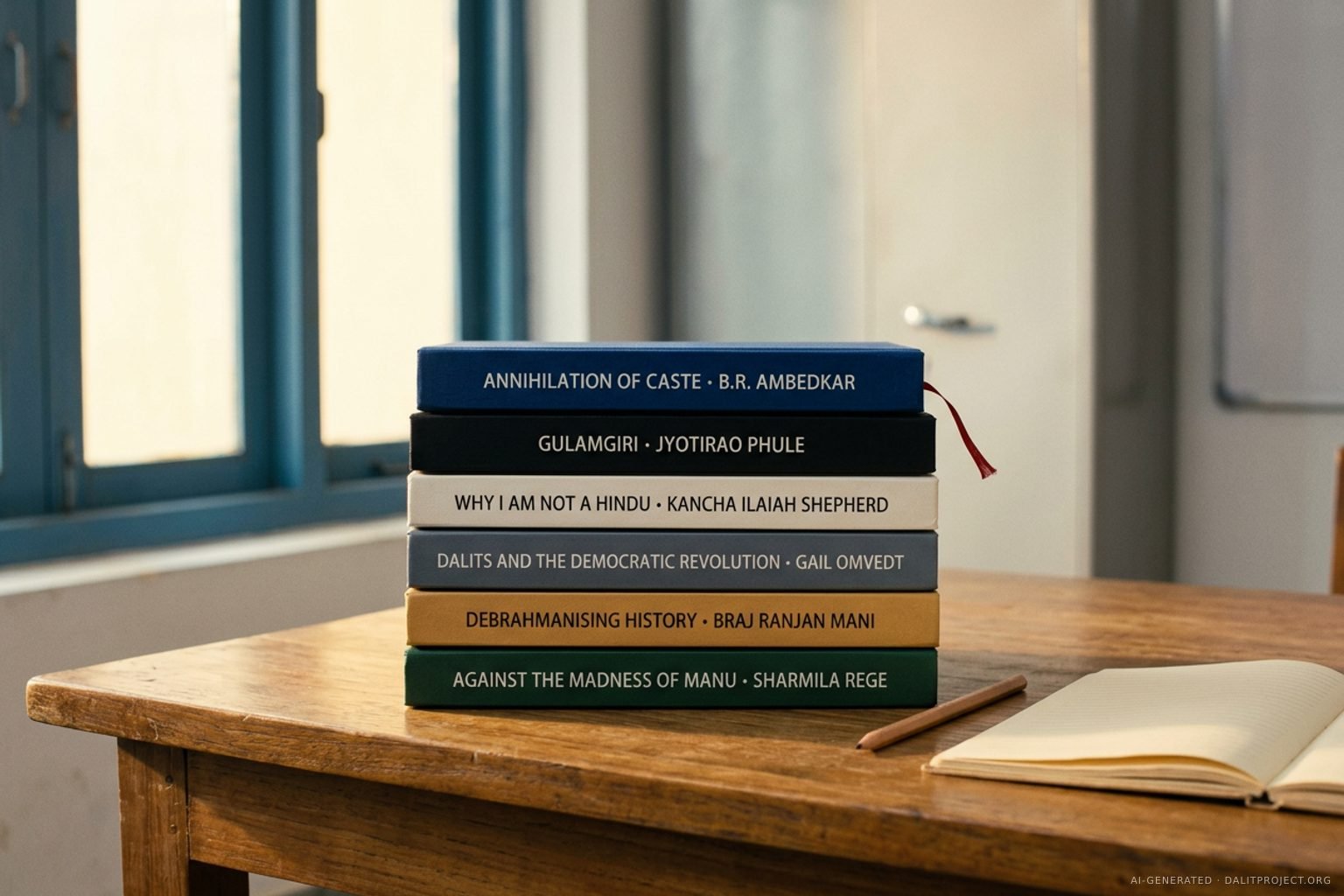
The list includes founding texts of the movement against caste, B.R. Ambedkar’s Annihilation of Caste and Jyotirao Phule’s Gulamgiri (Slavery), alongside later scholarship such as Sharmila Rege’s Against the Madness of Manu. No order has removed any of them. The email did something quieter. It made the teaching of anti-caste thought a matter the state wants explained, on the word of an account that never had to give a name.
That is the structure to watch. The readings reached the syllabus through departments, boards and academic councils. The complaint against them reached the registrars’ inboxes in a day, by way of the Prime Minister’s Office and the Education Ministry.
What happened
The post went up on 26 September from the handle @IamTheStory__, “The Story Teller”, whose bio lists “geopolitics”, “history”, “Vedas”, “Sanatan” and “Bharat”. The News Minute describes it as a right-wing account. “From patriarchy to Caste Annihilation to Debrahmanising the history to Curse of Manu we are feeding young minds with a poison which our leftist cabal use a apprenticeship for grooming their future rank and file,” it read.
Its table set readings against courses at Jawaharlal Nehru University (JNU) and Delhi University (DU), both in the capital, the Central University of Punjab and Asutosh College, which is affiliated to the University of Calcutta, according to The Pioneer. Beside Ambedkar, Phule and Rege, it named Gail Omvedt’s Dalits and the Democratic Revolution, Braj Ranjan Mani’s Debrahmanising History, Kancha Ilaiah Shepherd’s Why I Am Not a Hindu, and work by the Tamil social reformer Periyar (E.V. Ramasamy) and Savitribai Phule. It also listed the Ramayana and the Mahabharata, set against a JNU course on ancient Indian political thought. The thread called the texts “anti-Hindu propaganda” and ended: “We need to break this cycle.”
At 12:32 pm on 27 September, an assistant section officer, a junior official, on the Central Universities desk of the ministry’s Department of Higher Education emailed the registrars, the chief administrative officers, of ten central universities, the universities set up and funded by the federal government. Among them were the University of Hyderabad, in the southern state of Telangana, Pondicherry University, Rajiv Gandhi University, Tezpur University, Maulana Azad National Urdu University (MANUU) and the English and Foreign Languages University. The subject line read “Seeking comments on PMO Reference-reg.”
“I am directed to refer to a communication received from the Prime Minister’s Office regarding a recent tweet posted on the social media platform X (earlier Twitter),” the email said. “All the Central Universities are requested to furnish comments on the above. Further, enrollment in the courses mentioned in the tweet may also be apprised to the Ministry.” It added: “This may be treated as ‘URGENT’, and the required comments/information may be furnished to the Ministry at the earliest.” The courses it pointed to included MA English and MA Political Science at DU and MA History at JNU and the Central University of Punjab.
The email did not stay with the registrars. A professor at the University of Hyderabad told The Wire that the registrar forwarded it to all departments, and the history department then shared it with every faculty member. Representatives of MANUU and Rajiv Gandhi University also confirmed it had circulated. The Pioneer, The Wire and The News Minute report no statement from the PMO or the Education Ministry explaining the email.
How a post becomes a file
A reading normally reaches a syllabus by a slow, recorded route. Sowmya Dechamma CC, who heads the Centre for Comparative Literature at the University of Hyderabad, told The News Minute that every syllabus, recommended readings included, is cleared by the department board, the school board and the academic council, and that the minutes go to the Education Ministry. “The PMO cannot tell me what to teach and what not to, my university’s statutory bodies (departmental committee, school board, and academic council) decide it,” said Bhangya Bhukya, a historian at the same university.
The complaint skipped every one of those rooms. It went from a social-media thread to the PMO, from the PMO to a ministry desk, from the desk to ten registrars and, at Hyderabad at least, from the registrar to departments and teachers. It asked for two things: comments, and a count of who is enrolled. A request for enrolment figures turns a reading list into a head count of students.
1 day from the anonymous post (26 September 2026) to the Education Ministry’s “urgent” email to central universities (27 September 2026). Source: the email and the post, as reported by The Pioneer.
What the complaint objected to tells you what it was defending. Deccan Herald summarised the thread as alleging that students were exposed to material that promotes an anti-Brahmin and anti-Hindu worldview. Among the texts it singled out are ones that name Brahmanism, the order that places Brahmins at the top of caste, as a structure of power: Mani’s Debrahmanising History, and Rege’s collection of Ambedkar’s writings on Brahmanical patriarchy. Its complaint, in its own words, was about what students were being fed.
What the readings are
Annihilation of Caste was written in 1936, after the Jat-Pat Todak Mandal, a Lahore society of caste Hindu reformers whose one aim was to end the caste system, rejected Ambedkar’s speech to it because of its radical attack on the caste system. It argues that the complete destruction of caste is essential to social justice. Ambedkar was the jurist who chaired the committee that drafted India’s Constitution and campaigned for the rights of Dalits, the communities once branded “untouchable”. Other texts on the list take on caste in history, sociology and feminist thought.
The thread blamed a “leftist cabal”. The News Minute notes that most of the texts are by Ambedkarite scholars, and some are critical of the Indian left. Ravikant Kisana, an academic and writer, said the list held standard texts that have been part of university curricula for decades.
Kancha Ilaiah Shepherd, a political theorist and writer, three of whose works were on the list, told The News Minute: “This is very dangerous if the syllabi in higher educational institutions is being monitored by the PMO. It needs a major debate. How can a tweet from an anonymous account be of serious concern to the PMO?”
“It is the first generation of Dalit-Bahujan graduates who went back to academia and introduced so many of these writers and reading.”
— N. Sukumar, who teaches Dalit writings at Delhi University, speaking to Scroll
N. Sukumar teaches a course on Dalit writings at Delhi University and has described himself as “a first-generation Dalit teacher”. He reads the email as a threat to that generation’s work. “I teach a subject called Dalit writings. It was introduced a few years ago and it took a lot of efforts for these courses to actually be added to the curriculum,” he told Scroll. He has over a hundred students in his class, and he connects that to the ministry’s question: “The demand for such courses has gone up, which is why maybe the government wants to know how many students are enrolled in these courses.”
The counter-reading: nothing has been banned
The strongest case against alarm is that nothing has happened yet. There has been no governmental directive prohibiting the inclusion of Annihilation of Caste in university syllabi, and no notification requiring universities to delete Ambedkar or Phule, as Ahmed Shabin, an assistant professor at Presidency University, Bengaluru, wrote in Counterview. “This is not a story about banning a book. Not yet,” he added. A ministry forwarding a PMO reference and asking for comments can be read as paperwork. Universities also keep control of their syllabi: Sowmya said that, short of a complete overhaul of the system, it would be difficult for the PMO or the ministry to make direct changes.
That reading misses how the pressure works. “The communication could put indirect pressure on these universities. In some cases, the vice chancellor or registrar or dean may start putting pressure on the department on their own, and subsequently, people may drop some readings of their own volition,” Kisana told The News Minute. Nobody has to sign an order for a head of department to decide a reading is not worth the trouble. The email has already travelled down that chain at Hyderabad. Syllabi do change under pressure: The Wire notes that DU has dropped the Delhi Sultanate from its postgraduate syllabus, and that papers on Kashmir and Palestine have been removed.
Shabin names the inversion. “The person who made the accusation does not have to appear before the university. The university is the one that has to answer.”
What to watch
- The replies. What the universities send back, and whether any department, school board or academic council reopens a reading. On Kisana’s account, pressure would come through a vice chancellor, registrar or dean, and need never be announced.
- Teachers’ bodies. “We thought our classrooms were immune,” Sowmya said, adding that she hoped teachers’ associations across universities would resist any such intervention and insist on autonomy. On 9 October the Democratic Teachers’ Initiative called on the University Grants Commission to withdraw the ministry’s 27 September email, arguing that decisions on prescribed readings belong to universities’ own departments and academic bodies, and asked the commission to say whether it played any role, The Wire reported.
- The politics. Kisana said the email could be seen as a perfunctory move to appease supporters of the Bharatiya Janata Party (BJP), which leads the federal government, who are disappointed with the party’s outreach to Scheduled Castes, Scheduled Tribes and Other Backward Classes (SC, ST and OBC), the official categories for Dalit, Adivasi and other historically excluded communities. “This could be a part of BJP’s own strategy of managing some of its inherent contradictions,” he said. Rahul Gandhi, the Leader of the Opposition in the Lok Sabha, Parliament’s lower house, said it was “extremely shocking” that the Prime Minister “immediately springs into action at the mere hint from internet trolls”.
- An explanation. Whether the PMO or the ministry says what the comments and enrolment figures are for.
The thread that started this ended with a demand: “We need to break this cycle.” The cycle, in its words, is an education system “infested with such books”. A day after it was posted, the state asked universities to account for that reading. No text has yet been ordered off a syllabus. The question Shabin leaves is who has the right to decide what the student may or may not read.