Listen to this article
Read by an AI-generated voice · Report a mispronunciation
Thirty-one people sent into sewers and septic tanks to clean them have died in India so far in 2026, and the families of nine of them have been paid their compensation in full. Those are the figures of the National Commission for Safai Karamcharis (NCSK), the commission that watches over India’s sanitation workers, as reported by The Hindu on 20 October. Haryana, the northern state that wraps around Delhi, recorded the most, eight, followed by Maharashtra, the western state that includes Mumbai, and Delhi, the national capital territory, with six each.
In the same statement, the Commission said it has no statutory mandate to register or keep a comprehensive database of sewer and septic tank deaths, and no online portal of its own for the data. Its figures are compiled from what district officials, police and state governments send it, and from incidents it reads about in the press or hears of from sanitation workers’ organisations and individuals.
Compensation for a sewer death in India is not a claim a family files with an insurer. It is a sum the Supreme Court has ordered “the Union, the Union Territory or the State”, that is, the central, state and union territory (centrally run region) governments, to pay. The official counts are where anyone outside a district would look to check that it was paid. The people whom contractors and government agencies send down sewers are mostly Dalit, from the communities once branded “untouchable” and assigned the cleaning of human waste by caste. When the counting is left to whatever gets reported, so is the checking of the money.
What the Commission recorded
The NCSK’s statement covers 2016 to 2026 and, as The Hindu reported it, records 773 deaths over those 11 years, with compensation paid in full in 677. The worst year was 2019, with 131 deaths. In 2025 it counted 51 deaths and full payment in 28 cases; in 2024, 54 deaths and full payment in 43.
The gap widens for more recent deaths: about four in five families paid in full for 2024, just over half for 2025, and fewer than one in three for 2026 so far. Across the decade, 96 of the 773 families the Commission knows of have not been paid in full.
What the families are owed
The money comes from the Supreme Court, not from Parliament. In 2014, in Safai Karamchari Andolan v Union of India, the court ordered governments to identify the families of everyone who had died in sewer work since 1993 and pay each Rs 1 million (Rs 10 lakh, about US$16,000 at 2014 rates), a direction the court set out again in 2023.
On 20 October 2023, in Balram Singh v Union of India, the court went further. It held that “entitlements which are akin to those given to manual scavengers must be granted to families of hazardous workers who had died in sewers and septic tanks”, and it directed that “compensation for sewer deaths shall be ₹ 30 lakhs [Rs 3 million, about US$36,000 at 2023 rates]”, to be paid “by the concerned agency, i.e., the Union, the Union Territory or the State as the case may be”. Among its directions was one that bears directly on the NCSK’s statement: the court ordered “a portal and a dashboard, containing all relevant information, including the information relating to sewer deaths, and victims, and the status of compensation disbursement”, to be launched “at an early date”.
Three years on, the commission whose figures track those payments says it has no portal of its own and no duty to keep a full record. Its statement, as The Hindu reported it, does not say whether the court’s dashboard exists.
The mechanism: a count built from whatever is reported
The court put the duty to pay on governments. The Commission told the court its role was limited, chiefly recommending measures and pursuing states and local bodies to act. The 2023 judgment records its account that, through continuous monitoring, compensation was paid in 167 sewer-death cases in financial year 2022-23, and that of 19 deaths that year it took up from newspaper reports, legal heirs were paid in 15. Its count is built from whatever reaches it: official reports, news cuttings, word from workers’ groups, as The Hindu reported its statement. A death that no one reports upward stays outside the record.
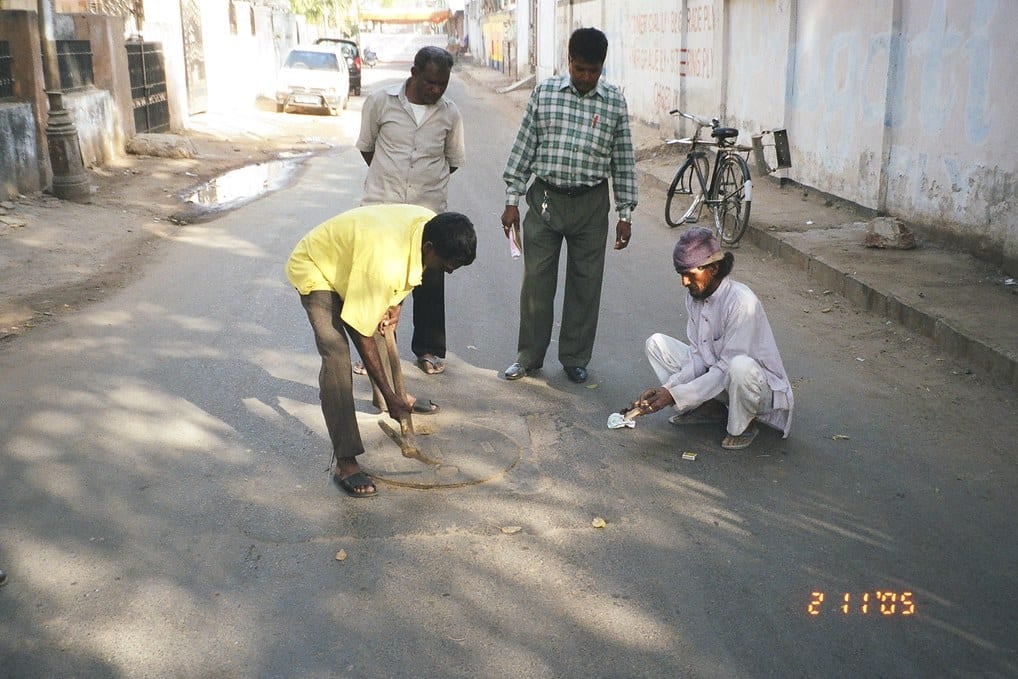
Amit Sahni, who filed a public interest petition in the Delhi High Court, the highest court of the Delhi territory, in 2019 seeking strict enforcement of the 2013 law against manual scavenging (the cleaning of human waste by hand), told Outlook that sanitation work is outsourced without proper monitoring, and that authorities know sewers are still cleaned by hand and often ignore it as long as the work is done. When a worker dies, criminal liability “is usually pushed onto the contractor or immediate supervisor, while government departments distance themselves by claiming no permission was given for manual entry”.
The Supreme Court named the same chain in 2023. It directed the central government to ensure that sewer cleaning “outsourced, or required to be discharged, by or through contractors or agencies” does not require anyone to enter a sewer, and held that the defence of “any contractor or authority” that a worker went in voluntarily without protective gear “would not stand constitutional scrutiny”. ThePrint, reporting among bereaved families in Delhi, described how the sending works on the ground: “When work is scarce, and a contractor offers a few hundred rupees for a day’s labour, refusing isn’t always an option.”
i
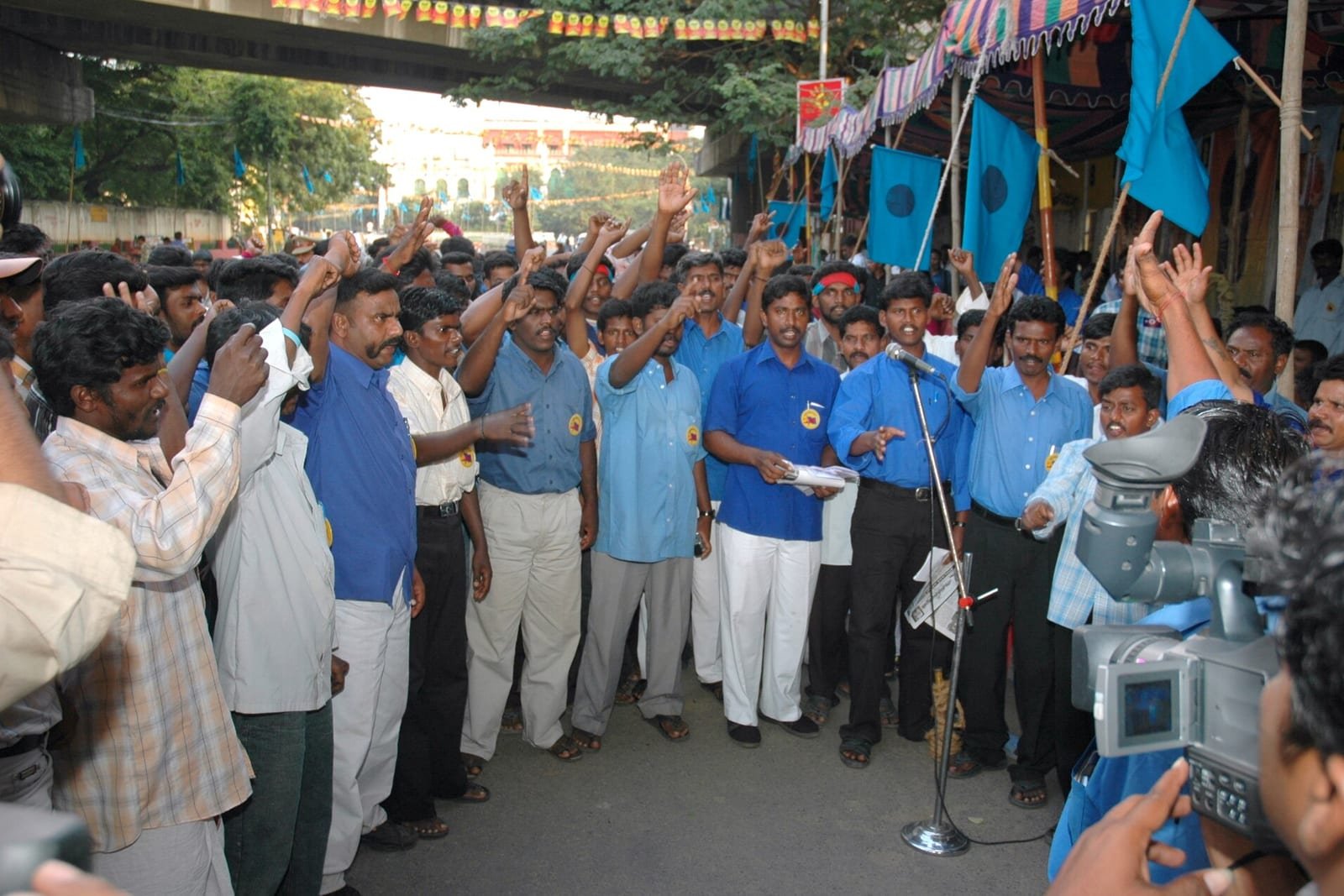
CC BY-SA 3.0Original on Wikimedia CommonsThe Safai Karamchari Andolan (SKA), a movement for the elimination of manual scavenging, counted 101 sewer and septic tank deaths in the first 188 days of 2026. The NCSK counted 31 in nearly ten months. The government’s half-year count shows the same gap, as an earlier piece on the two counts set out. Official figures do not agree with one another, and claims that manual scavenging has ended do not agree with the figures. For 2025 the NCSK counts 51 deaths; the Ministry of Social Justice’s reply to the Lok Sabha, Parliament’s lower house, reported by Outlook in August, listed 47; and the court’s amicus curiae, the lawyer assisting the bench, cited 46 in July, from data laid before Parliament.
Who is in the sewer is not in doubt. When the central government profiled sewer and septic tank workers under its mechanisation scheme, the National Action for Mechanised Sanitation Ecosystem (NAMASTE), it found, Scroll reported, that 67.91% were from the Scheduled Castes, the legal category for Dalit communities. The same government told Parliament that cleaning sewers and septic tanks is an “occupation-based activity” rather than caste-based work.
“Those who made him do it must be caught. Everyone knows there is fatal gas inside the tanks, yet my husband was asked to go down into it. Why? Why are only people of my caste employed for cleaning the sewers and gutters?”
— Putul Daloi, of the Bagadi community, a Scheduled Caste, whose husband Chandan, a cleaner employed by a contractor at a Delhi mall, was asked to clean a septic tank there in 2016, went in without protective gear and choked on its gases
She did not wait to be counted. With help from her employer she filed a police complaint, and after months of follow-up her husband’s employers paid her Rs 10 lakh (Rs 1 million, about US$15,000 at 2017 rates). “I will fight to my last breath to break the shackles of caste,” she told PARI.
9 of 31 Sewer and septic tank deaths recorded in 2026 so far for which compensation has been paid in full. Source: National Commission for Safai Karamcharis, via The Hindu, 20 October 2026
What payment looks like on the ground
Even where a death is counted, full payment is not certain. A written reply in the Lok Sabha by Ramdas Athawale, a junior minister for social justice in the central government, reported by Outlook on 5 August, set out payments for the 498 deaths it had recorded from January 2019 to June 2026: 345 families paid in full at the old rate of Rs 1 million (about US$16,000 at 2014 rates), 75 paid in full at the new rate of Rs 3 million (about US$36,000 at 2023 rates), 22 paid in part, and 56 for which payment could not be confirmed. For 2026’s first half, full payment of Rs 3 million was confirmed for six of 16 deaths; the rest could not be confirmed.
ThePrint’s reporting among bereaved families in Delhi found that compensation “can take years to arrive, often only after repeated visits to government offices”. Ram Kali’s 18-year-old son, Manoj Kumar, climbed into a sewer of the Delhi Development Authority, the capital’s planning agency, for a day’s work in 2012 and never came home; the family received government compensation only in January 2026, more than a decade later. Another family, whose relative Ashok died cleaning a sewer in 2009, had received neither compensation nor support, and did not know they were entitled to any.
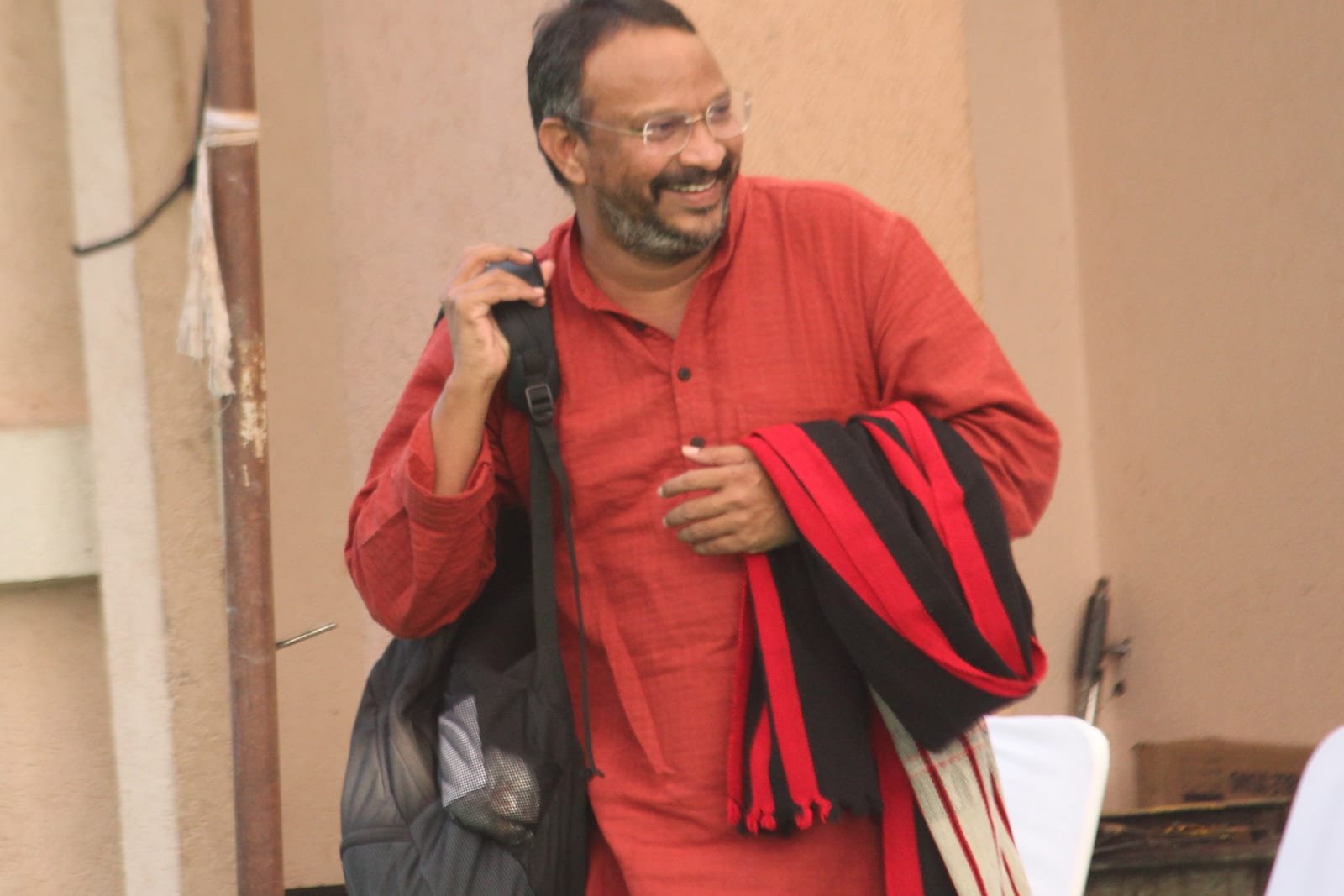
Bezwada Wilson, the SKA’s national convenor, told ThePrint what a death leaves behind in such a family: “Children drop out of school. Even if they continue for a year or two, many eventually have to stop. The wife becomes a widow and often returns to her parents’ home. Families are displaced, some go back to their villages, and everything is reshuffled. It creates such chaos that they cannot rebuild their lives.”
The strongest counter-reading
The first counter-argument is that the NCSK’s tally is a monitoring record, not the channel that pays, so a death missing from the Commission’s list need not mean an unpaid family. That is true: the ministry keeps payment figures of its own. But the two official counts disagree with each other, and both fall far short of the workers’ own count. A death that reaches no official table has no payment status anyone beyond its district can see.
The second is that the 2026 gap is mostly a matter of time: payment takes time to process, and a death in September cannot be paid by October. The decade-wide figures look better: 677 of 773 families paid in full is 88%. On this reading, nine of 31 is a snapshot of a queue, not a failure: the families will be paid eventually.
It falls short on three counts. First, “eventually” is not a measure of justice when eventually means more than a decade, as it did for Ram Kali, or not confirmed at all, as for ten of the 16 deaths in the ministry’s figures for the first half of 2026. Second, the decade total still leaves 96 families the Commission knows of without full payment. Third, the percentage is calculated only over the deaths the Commission has heard of. If the SKA’s count is closer to the truth, most of 2026’s dead are not in the Commission’s queue at all, and no official table shows whether their families have been paid.
What to watch
On 27 July 2026 the Supreme Court, still hearing the Balram Singh case, issued notices to the Chief Secretaries, the top civil servants, of five states, asking them to show why contempt proceedings should not begin over continuing deaths, and to answer on affidavit within four weeks. “You start putting the blame on contractors…we will fix the responsibility. Somewhere it has to stop,” Justice Aravind Kumar told the states. That four-week window ran out in late August. Watch, in those proceedings, for what the five states answered, and for the dashboard the court ordered in 2023: a public record where a family could see whether a death had been counted and a payment made.
The Commission has counted 31 deaths this year and nine families paid in full, and says it is not required to count every death. Until someone is, the families of the uncounted are owed money that no official table shows.